Democratic Republic of the Congo: Kimareki rebuilds a life beyond disability

Decades of armed conflict and violence have left deep scars in Ituri, in the north-east of the Democratic Republic of the Congo (DRC). Many victims are now living with a disability that renders them more vulnerable. In addition to imposing physical limitations, disability has far-reaching effects on their social inclusion and their economic potential. But the resilience they show as they rebuild their livelihoods and find their way back into society is remarkable.
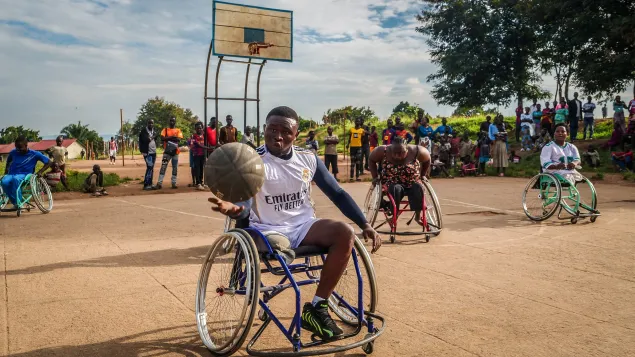
His jersey is still soaked in sweat and the veins are showing slightly under the glistening skin of his arms. Following a training match, Kimareki Bonhomme (23) is having a chat and a laugh with his team-mates on the basketball court at a higher education college in Bunia, capital of Ituri province. He joined the Léopards under-23s – the DRC’s national wheelchair basketball team in 2024.
The previous year, an attack on his village in the south of Ituri province had changed Kimareki’s life forever when he lost his right leg to a bullet. But the tragedy marked a turning point: contrary to expectations, it opened up the prospect of a sporting career.
Things began to take off in 2024, when he received his first prosthesis at Rwankole physical rehabilitation centre, Bunia. The centre was built and equipped by the International Committee of the Red Cross (ICRC), and Kimareki and several of his team-mates are among more than 700 people who benefited from its services between 2023 and 2025.
From rehabilitation centre to resilience
The ICRC is furthering the rehabilitation of people with a handicap in Ituri via its support for the Rwankole centre, in particular by providing orthopaedic appliances, prostheses, wheelchairs and other mobility aids. Since its construction in 2023, the centre has helped a large number of people with disabilities, 80% of them from areas affected by armed conflict and violence.
Like many others, Kimareki Bonhomme arrived at the centre suffering not only pain in his armpits from supporting his weight on crutches but – worse still – the stigma of the way people looked at him. He was just hoping to leave the centre with an artificial leg. He had no idea his prosthesis would open up new horizons.
“When I arrived at the ICRC-supported centre, I found several physical therapy balls in the room. I amused myself by hopping around with them, even though I only had one foot,” he recalls.
Thanks to awareness-raising sessions organized by the paralympic league at the Rwankole centre, Kimareki soon joined the local wheelchair basketball team, before being selected to play at national level.
“I played my first match at this level in Kinshasa, against the Central African Republic. My family back in Bunia couldn’t believe it. When I came home from Kinshasa I showed them videos of the matches. Their perception has completely changed regarding this sport – and me,” he says with a smile.
Chantal Tabo (44) is another patient at the ICRC-supported rehabilitation centre. She lost the use of both legs in 2006 when she stepped on a mine in a village near Bunia.
The landmines in Ituri were laid during the armed conflicts of the 1990s. But they continued to affect the population until the 2000s.
“I’d gone to draw water with my two children. I was pregnant. I had no idea there was a mine near the water point. It exploded, flinging me through the air. I lost the baby in my belly and one of my children was wounded in the head. My husband abandoned me, because he thought there was no future for us.”
It was twelve years before Chantal received her first prostheses. The ICRC had to take her to the Heri Kwetu centre in Bukavu, about 500 kilometres away. Today, she goes to the Rwankole centre in Bunia when her prostheses need replacement. By giving her mobility and autonomy, they have enabled her to rebuild her life.
“My prostheses allow me to do housework. And I’ve started growing manioc, corn, bananas and vegetables, and selling various products.”
Landmines – an ongoing danger
The federation of disabled persons’ associations currently lists over 2,500 people with a disability in Ituri province. Many are the victims of armed conflict and violence. But those figures fail to give the full picture, because in many areas violence makes it impossible to carry out a census of people with disabilities or get them together.
To support people with disabilities, the ICRC carries out social and economic inclusion activities via its physical rehabilitation programme. Activities include sport, vocational training, cash support for income-generating activities and covering the educational costs of the most vulnerable children.
“Constant exposure to the effects of firearms, explosive remnants of war and mines is one of the most pernicious consequences of the cycle of conflicts and violence raging in the east of the DRC. It leaves an invisible legacy that destroys thousands of lives,” explains Arda Kuran, the ICRC Protection Coordinator in the DRC.
“Looking beyond Ituri, civilians in North and South Kivu are currently exposed to a broader range of risks related to explosives. It is important to guard against the danger, and equally important to support the victims,” he concludes.
The ICRC talks to arms bearers with the aim of reducing the risks related to explosives. International humanitarian law requires parties to a conflict to take all possible precautions to protect civilians against explosive remnants of war, not only during hostilities but also after. This includes marking and clearing affected areas, sharing information regarding munitions used or abandoned, issuing warnings and supporting awareness-raising for affected communities. Fulfilling these obligations saves lives. It also facilitates humanitarian access, recovery and socio-economic development.
ICRC activities during 2025 to support people with disabilities in the DRC
- 5 rehabilitation centres supported, including the department of physical medicine and functional rehabilitation at Renaissance Hospital, Kinshasa, the Rwankole centre in Ituri, the Shirika La Umoja centre in North-Kivu and the Heri Kwetu and Bethanie centres in South-Kivu
- 2,331 people obtained physical rehabilitation services and/or received mobility aids (including wheelchairs) at the five ICRC-supported physical rehabilitation centres
- 2,431 mobility aids were supplied to users of those centres
- 714 people benefited from social inclusion activities in the form of sport, education or vocational training
- 30 rehabilitation or social inclusion specialists received training