Frequently asked questions: Understanding the ICRC’s neutrality

Photo: Sidi Boubacar Diarra/ICRC
Our work can sometimes be difficult to understand. We operate during armed conflicts and other situations of violence, we speak with all sides, and we rarely talk about what we see on the ground. This is not due to a lack of transparency, but because this discretion is essential for us to access civilians, detainees, the wounded, and separated families who need our help. Here's how, and why.
Our neutrality: Your questions answered
-
The ICRC is a neutral, impartial, and independent humanitarian organization, founded in 1863. Our mandate, to protect and assist people affected by armed conflicts and other situations of violence, was entrusted to us by the States through the Geneva Conventions.
This unique status distinguishes us from both intergovernmental organizations (such as the specialized agencies of the United Nations) and non-governmental organizations (NGOs). We operate independently of governments, which allows us to reach those most in need of assistance impartially.
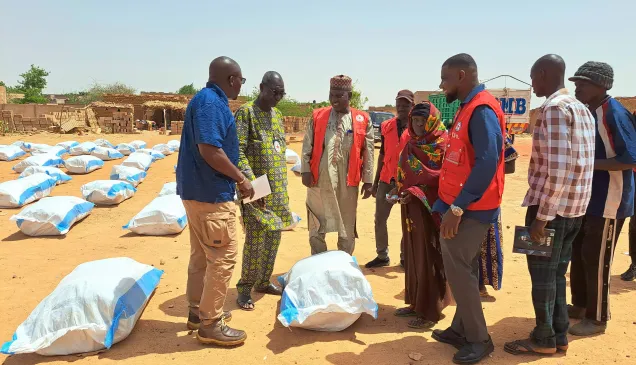
In the field, this translates into concrete actions: providing clean water, food, medical care, shelter, but also protecting detainees and supporting families separated by war.
We are neither political actors nor military actors. Our objective is strictly humanitarian: to protect life and dignity during armed conflicts and other situations of violence.
-
It means we don't take sides in war, hostilities or political disputes. We don't support one government over an armed group, one army over another, or one religion, ideology or political movement over another.
This isn't a moral indifference to suffering. It's an operational method that allows us to gain access to people trapped on all sides of a conflict. Without neutrality, one side would refuse us entry, frontlines would close, and the people we exist to help would become unreachable.
Neutrality isn't a public relations posture. It's what makes our work possible.
-
No. We don't make judgments about which side is "right" or "wrong" in a conflict. That's not our role. What we focus on is how parties behave during conflict, because international humanitarian law applies to everyone, regardless of who started the war or who controls the territory.
The core principle is simple: even wars have limits. Our job is to work to preserve those limits, and in doing so, reduce the suffering of those who have no part in the fighting.
-
Because public denunciation is not always the most effective way to protect people.
Our primary objective isn't public positioning; it's humanitarian access and concrete outcomes. Confidential dialogue often allows us to gain access to detainees, negotiate evacuations, secure humanitarian access, improve conditions in places of detention, recover bodies from battlefields, and reconnect separated families.
If we made every discussion public, parties to the conflict, third states, and other actors might stop talking to us. Access could be withdrawn. Detainees could disappear from all oversight. Affected population could lose assistance. Humanitarian negotiations could collapse entirely.
Confidentiality is a method designed to maximize our impact on the ground.
-
No. We document concerns, raise violations directly with the authorities and armed actors responsible, and press for compliance with international humanitarian law. Confidential dialogue isn't silence. It isn't approval. It's a deliberate strategy aimed at changing behavior while preserving our access to persons affected by armed conflict.
We can and do speak publicly when confidential dialogue has repeatedly failed, when violations are serious and ongoing, when public communication may directly help victims, or when public awareness becomes operationally necessary. But public condemnation is one tool among many, not automatically the most effective one.
-
Because in many conflicts, armed groups control territory, checkpoints, detention facilities, weapons, roads and civilian populations. If we refused all contact with them, civilians in those areas would become unreachable. Medical evacuations would fail. Aid convoys couldn't pass. Detainees couldn't be visited. Human remains might never be recovered.
Talking to armed groups isn't an endorsement. It's a humanitarian necessity. We engage with any party that has the power to affect civilians or humanitarian operations.
-
No. Dialogue for humanitarian purposes is not political recognition. States, diplomats and humanitarian actors regularly communicate with all parties during conflict, because communication is necessary to protect civilians, negotiate ceasefires, release and repatriate prisoners, deliver aid and prevent escalation.
Our contact with an armed group doesn't validate their ideology, their tactics, or their legal status. We speak to them because people under their control are protected by international humanitarian law.
-
Because we spend enormous effort maintaining trust with all sides. We explain our neutrality, negotiate security guarantees, avoid political alignment, maintain independence from military operations, preserve confidentiality, and ensure aid reaches people based on need alone.
Over time, parties may come to accept us as a neutral intermediary, even when they distrust each other completely. That acceptance is what allows medical evacuations, humanitarian convoys, prisoner releases and repatriations, family reunifications, and the delivery of water, food, and medicine.
Crossing frontlines is never automatic. It's negotiated constantly, and it can fail at any time.
-
Because visible association with military operations would undermine our neutrality. If armed actors perceived us as aligned with one side, we'd lose access to opposing territory, our staff safety would deteriorate, civilians would stop trusting us, and the humanitarian space we depend on would shrink.
We maintain operational independence from military and political actors wherever possible. That independence is what keeps us useful and keeps our people safe.
-
We are an impartial humanitarian organization. Our efforts are based on need, not allegiance. A wounded civilian is a wounded civilian, regardless of nationality, political opinion, religion, ethnicity or who controls the area they're in. Human suffering is not conditional on political affiliation.
-
No. The ICRC’s work is grounded in international humanitarian law (IHL), the body of international rules enshrined in the Geneva Conventions of 1949, designed to limit the human suffering caused by armed conflict and applicable national norms. The Geneva Conventions were adopted and ratified by all States and established essential protections for people affected by war and recognize the role of neutral humanitarian actors such as the ICRC.
States remain sovereign. The ICRC does not replace state institutions, intervene in political decision-making, or take positions on questions of legitimacy, territorial control, or governance.
At the same time, armed conflicts often involve multiple actors, including non-state armed groups. In such contexts, humanitarian organizations must engage with all parties to a conflict in order to safely reach affected populations, visit detainees, deliver assistance, and promote respect for IHL. This humanitarian dialogue is not political mediation, recognition, or interference in state affairs.
The ICRC operates with the knowledge and consent of states wherever it works and maintains dialogue with authorities at multiple levels to carry out its exclusively humanitarian mandate. Its role is not to challenge sovereignty, but to help reduce the human cost of armed conflict within the legal framework that states themselves have established under international law.
-
No. The ICRC is a neutral, independent humanitarian organization with a global mandate derived from the Geneva Conventions of 1949.
While the organization was founded in Switzerland and its headquarters are in Geneva, the ICRC works worldwide and employs staff of over 150 nationalities, a wide range of cultures and professional backgrounds. The Geneva Conventions have been ratified by every state in the world. The ICRC’s mandate does not derive from Swiss foreign policy or from any geopolitical bloc.
Today, the ICRC operates in more than 100 countries and contexts, working alongside local communities, National Red Cross and Red Crescent Societies, and authorities across diverse political and cultural environments.
Our humanitarian action is guided by international humanitarian law and the Fundamental Principles of the International Red Cross and Red Crescent Movement. Not by political interests.
-
It goes back to our roots. We were founded in Geneva in 1863 by five Swiss citizens, and we've been structured as a private Swiss association ever since. That origin has shaped how the ICRC is governed right up to the present day.
The main reason we've maintained this rule is neutrality. Switzerland has a long tradition of political neutrality, which means Swiss nationals are less likely to have a direct political stake in any given war or crisis. By keeping our Assembly exclusively Swiss, we signal to all parties in a conflict, whether governments, armed forces, or armed groups, that our leadership isn't beholden to any of them. That perception of impartiality is absolutely central to how we work.
There's also a confidentiality angle. We operate through private, often sensitive dialogue in very difficult and challenging contexts. Being trusted by everyone at the table is what makes that possible, and the composition of our Assembly is part of building that trust.
We recognize this is a rule that has attracted its share of criticism over the years. Some see it as an outdated legacy of 19th-century Geneva. We take that seriously and have worked to bring considerable diversity into our staff and operational leadership. The Assembly's composition, however, remains something we see as a cornerstone of our neutrality and independence.
-
In many conflicts, some detainees would become inaccessible. Frontline crossings would stop. Prison visits would end. Evacuations would fail. Civilians in opposition-held territory would lose aid. Armed actors might begin to target humanitarian workers as enemies.
Neutrality isn't an abstract principle. It's what allows us to operate in places where almost no one else can work.
-
Yes, often in ways the public never sees. Neutral humanitarian access can enable the safe evacuation of wounded civilians, the delivery of medicine into besieged areas, visits to detainees, the reconnection of separated families, the return of human remains, negotiated pauses in fighting and the protection of hospitals and medical staff.
In May 2025, in the Democratic Republic of Congo, the parties to the conflict jointly requested that the ICRC act as a neutral intermediary. As a result, 1,359 Congolese soldiers were disarmed, and they and their families were safely transported from Goma to Kinshasa, nearly 2,000 kilometers across an active front line. Without this neutral status, neither party would have agreed to entrust this operation to the same organization. It is precisely because the ICRC does not take sides that it can act where no one else can.
Much of this happens quietly, because publicity can jeopardize future operations. Successful humanitarian work is often invisible.
Rumors and misleading information about humanitarian organizations have a very real human cost. When the work of the ICRC is distorted, misrepresented, or exploited, it's not just our reputation or credibility that suffers; it's our ability to reach the people who need help the most. A blocked convoy, denied access, a team targeted, volunteers attacked: misleading information has real-life consequences.
It also fuels polarization. In already tense situations, false information exacerbates distrust between communities, complicates dialogue with the parties to the conflict, and undermines the very foundations on which humanitarian action rests: neutrality, impartiality, and independence.
That's why we are calling on everyone; media outlets, public figures, influencers, but also ordinary citizens; to take responsibility. Verify before sharing. Provide context before commenting. Contribute to an information environment where rigor, dignity, and respect for international humanitarian law are not options, but requirements.
How do we ensure staff abide by professional standards?
The ICRC’s Code of conduct sets strict standards for how staff must behave professionally and ethically which includes respect of our principles and confidentiality.
Read more about our neutrality
- The critical importance of neutrality: A humanitarian perspective into a multipolar world
- Access beyond front lines: Neutrality in conflict
- Neutrality in war - a lifeline across front lines
- Neutral intermediary: Our role, saving lives
- Neutrality and Impartiality—The importance of these principles for the International Red Cross and Red Crescent Movement and the difficulties involved in applying them
- Principles under pressure: have humanitarian principles really stood the test of time?
- Sixty years on: why the Fundamental Principles must be lived, not just remembered
- Back to basics: humanitarian principles in contemporary armed conflict
Why neutrality matters: Exploring the ICRC's mission
In times of war, neutrality is not indifference; it is a deliberate way of working to be able to help without taking sides, allowing the International Committee of the Red Cross to reach those who need it most. Join us and artist Vaskange for a minute of reflection on the serious, often misunderstood role of neutrality in protecting lives and bringing families back together in conflict zones.