Venezuela earthquake: ICRC mobilizes rapid response in support of the Venezuelan Red Cross
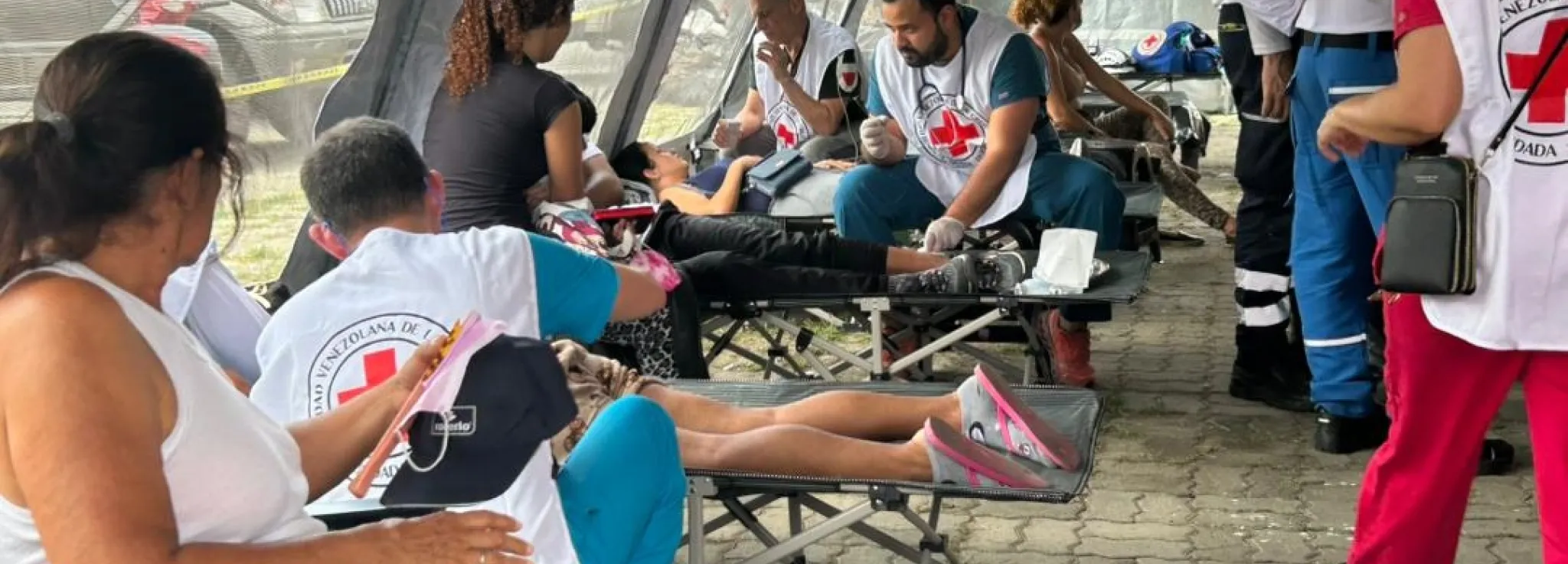
In the days following the 24 June earthquakes, the Venezuelan Red Cross (VRC) has moved quickly to support affected communities and national authorities. The ICRC supported their efforts, with emergency assistance spanning water, health, forensic management and detainee welfare.
Water supply
So far, the ICRC has donated 18,400 water purification tablets to Venezuela's Ministry of Water (MPPAA), enabling the treatment of up to 755,000 litres of water for use in hospitals. According to Sphere standards, this quantity can cover the daily water needs of approximately 50,000 people at 15 litres per person per day.
21 water cisterns were also delivered to four hospitals and two shelters in La Guaira, the most affected area, providing more than 297,000 litres of water. Additionally, 300 twenty-litre water bottles were donated to the Ministry of Water, and 9,000 plastic bags and 24 protective goggles were donated to the Caracas fire service.
ICRC water and habitat engineers also provided technical support to the Venezuelan Red Cross WASH team, contributing to the design of shower facilities and the electrical systems for the field hospital in La Guaira, and procured and installed eight showers and a generator for the field hospital, as well as 14 waste containers for use at the facility.
Health
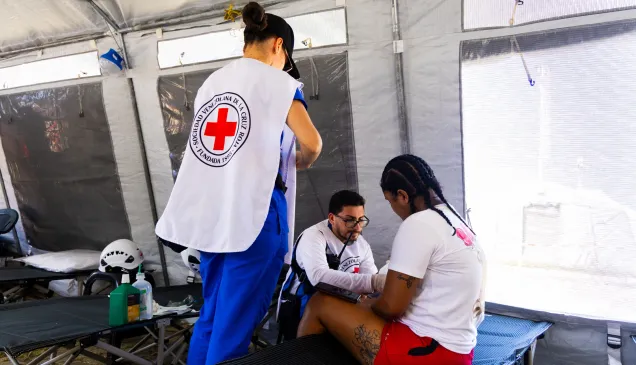
The ICRC has provided technical support and medical supplies to the Venezuelan Red Cross, including assistance in setting up a field hospital in La Guaira. On 26 June, the ICRC supported the transportation of a VRC water purification unit from Barquisimeto to La Guaira Stadium, where the field hospital is operating, so that it can provide clean water for both patients and the surrounding population.
Forensic support
The ICRC donated a total of 540 body bags over 25 and 26 June to the National Forensic Medicine and Forensic Sciences Service (SENAMECF) at Bello Monte.
On 27 June, a further 650 body bags were distributed across three locations in La Guaira and an additional 150 body bags were donated to the Caracas fire service. The ICRC also provided technical guidance to the VRC field hospital team on setting up a temporary morgue tent.
Economic security and essential items
100 mattresses and sheets were donated to the Venezuelan Red Cross headquarters. The ICRC also provided technical support to the VRC Disaster Risk Management Directorate for a rapid basic needs assessment and information management.
Detainees and people deprived of liberty
The ICRC intervened with prison authorities to facilitate Restoring Family Links (RFL) activities for people deprived of liberty. Information was shared to help them notify their families and re-establish contact with relatives from whom they had been separated. In addition, 300 individual hygiene kits – 150 for men and 150 for women – were donated to the Ministry of Prison Services (MPPSP).
Restoring family links (RFL) and connectivity
The ICRC has provided 10 mobile phones to the Venezuelan Red Cross to support connectivity and family links activities and helped the VRC activate communication systems previously donated. Nine VRC volunteers received basic training on connectivity services and family links needs assessment. The ICRC also accompanied VRC teams conducting RFL needs assessments at four hospitals in Caracas and at two shelters, and supported the VRC hotline, providing direct assistance to people calling for information.
In addition, two laptops were made available to the VRC, and communications systems previously donated by the ICRC were deployed to La Guaira to support connectivity for the response. A family links assessment was conducted in La Guaira to map shelters, identify people with family contact needs, and assess the response capacity of local authorities and other organizations.
Continuing support for communities
The ICRC has been present in Venezuela since 1966, working alongside national authorities, the Venezuelan Red Cross, and civil society to address the humanitarian consequences of violence, detention, and displacement. In the wake of the earthquake on 24 June, we have drawn on our established presence and partnerships across the country to scale up support rapidly. We will continue to assess needs and adjust our response in the coming days.