Frequently asked questions: Our work in Mali

-
The International Committee of the Red Cross (ICRC) has been active in Mali since 1965 and has maintained a continuous presence in the country for more than 30 years. Our mission is exclusively humanitarian, neutral, impartial and independent, in support of populations affected by armed conflict. We operate mainly in the regions most affected by armed conflict and insecurity, notably in the north and centre of Mali.
Our actions cover several key areas:
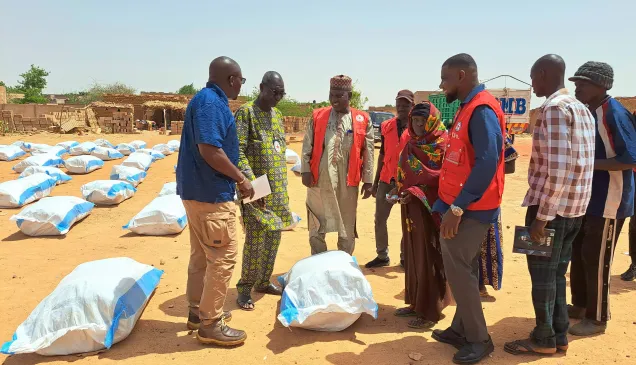
- Food assistance and livelihood support: We provide emergency food assistance to people affected by conflict and the impact of climate change to cover their basic needs. We also support the restoration of livelihoods for individuals and communities by donating seeds and farming tools, and even vaccinating livestock to enable families affected by armed violence to regain a degree of autonomy, despite the challenging context.
-
Support for health facilities: We have been supporting the regional hospitals in Gao since 2012, and in Mopti since 2019, as well as the referral health centres in Kidal since 2014, and in Ménaka since 2019. The ICRC also supports some thirty community health centres in areas most affected by conflict and insecurity. This support is provided through the continued presence of its medical and/or surgical teams that reinforce the capacities of health personnel, as well as through the supply of equipment, medicines, stipends, consumables, and the rehabilitation of infrastructure. We also support war-wounded individuals, persons with disabilities, and pregnant women, to ensure they have access to quality health care.
We provide mental health and psychosocial support to people who have suffered psychological trauma as a result of conflict and violence. In addition to this support, we raise community awareness of the impact of violence, including gender-based violence. Such support aims to preserve and strengthen the psychosocial well-being of communities.
- Access to drinking water and hygiene: We construct or rehabilitate wells, boreholes, water networks, and build latrines. We also support communities in managing water points we build in rural areas, and in adopting good hygiene practices.
- Humanitarian dialogue: We remind parties to conflicts of their obligations and responsibilities under international humanitarian law (IHL) in a bilateral, confidential dialogue. This includes the protection of people who are not, or are no longer, directly taking part in hostilities, as well as the protection of civilian property, health personnel and essential infrastructure such as health facilities and water supply infrastructure.
- Protecting civilians affected by the conduct of hostilities, people deprived of their liberty, and families separated or without news of their loved ones:
We visit detention facilities to ensure that people deprived of their liberty enjoy conditions of detention and treatment that respect human dignity. We also help separated families to reconnect or reunite through our Restoring Family Links service.
- Promoting IHL and humanitarian principles: We organize training and awareness-raising sessions on the principles of IHL, also known as the law of armed conflict, and humanitarian principles for weapon bearers, including armed groups, the judicial sector, community and religious leaders, and various segments of civil society. We also support governmental and legislative authorities in ratifying IHL treaties and incorporating their provisions into national law. In addition, we support the promotion and teaching of IHL in universities and higher education institutions.
- Cooperating with the International Red Cross and Red Crescent Movement: We help to strengthen the organizational and operational capacities of the Mali Red Cross (MRC), and provide it with technical, logistical and financial support. The MRC and ICRC are working closely together across a number of areas, including Restoring Family Links, needs assessment and distribution of food and essential goods, and the health sector. They are also working on providing support for agricultural production and livestock breeding, access to water, first-aid training and the promotion of humanitarian principles.
All ICRC activities are carried out in coordination and full transparency with national, regional and local authorities, as well as with the communities themselves. The ICRC works closely with the Mali Red Cross.
- Food assistance and livelihood support: We provide emergency food assistance to people affected by conflict and the impact of climate change to cover their basic needs. We also support the restoration of livelihoods for individuals and communities by donating seeds and farming tools, and even vaccinating livestock to enable families affected by armed violence to regain a degree of autonomy, despite the challenging context.
-
The ICRC is mandated by the community of States to assist and protect the victims of armed conflict and other situations of violence, in particular through the promotion of international humanitarian law (IHL).
Given that IHL was specifically designed to solve humanitarian problems arising from armed conflict, it does not govern the legitimacy or legality of resorting to war, nor does it shed any light on how peace can be restored. However, compliance with IHL contributes to the return to lasting peace, and some IHL obligations explicitly extend beyond the temporal limits of armed conflict and into the peace-building process.
-
The ICRC never takes sides.
The ICRC’s mandate is to assist the victims of conflict without distinction, and this includes caring for the war-wounded, whoever they may be. When a combatant is wounded, they are considered hors de combat, meaning that they no longer take part in hostilities and can therefore no longer be attacked. Under IHL, the wounded and sick must be treated without discrimination, and must not be subjected to any distinction based on criteria other than medical. All parties to a conflict and actors involved in a conflict have an obligation to provide impartial assistance, including opposing parties who capture wounded combatants.
When an ICRC surgeon enters an operating theatre, they do not ask themselves where the patient is from, or what ethnic group the patient belongs to. The only distinction a surgeon can make is based on the severity of the patient’s condition. A surgeon has a duty to care for the injured person, and to carry out their medical mission in accordance with the fundamental principles of humanity and impartiality, as well as medical ethics.
The ICRC assists victims of conflict and violence by supporting regional hospitals in Gao and Mopti, referral health centres in Kidal and Ménaka, and some thirty community health centres across Mali.
-
The ICRC in Mali operates where humanitarian needs are greatest, as close as possible to affected populations, and where there are few or no other humanitarian actors.
Access depends on the ICRC’s acceptance by local actors, including authorities, weapon bearers and communities. Such acceptance is achieved thanks to our strictly neutral, impartial and independent modus operandi, which enables us to engage in dialogue with all parties. This facilitates access to those most in need, so that we can provide them with strictly humanitarian assistance. In addition, we are transparent about the nature and objectives of our activities. We clearly explain to each actor what we do, why and how. This transparency enables all parties to see that the ICRC’s action is exclusively humanitarian, with no hidden political or security agenda.
Our dialogue with all armed actors focuses exclusively on:
* the ICRC’s access to the populations living in territories under their control, and therefore the safety of ICRC teams and the acceptance of the ICRC’s humanitarian work.
* upholding the law of armed conflict and respecting the situation of civilian populations or other protected persons in wartime.
-
In its role as a neutral intermediary, the ICRC may be called upon to help hostages by, for example, re-establishing contact with their loved ones, or assisting with their return home, only when all parties concerned have agreed to and requested the ICRC to intervene. The ICRC does not get involved in release negotiations or political aspects, but focuses solely on the humanitarian response. A key prerequisite is security guarantees, namely safe and unhindered access to enable the ICRC to carry out its operations successfully. Finally, it is essential that the requirements of international humanitarian law are complied with at all times by all parties to these operations.
-
The ICRC does not provide information to any state.
One of the fundamental pillars of the ICRC and the rest of the International Red Cross and Red Crescent Movement is the principle of independence.
Independence means that the ICRC must be able to act without being influenced by political, military, economic or ideological interests. Although the ICRC often works in cooperation with governments and other actors, the ICRC is careful to maintain autonomy in its decision-making and operations.
In addition, confidentiality is essential to the ICRC’s work. Confidentiality is based on our principles of neutrality and independence, and means that the ICRC does not disclose sensitive information obtained in the course of its activities. This confidentiality policy applies to all ICRC employees, even after they have left the organization.
Independence and confidentiality are key in contexts of armed conflict or violence to gain the trust of all parties and ensure access to affected populations. The loss of trust and lack of independence, or understanding of it, can have devastating consequences, such as losing access to a segment of the population in desperate need of assistance and protection.
Our independence and our confidentiality policy enable us to be credible, accepted and effective in situations where trust is scarce. Without them, our humanitarian action would be severely limited, if not impossible.
-
The ICRC’s financial contributions come mainly from governments (85%), National Red Cross and Red Crescent Societies (10%) and private donors (5%). Each year, we issue an annual appeal to donors, as well as emergency appeals based on operational needs. These donors come from all over the world, not just from the West.
The ICRC only accepts funds from persons or entities that respect its independence and the impartiality of its work. The ICRC does not accept funding that is subject to strict conditions regarding its use. For example, the ICRC does not accept funds that are solely dedicated to a specific project, or to a specific category of beneficiaries. Funds are used according to operational priorities and the most pressing humanitarian needs.
-
Despite an increasingly challenging context and a decrease in funding, the ICRC remains firmly committed to working alongside the most vulnerable communities, including in the most isolated areas where few humanitarian actors are present. This proximity reflects the ICRC’s commitment to stand by those who need support the most.
In 2025, our support in the health sector enabled us to care for more than 24,000 patients, including close to 14,000 people who were injured, otherwise in need of urgent care or particularly vulnerable, and whose care was entirely provided by the ICRC.
We also strengthen the resilience of affected communities through concrete, sustainable initiatives. In this way, nearly half a million people have received support for livestock vaccination, market gardening, microeconomic initiatives and seed multiplication, contributing to their resilience and enabling families affected by armed violence to regain a degree of autonomy, despite the challenging context. In addition, more than 160,000 people have regained access to water owing to the construction or rehabilitation of water sources across the country.
All too often, armed conflict separates families. In 2025, the ICRC and the Mali Red Cross facilitated 22,222 telephone calls and the exchange of 641 Red Cross messages to maintain or renew contact. We also facilitated the reunification of eight families, and opened 212 new tracing requests, of which 167 have been resolved.
None of this would be possible without close collaboration with the Mali Red Cross and partners of the International Red Cross Movement. It is thanks to this cooperation, founded on the principles of humanity, neutrality and impartiality, that we can continue to carry out our mission.
-
To meet the needs of those affected, the ICRC provided technical support and supplied medicines and medical equipment to treat the wounded. In addition, some hospitals received diesel fuel to maintain service continuity.
At the request of certain medical facilities in Bamako/Kati, Gao and Mopti, the ICRC provided medicines and medical equipment needed to treat the wounded as of 30 April, including:
- Two emergency kits for injured patients, one delivered to the Kati University Hospital and one to the private army hospital in Kati. A kit consists of drugs (antibiotics and analgesics), dressing and sterilization materials, surgical and examination gloves, serums and disinfectants. Each kit is designed to allow for the treatment of more than 25 wounded patients.
- 10 containers of medical supplies, five of which were delivered to the Gabriel Touré University Hospital and five to the Point G University Hospital, in Bamako. These containers include dressing materials, surgical gloves, drugs (antibiotics and analgesics), intravenous fluids and supplies for administering injections.
- 72 with medication and consumables for individual patients, including gloves and compresses, to the hospital in Mopti.
- 30 with medication and consumables for individual patients, including gloves and compresses, to the hospital in Gao.
The ICRC medical teams based in Mopti and Gao are working alongside surgeons in regional hospitals to care for the wounded.
A diesel fuel supply is provided to ensure the continuous delivery of health-care services in hospitals:
- 2,000 litres of diesel fuel were supplied to Gao regional hospital
- 7,000 litres of diesel fuel were supplied to the Mopti regional hospital
In addition, patients and their companions in the Gao and Mopti regional hospitals received nutritional care.
Since 5 May, the inhabitants of the city of Gao have once again regained access to water, thanks to the ICRC’s long-standing cooperation with the Malian Water Management Company (SOMAGEP). This was made possible by the donation of a generator to restore the city’s water supply.