In response, the International Committee of the Red Cross (ICRC) is helping to meet the urgent needs of those affected while maintaining essential services and strengthening community resilience. The organization has provided quality health care to the wounded and distributed everyday necessities to displaced people. ICRC teams are also engaged in confidential, bilateral dialogue with the authorities and parties to the conflict to promote the protection of civilians, health workers and facilities, and public goods essential to people’s survival, such as drinking water and food stocks.
“We are deeply concerned about the repercussions of escalating armed violence on civilians,” said Nicolas Lambert, head of the ICRC delegation in Mali. “Civilians are not targets. They must be respected and protected, as should health facilities and water supply systems. We are redoubling our efforts to provide emergency aid, ensure access to essential services and strengthen community resilience.”
Operational update
In May 2026, the ICRC took the following actions to meet the urgent needs of the most vulnerable while strengthening community capacities and local infrastructure in response to the ongoing crisis.
Health facilities and care for the wounded:
- 16 wounded patients received care from the ICRC’s medical team, in collaboration with the regional hospital in Mopti, following outbreaks of violence in Bandiagara and Bankass.
- 2 containers of medical supplies including dressing materials, surgical gloves, medication (antibiotics and analgesics), intravenous fluids and injection supplies were provided to the military hospital Gao.
- 1 kit with medication and consumables, including infusion sets with tubes and syringes for treating heatstroke, was provided to the regional hospital in Gao.
- 1 kit with supplies for managing human remains (gloves, surgical masks and body bags) was provided to the Mopti civil protection service so the dead could be buried with dignity.
- Patients and their companions in the Gao and Mopti regional hospitals received nutritional care.
Energy
- To ensure that medical services remained available, 7,000 litres of diesel fuel were provided to Mopti regional hospital, 1,000 litres to the region’s physical rehabilitation centre and 2,000 litres to the hospital in Gao.
Emergency aid for displaced people:
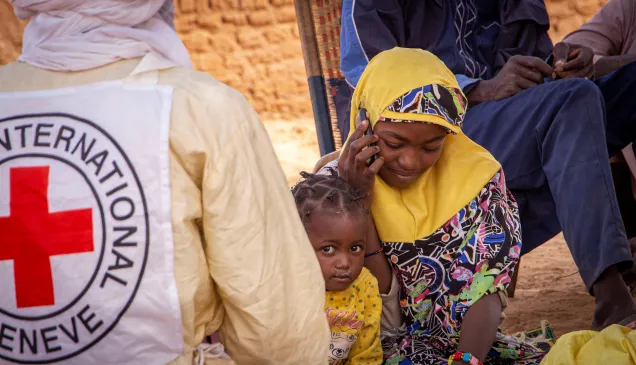
- The ICRC and the Mali Red Cross provided household essentials (mats, kitchen utensils, clothing, and more) to 100 families that had been displaced from Korikori to Sevaré in the Mopti region.
- The ICRC and the Mali Red Cross provided more than 650 families with household essentials and money to buy food in Bandiagara.
Livelihood support for community resilience:
- 1,000 families in Taoudeni each received 100 kg of cottonseed meal and 100 kg of wheat bran to feed their livestock.
- More than 56,000 animals were immunized against sheep and goat plague (PPR), benefiting roughly 750 families in Mopti.
- More than 1,500 families in Timbuktu each received 12,000 CFA francs (about $21) to buy feed for their livestock.
- The Gao regional agriculture office received 37.5 tonnes of rice seed to support 6,000 farmers.
Water and essential infrastructure:
- A 500-kVA power generator was provided to Mali’s public water utility, SOMAGEP, to maintain the production of drinking water in Gao.
- 20,000 litres of diesel fuel were provided to SOMAGEP in Gao and 7,000 litres in Nara to maintain the supply of drinking water in both cities.
Detainment conditions at Bamako Central Prison
- Solar panels were provided and installed for a more stable supply of electricity to improve ventilation and lighting.
- Food supplies were provided for nutritional support (2,000 kg of millet, 1,600 kg of beans, 50 kg of onions, 400 litres of oil, 340 kg of powdered milk, 400 kg of sugar and 30 kg of salt) along with 60 cases of ready-to-use therapeutic foods.
- 1 emergency medical kit containing medication (in tablet, injectable and intravenous form) and other supplies was provided to support care for more than 3,600 detainees.
- 4 life-threatening cases were referred to Gabriel Touré University Hospital, and a team of one doctor and three nurses was sent to support the prison’s medical team and provide round-the-clock care.
- 14 social welfare and health staff and 3 security staff were trained to recognize and treat heat-related medical emergencies.
Protection of people affected by armed violence
- ICRC teams continued to monitor the humanitarian consequences of the armed violence and engaged in confidential, bilateral dialogue with the authorities and parties to the conflict to promote respect and protection for civilians, the wounded, health workers and essential infrastructure.
- The ICRC also engaged with communities to better understand their concerns and direct its response towards the most urgent needs.
Tracing missing people and reuniting families
- The ICRC and the Mali Red Cross continued to provide services related to putting displaced people and detainees back in contact with their loved ones and reuniting families separated by the fighting.
- ICRC teams continued to record and follow up on requests to trace missing people and those arrested in connection with the conflict, while also helping maintain contact between separated family members.
Much of the ICRC’s work was carried out in collaboration with the Mali Red Cross, whose volunteers helped to evaluate needs, keep communities informed and distribute aid.
The ICRC’s humanitarian action in Mali reached more than 1.1 million people in 2025.