Violence consumes land and lives in Mali

As far as the eye can see, for hundreds of kilometres, the landscape has become unrecognizable. Once lush and green, the ground is now greyish. Where there was once greenery, a thick layer of ash now stretches across the land. The contrast is chilling: the charred landscape alone bears witness to the scale of the disaster. We are in Nouna, a village located about 100 kilometres from Djenné, in the Mopti region.
Nouna was once a breadbasket for its inhabitants. The land was fertile, the herds thrived, and the people were content. Today, all of that is nothing more than a distant memory. The village now lives at the mercy of armed violence, which is affecting both the ecosystem and the vital resources essential to the population’s survival.
Samba Djenta*, a respected community leader, recalls sorrowfully: “This land used to be very fertile. We used to grow millet and rice, and after the harvests, the fields provided all kinds of pasture that sustained the herds. Today, there’s nothing left.”
When the land no longer feeds
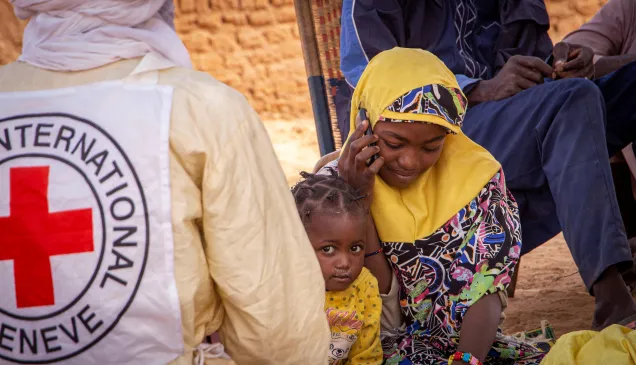
In central Mali, communities live amid insecurity and armed violence. This violence, compounded by the effects of climate change, leaves communities in a state of extreme vulnerability.
Already forced to limit their movements because of insecurity, farmers can no longer access their more remote fields. They have had to fall back on the fields near their homes, but even there, the effects of climate change are making the situation worse.
“Last year, some of the fields were severely flooded, while others received too little rain. Our yields were low. No farmer was able to harvest more than five 100-kg bags of millet per hectare, whereas under normal circumstances, each farmer would harvest at least one metric tonne per hectare,” laments Samba*.

A devastating reality
With no grain available, livestock farming was the residents’ last source of income. Then another event turned everything upside down: a fire.
“We relied heavily on our livestock to provide for ourselves, but after the attack on the village, the bush was set on fire. Gusts of wind fanned the flames and made them worse, and everything went up in smoke. No more fields, no more grazing land. The animals that survived the fire are now dying because they have no food,” says Samba*.
Bushfires have caused extensive damage to grazing lands, jeopardizing livestock feed and increasing families’ vulnerability.
Livestock, which is key to the survival of communities, has been decimated. In addition to providing meat and milk, livestock ensures a stable income for communities that depend on livestock farming. For those who make their living from farming, livestock is crucial for plowing the fields. Its disappearance increases communities’ vulnerability and exposes them to food insecurity.
A vicious cycle of poverty and precarious living conditions
The destruction of grazing land sets off a chain of consequences. Bakary Coulibaly, a veterinarian with the International Committee of the Red Cross in Mopti, explains: “livestock mortality is not the only consequence of the loss of grazing land. Overgrazing is also occurring in the few areas that are still usable, further straining communities’ livelihoods.”
He adds, with concern: “combined with the effects of climate change, the destruction of grazing land is forcing families to sell the last few animals they have left in order to survive.” In the worst-case scenario, we could see the complete disappearance of livestock.”
For communities that depend on agriculture and livestock for their livelihoods, the destruction of farmland during times of armed conflict is a tragedy that goes beyond mere material loss. It strikes at the very heart of these communities’ survival, destroying their livelihoods and undermining their food security.
With no other choice, many families had to leave Nouna for other villages considered safer.
Hope despite everything
Despite an increasingly difficult situation, efforts are underway to support the affected populations. The ICRC remains committed to supporting vulnerable communities by providing them with multifaceted assistance.
Bakary Coulibaly explains: “We distribute improved seeds, vaccinate small and large ruminants, support income-generating activities, develop vegetable farming projects, and build water points.”
While these initiatives are crucial, they alone are not enough to meet the growing needs of the population in the long term.
For Samba Djenta*, hope lies in mutual support and resilience.
“We are going through a difficult time, but we are not losing hope. With a little help, we could rebuild our lives and our lands.”
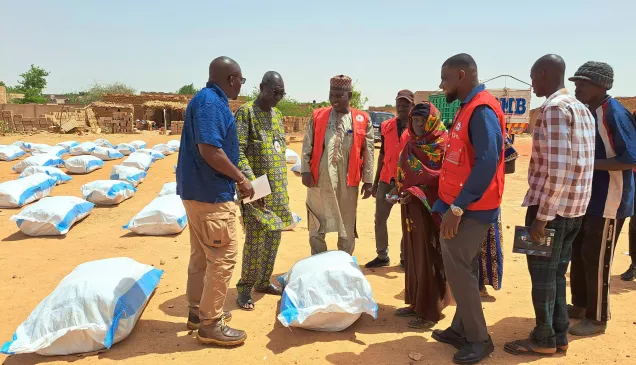
In response to the immediate needs of populations affected by the conflict, the ICRC, in collaboration with the Malian Red Cross (MRC), is providing emergency assistance to address critical situations.
As of May 2026, in the central regions, we have:
- vaccinated more than 56,000 animals against sheep and goat plague (PPR), benefitting approximately 750 farming and herding families.
- provided support to more than 750 families through kits containing essential household items (mats, kitchen utensils, clothing, etc.). Among these beneficiaries, more than 650 families received cash assistance to purchase food.
*Samba Djenta is a pseudonym.