Nigeria: A day in the life of a nutritionist on the frontline against hunger

Priscilla Agwa is an ICRC nutritionist working in Nigeria, where a projected 36.3 million people will face food insecurity in 2026 – the highest number in six years. Conflict-affected regions in the north are among the hardest hit. A few weeks ago, Priscilla travelled to Dikwa in northeastern Nigeria, where she witnessed first-hand the combined impact of hunger, conflict, economic hardship and climate change. This is her account.
Humanitarian workers like me and my colleagues cannot reach Dikwa by road. It is simply too dangerous. To get to this remote town in northeastern Nigeria, we must board a helicopter in Maiduguri and fly more than 50 miles to Dikwa.
As we climb out of the cabin, we see a town shaped by more than a decade of armed conflict. The crisis has disrupted markets and livelihoods, leaving people struggling to meet their basic needs.
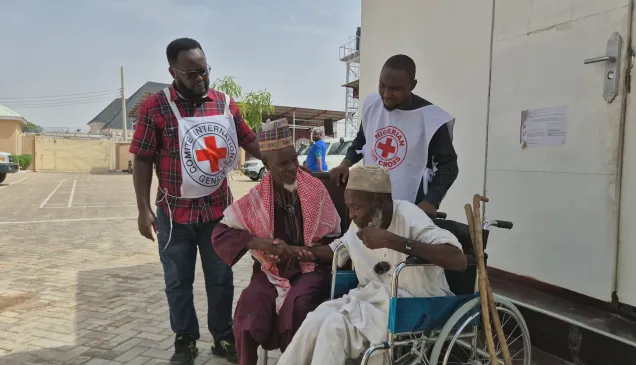
On arrival, we meet our trusted partners – volunteers from the Nigerian Red Cross Society (NRCS) – to plan our movements and activities for the day. These volunteers come from the very communities we work with. Working together improves the quality of the humanitarian response we are able to provide.
They brief us on the latest developments in Dikwa. We decide that our first stop will be a camp for internally displaced people known as “1,000 Shelters”. It is a short drive away.

The compounding impacts of conflict and climate change
As we make our way there, the combined effects of climate change and conflict are plain to see.
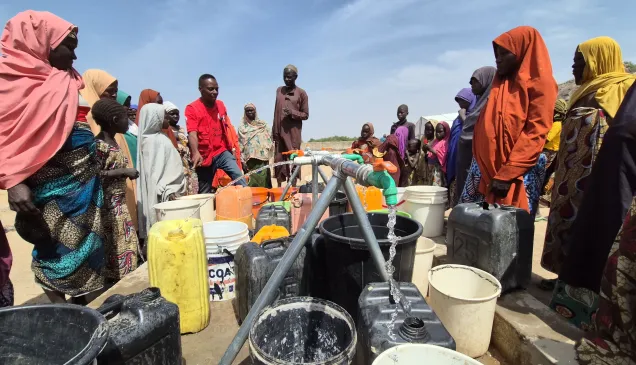
NRCS volunteers show me the aftermath of recurrent flooding, which has added another layer of hardship for people in the area. One image stays with me: a potable water tank, intended to provide safe drinking water, now submerged in floodwater. It is a clear reminder of the impact on people in Dikwa, who have no choice but to use whatever water is available.
Water and sanitation facilities are already struggling under the sheer number of people in the camp. Toilets fill up quickly, and following the recent floods, the risk of disease outbreaks has increased significantly. In turn, these outbreaks can worsen the risk of malnutrition, particularly among children.

The rising toll of malnutrition
Our next stop is an ICRC-supported primary healthcare centre in the camp. Here, I meet children and mothers battling malnutrition.
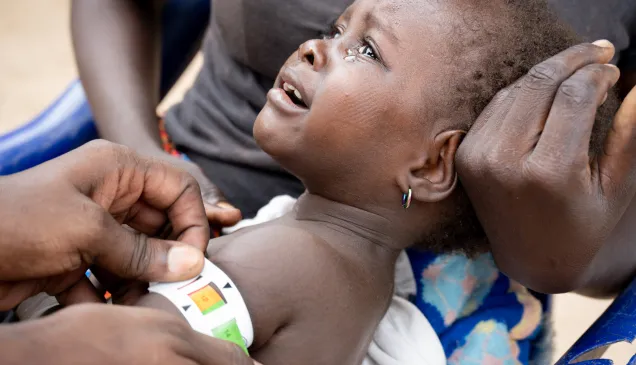
Among them is one-year-old Amina, who has been diagnosed with severe acute malnutrition. Her tiny frame and sunken eyes are a painful reminder of prolonged hunger. She is one of many children receiving ready-to-use therapeutic food (RUTF) from the ICRC – a lifesaving treatment.
A projected three million children under five are expected to become severely malnourished in 2026 and will require treatment to prevent them from dying. Severely malnourished children face up to 11 times the risk of death compared with children who are not malnourished.
I speak with my colleague Fatima, an ICRC Health Officer, who shares troubling statistics. She explains that the 'lean season' – the period of food scarcity between harvests – has contributed to a sharp increase in malnutrition cases. Admissions to ICRC-supported malnutrition treatment programmes have increased by 26% compared to last year.

A mother struggling to feed her child
Moving on from the clinic, I meet Aisha, a single mother struggling to provide for her family. Her husband has been away for six months, searching for work. It never gets easier to see a loving mother struggling to feed her baby.
She scrapes together what little ingredients she can find to prepare thin porridge for her child. It’s not enough. Her empty pot, scraped clean, reminds me of the struggle facing so many mothers in this region.
As I listen to her speak, I am overwhelmed by sadness and frustration – but also by a renewed determination to continue our work.

When food is out of reach
My final stop is the local market, where I assess the availability and affordability of food. While imported food is available, it is prohibitively expensive for most of the population.
This economic struggle is tied to the community’s inability to farm due to insecurity and conflict, leading to smaller harvests and reduced income. With fewer buyers, traders face declining profits, and the cycle of poverty deepens. Families are left with limited resources to buy food, farmers lack the capital to invest in their crops, and malnutrition continues to rise.
A cycle that must be broken
As I reflect on my visit to Dikwa, I am struck by the interconnectedness of the challenges facing this community - conflict, climate change, economic hardship, and malnutrition. It’s a vicious cycle, but it’s one we must try our hardest to break.
Through the combined efforts of the ICRC, the NRCS, and the resilience of the people themselves, there is hope. The ICRC is supporting the treatment of malnutrition in 19 health centres and hospitals as well as over 200 surrounding communities in conflict-affected areas of Nigeria.
I have to hope every therapeutic food packet distributed, every healthcare service provided, and every life saved brings us one step closer to breaking this cycle.