Nigeria: Red Cross Movement continues tracing 17,000 missing persons cases as families await answers

As of July 2026, the Red Cross and Red Crescent Movement records 17,000 active tracing cases of missing persons in Nigeria, down from close to 24,000 cases worked on over the years, following a comprehensive review aimed at ensuring the Movement maintains regular contact with the families it supports.
Families separated by armed conflict, violence, disasters, or migration endure one of the most painful forms of uncertainty: not knowing what has happened to a loved one. For many, the absence of answers becomes a lifelong burden.
Years after a person goes missing, families continue searching, hoping for news while struggling to cope with the emotional, social and economic consequences of their loss.
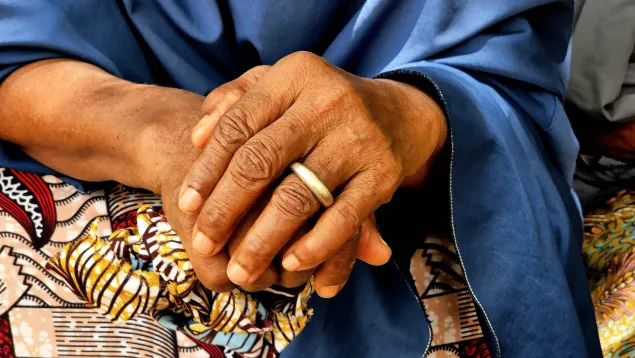
Fatima left with a ring to remember her lost son as a result of the violence in Northeast Nigeria.
Across the world, the issue of missing persons remains one of the most pressing humanitarian concerns of the International Red Cross and Red Crescent Movement. By the end of 2025, more than 227,000 people worldwide had been registered as missing within the Red Cross and Red Crescent Family Links Network. Behind every one of these cases is a family waiting for answers.
However, these figures represent only the cases reported to the Red Cross and Red Crescent Movement and should not be interpreted as the total number of missing persons worldwide. Many families never report a case or are unable to access our services. As a result, the figures we publish represent only a fraction of the true humanitarian impact of missing persons.
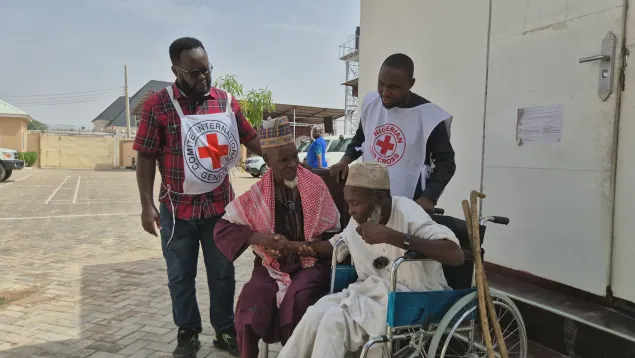
73 years old Baba Garba Usman reunited with his family in Gilsume Community, Bursari LGA, Yobe State
In Nigeria, the Nigerian Red Cross Society (NRCS), working together with the International Committee of the Red Cross (ICRC), has for many years supported families searching for relatives who disappeared as a result of armed conflict, violence and other humanitarian crises.
Through dedicated staff and volunteers, we help restore contact between separated family members whenever possible by facilitating phone calls, Red Cross Messages and other means of communication. When a person's whereabouts remains completely unknown, families can request that the Red Cross and Red Crescent Movement open a tracing case and search for their missing relative through our national and international Family Links Network.
Searching for missing persons is often a long and complex humanitarian process. It can take many years before information becomes available. Security constraints may prevent access to certain areas, while continued displacement means that both missing persons and their relatives who are looking for them frequently move from one location to another. These realities make tracing efforts particularly challenging.
Over the years, the NRCS and the ICRC have worked actively on approximately 24,000 missing persons cases across Nigeria. These efforts have included door-to-door tracing, engagement with community leaders, field visits, phone calls, and collaboration with humanitarian partners who may hold relevant information that could help reconnect families or clarify the fate and whereabouts of missing persons.
As part of our commitment to accuracy, accountability and responsible humanitarian reporting, the NRCS and the ICRC recently undertook a comprehensive review of all active tracing cases. This review aimed to determine whether we were still able to maintain active contact with the families who had originally requested our assistance.
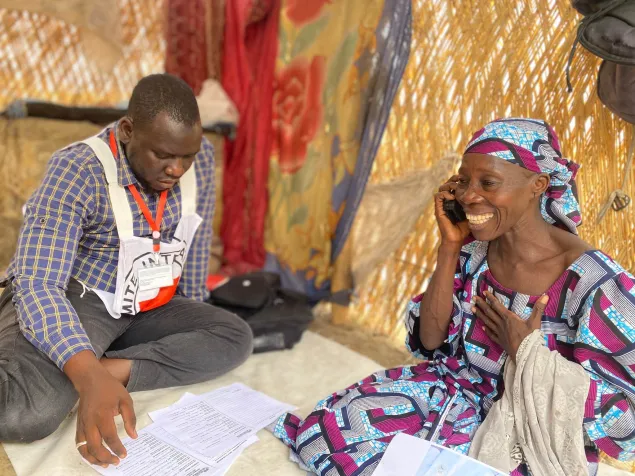
Over recent months, our teams made extensive efforts to reconnect with these families. These efforts included telephone calls, bulk SMS campaigns, door-to-door visits, consultations with community leaders, and cross-checking information with displacement and beneficiary records where appropriate. We were pleased to successfully re-establish contact with many families and continue supporting them.
For this reason, as of July 2026 onward, the NRCS and the ICRC will report approximately 17,000 missing persons as the number of cases that are currently under active tracing in Nigeria. This figure reflects a snapshot of active cases at the time of this review and is expected to evolve over time, as new cases are opened, contact is re-established with families, or cases are otherwise resolved or closed. The NRCS and the ICRC will continue to review and update this number periodically to ensure it accurately reflects the current caseload.
Despite our sustained efforts and for reasons outside of our control, we have unfortunately been unable to maintain contact with some of the families who initially approached us. In many cases, families have relocated, changed their telephone numbers, returned to their places of origin, or are now living in areas that are difficult to access due to security or logistical constraints. These circumstances have made it increasingly challenging to re-establish communication despite repeated attempts.
Maintaining contact with requesting families is essential to the tracing process. It enables us to verify information, share updates, and explore new leads that could bring clarity to their cases. Unfortunately, when communication can no longer be re-established, it becomes impossible to continue active tracing for those specific cases.
We fully recognize the emotional toll this process takes on families and the critical importance of staying connected throughout what is often a long and arduous process. In the future, we are committed to strengthening our outreach efforts to reduce the risk of losing contact and to ensure that families remain engaged whenever circumstances allow.
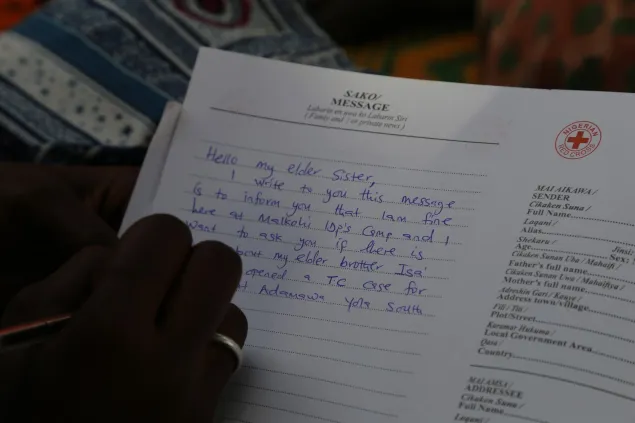
Restoring Family Links messaging facilitated by Nigeria Red Cross volunteer
This update reflects our commitment to transparency and to reporting figures that accurately represent our current operational reality. It ensures that the information we share publicly corresponds to the number of families with whom we are actively working today, while continuing to acknowledge that many more families in Nigeria still live with the anguish of not knowing the fate and whereabouts of their loved ones.
The NRCS and the ICRC remain fully committed to supporting families of missing persons, restoring family links whenever possible, and pursuing every humanitarian opportunity to clarify the fate and whereabouts of those who remain missing. Every missing person represents a family waiting for answers, and every effort to provide those answers remains at the heart of our humanitarian mission.
It is important to stress that this updated figure does not mean that fewer people are missing. Rather, it reflects the number of cases for which we are currently able to maintain active engagement with requesting families and therefore continue operational tracing activities. The humanitarian need remains significant, and our commitment to families affected by the uncertainty of a missing loved one is unchanged.
We encourage families who have previously reached out to the International Committee of the Red Cross (ICRC) or the Nigerian Red Cross Society (NRCS) or any other Red Cross and Red Crescent Movement component requesting support in searching for a missing loved one to remain in contact with us. This allows us to mutually share any new information, update case details when circumstances change, and ensure we have the most current contact information should new tracing opportunities arise.
Families are always welcome to reach out to us for updates, to share new information, or simply to discuss their case. They can contact the Community Contact Centre by calling 0800 5000 4000, or visit the nearest ICRC or NRCS office. Even where immediate answers are not available, we remain committed to listening, maintaining contact, and exploring every possible humanitarian avenue to help clarify the fate and whereabouts of missing loved ones.