Frequently asked questions: Our work in Pakistan

Our work in Pakistan
Building on our core principle of humanity, the ICRC has been working with vulnerable communities in Pakistan since 1947, ensuring basic health care that meets universally recognized standards and providing physical rehabilitation services and community-based risk education. We also help reunite families through our Restoring Family Links programme, promote respect for international humanitarian law and support the dignified management of the dead in emergencies.
With a delegation in Islamabad and a sub-delegation in Peshawar, the ICRC works in close coordination with the Pakistan Red Crescent Society and relevant national authorities.
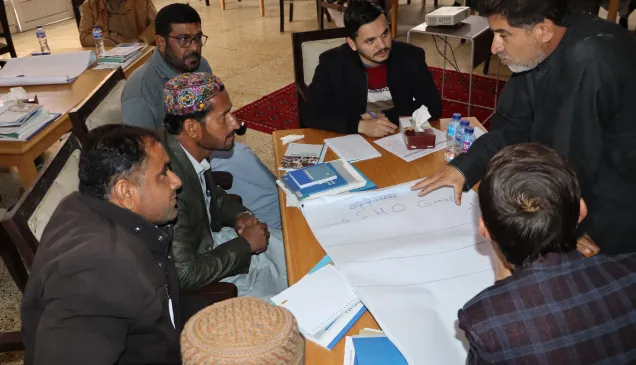
Saving lives, alleviating suffering and responding to people’s needs are the driving force of our humanitarian work. We do this by facilitating the meaningful participation of people in need of our support and ensuring that they have space and agency within our humanitarian response. Whether it is health-care workers, emergency responders, armed forces personnel or legal practitioners, our work with all groups concerned is guided by a contextualized understanding of their needs.
Useful information
-
Since 1947, the ICRC has been working to ensure that basic health care meets universally recognized standards and providing physical rehabilitation services and community-based risk education. We also help reunite families through our Restoring Family Links programme, promote respect for international humanitarian law and support the dignified management of the dead in emergencies.
In close coordination with the Pakistan Red Crescent Society and relevant national authorities, we have working to alleviate suffering, responding to people’s needs and saving lives. We do this by facilitating the meaningful participation of people in need of our support and ensuring that they have space and agency within our humanitarian response. Whether it is healthcare workers, emergency responders, armed forces personnel or legal practitioners, our work with all groups concerned is guided by a contextualized understanding of their needs.
-
If you or someone you know needs support, please visit our Find Help page. It provides guidance on how the ICRC may be able to assist, depending on your situation and location.
You can contact the ICRC in Pakistan here:
Telephone: +92518842001
-
The ICRC has a delegation in Islamabad and a sub-delegation in Peshawar and works in close coordination with the Pakistan Red Crescent Society and relevant national authorities to try and meet humanitarian needs of affected population.
-
At the moment, the ICRC is providing support to local facilities, to enable them to provide appropriate treatment and support to people affected by the conflict. We are not distributing food, cash or medicines directly to individuals or families.
-
The Pakistan Red Crescent Society (PRCS) is the main provider in the country to help families restore contact with their loved ones. The ICRC team works jointly with the Pakistan Red Crescent Society and provides its technical support in addressing these cases.
If you are in Pakistan, you can visit the nearest Pakistan Red Crescent Society branch or ICRC office where you live:
OR use the Restoring Family Links (RFL) hotline: 1030
OR email: islamabad@icrc.org www.familylinks.icrc.org
If you have lost contact due to lack of connectivity, we recommend that you first wait a few days and approach the Pakistan Red Crescent Society, once the telecommunications are restored, if you still cannot reach your loved one.
If you are outside Pakistan, please contact the nearest Red Cross or Red Crescent office in the country where you currently live.
-
Yes, the ICRC prioritizes assistance based on humanitarian needs, focusing on the most affected and vulnerable populations. We work to reach remote and difficult-to-access areas whenever possible.
-
The ICRC works closely with the Pakistan Red Crescent Society and other Movement partners to scale up assistance. Our teams are trained to respond to emergencies and have experience operating in conflict affected areas while upholding humanitarian principles.
-
The ICRC maintains confidential bilateral dialogue with the concerned authorities about the humanitarian situation and their obligations under IHL. In such situation, it is our mandate, as defined by the Geneva Conventions, to remind Parties of their obligations under IHL. In the framework of this recent escalation, the ICRC also stands ready to visit captured individuals who are detained by the Parties, support in the repatriation of the human remains of dead combatants or deceased civilians to their respective country and facilitate the transmission of information about persons who are separated, missing or deceased to the other Party, to ensure families know the fate of their loved ones.
Before the escalation, the ICRC was already providing legal and technical support for the implementation of International Humanitarian Law in national legislation in Pakistan. This will continue as well.
-
Neutrality is central to the ICRC’s identity. We do not take sides in political or military conflicts and operate solely based on humanitarian needs, with the consent of relevant authorities. All activities are guided by Fundamental Principles of the International Red Cross and Red Crescent Movement, including neutrality, as well as impartiality, and independence. We also engage bilaterally with the parties on a confidential basis.
-
We are observing the situation with concern. Afghanistan is already experiencing a protracted humanitarian crisis, resulting from past decades of conflict and violence, coupled with the influx of Afghans returnees from Pakistan and Iran who are returning and the impacts of the climate change, particularly visible in the water scarcity that characterize large areas of the country. A further escalation will likely worsen the situation of civilians who already live in hardship. Any sustained escalation could lead to a serious humanitarian crisis.
-
Like every National Society (NS) in our Movement, the PRCS remains legally an auxiliary to the public authorities in the humanitarian field, but also operate under the Fundamental Principles of neutrality, impartiality and independence. This means that all decisions, activities and responses are based entirely on humanitarian need – never on political considerations.
-
No. We operate without religious affiliation. We are a neutral, impartial and independent humanitarian organization and we work with impartiality as to nationality, race, gender, religious beliefs, class and political opinions.
Under international humanitarian law, all those caught up in war, no matter their affiliation, should be protected.
This doesn’t preclude us from speaking to religious groups, but this engagement is purely practical: we always speak to all parties involved, so we can get safe access to people who need support.
We strive to treat you with respect and dignity
All services provided by the International Committee of the Red Cross (ICRC) are free.
Everyone who works with the ICRC (our staff, partners, and suppliers) must always treat you with respect and dignity.
It is forbidden for ICRC employees and our partners to ask for money or any type of favours in exchange for aid. We encourage all to report in good faith suspicion of fraud, corruption, sexual exploitation and abuse, sexual harassment and other suspected misconduct.
You have the right to report cases of inappropriate behaviour or illegal actions on the part of the ICRC. To do so, you can email us at code_of_conduct@icrc.org. You can also report it directly in the Integrity Line (available in English, French and Spanish).
The information you provide will remain confidential. Filing a complaint will not affect the ICRC's work in your community.