Frequently asked questions about the ICRC’s work in Jordan

The International Committee of the Red Cross (ICRC) has been present in Jordan since 1967 as part of its internationally recognized humanitarian mandate. Today, the ICRC focuses on supporting families of missing persons as a result of the conflict in Syria, and their host communities, in collaboration with the Jordan National Red Crescent Society (JNRCS) in certain areas, whilst monitoring the situation of persons deprived of their freedom in different places of detention.
Additionally, the ICRC promotes International Humanitarian Law (IHL) and International Human Rights Law (IHRL) within the Jordanian Armed Forces, Public Security Directorate, Gendarmerie, academic circles, and other stakeholders. It also facilitates humanitarian aid shipments to conflict-affected populations in the region and beyond—including in Gaza, Yemen, Syria, Lebanon, and South Sudan—through its regional Logistics Supply Center in Amman.
ICRC in Jordan
-
The ICRC's role in places of detention is to visit detainees to assess their conditions of treatment and detention, including respect for their basic judicial guarantees and procedural safeguards, and for maintaining contacts with their families. Facilitates the exchange of Red Cross messages and “Safe & Well” messages between detainees and their family members, when family contact cannot be maintained through existing channels. Assesses detainees’ access to quality healthcare services and provide technical support to health personnel in places of detention.
-
The ICRC monitor the detainees’ condition and treatment during its regular visits to various places of detention, to verify that their medical management meets applicable medical and ethical standards of healthcare, and to ensure that their dignity and physical integrity are respected. The ICRC maintains its regular dialogue with CRCs with whom it shares its concerns, if any, in a bilateral and confidential manner. The ICRC is providing technical support to the MoH and CRCD in developing the hunger striker management guidelines which is up-to-date applicable. The ICRC does not comment on the use of hunger strikes as a means of protest. The ICRC does not take part in political negotiations. The ICRC does not support the hunger strikers’ demands, unless it would have done so anyway as a result of its independent analysis of the detainees’ humanitarian needs.
-
The ICRC and, following information collected from the concerned refugee or asylum seeker or family members, and upon their consent, shares the concerns with the competent authorities based on the respect of the principle of Non-refoulement. The ICRC engages in a bilateral and confidential dialogue with the authorities on the respect of their obligations under international law. This implies reminding authorities of the importance of listening to the risks detainees might be exposed to in case deported to their country of origin, and to give them a change appeal the order. Additionally, and based on the consent of the concerned person or family member, the ICRC mobilizes relevant institutions like the UNHCR who can also intervene on their behalf. The ICRC cannot guarantee that its interventions can stop deportation.
-
You can contact the Community Contact Center on: 0096265901999
And you can send email to amm_tracingsupport_services@icrc.org.
-
The ICRC will study each individual situation based on a case-by-case basis. Depending on this individual assessment, support that the ICRC can provide – or not – will be defined.
-
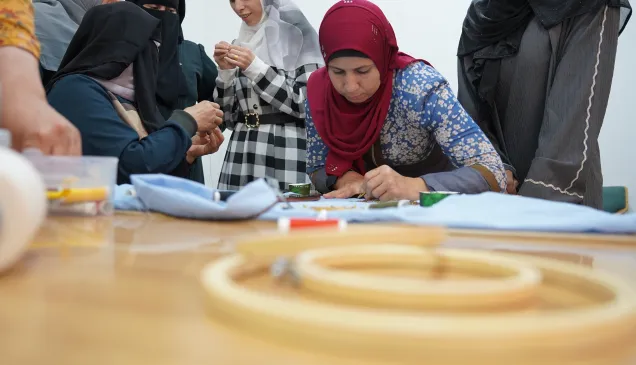
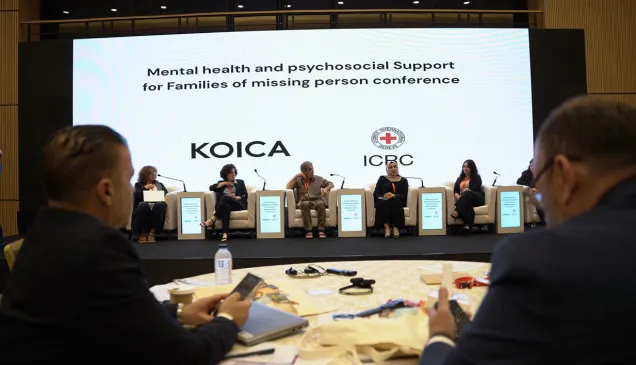
The ICRC works alongside families of the missing, offering different type of support (mental health and psychosocial, economic, orientation, referring them to relevant service providers) and facilitating the search for answers (for which, the ICRC collects information from families and open a case to do a follow-up with concerned actors). In addition, the ICRC raises awareness of the importance to prevent new disappearances, clarify the fate and whereabouts of missing persons, and support their families with relevant stakeholders, including authorities, NGOs, and other actors.
-
Thank you for your interest in joining the ICRC's humanitarian workforce. The ICRC in Jordan shares all open external vacancies on through Akhtaboot website. Most vacancies are also posted on ICRC social media platforms, including Facebook and X.
If you are interested in working with the ICRC, please follow these platforms regularly for new announcements, and carefully follow the instructions provided at the bottom of each vacancy announcement.
-
The ICRC is not a political organization and has no power to stop wars. Our role is to provide protection and assistance to people affected by conflict and remind all sides to respect the rules of war.
-
If you are in Jordan, reach out to us by calling the ICRC Community Contact Centre at this number +96265901999.
Working hours are Sunday to Thursday from 1 PM to 4 PM.
If you are outside Jordan, you can reach us through direct messages to the ICRC in Jordan's Facebook account or the ICRC Jordan account on X platform.
-
Thank you for your interest in joining the ICRC's humanitarian workforce. Unfortunately, the ICRC does not run a volunteer program in Jordan. All ICRC staff are recruited through a competitive hiring process for paid positions.
If you would like to volunteer with the Jordan Red Crescent Society (JRCS), our humanitarian partner in the field, please visit the closest branch office in your governorate.
-
We are very sorry to write that the ICRC does not have the capacity to support the movement of individuals out of the Gaza Strip. We are aware that some embassies have services to facilitate the movement of their nationals from Gaza. We kindly advise you to contact your embassy or consular services, who might be able to provide you with the support you need.
-
The ICRC does not have the expertise nor the mandate to work on resettling cases to a third country. It is advised to engage direct contact with embassies.
-
The Jordan Red Crescent Society (JRCS) and the ICRC work together as members of the International Red Cross and Red Crescent Movement, the world's largest humanitarian network.
The ICRC cooperates with the JRCS to deliver principled and effective humanitarian responses to key needs in Jordan. We work together on enhancing coordination with other Movement partners to prepare for emergencies and strengthen programmatic responses in areas such as disaster risk reduction, relief, health, water access, restoring family links, and climate change.
-
We have only one delegation in Jordan, located in Amman building 21, Princess Sumaya Bint Al Hassan Street, Al-Rawnaq District, Wadi Al-Seer.
We strive to treat you with respect and dignity
All services provided by the ICRC are free.
Everyone who works with the ICRC (our staff, partners, and suppliers) must always treat you with respect and dignity.
It is forbidden for ICRC employees and our partners to ask for money or any type of favours in exchange for aid. We encourage all to report in good faith suspicion of fraud, corruption, sexual exploitation and abuse, sexual harassment and other suspected misconduct.
You have the right to report cases of inappropriate behaviour or illegal actions on the part of the ICRC. To do so, you can email us at code_of_conduct@icrc.org. You can also report it directly in the Integrity Line (available in English, French and Spanish).
The information you provide will remain confidential. Filing a complaint will not affect the ICRC's work in your community.
Be careful before you share!
If you come across content online that you believe to be false or misleading, you can report it directly to the social media platform. You can also help slow the spread of misinformation by checking the veracity of questionable information before sharing it with others.