ICRC voices: Dispatch from Darfur

John Naughton is the head of sub-delegation for the ICRC in the Darfur region of Sudan. Born in Sheffield in the UK, he has previously worked with the ICRC in countries such as Afghanistan, South Sudan, and the Central African Republic.
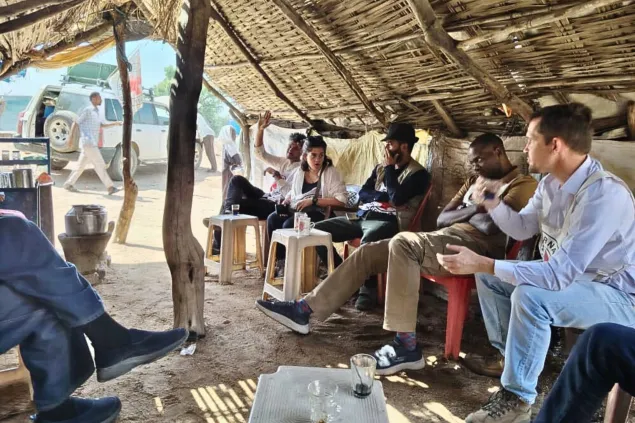
We stood in a huddle among the low, straw-roofed huts. This was a community meeting, a chance for me to listen to the men, women, and children who had fled their hometowns and sought refuge in Tawila – a once small town in North Darfur that has swelled to host 650,000 displaced people.
From the group, a young woman came forward and began speaking in Arabic. I could feel the weight of her words, even though I didn’t understand them. Through the translator, I learned she was describing the perilous journey from Al Fasher to Tawila.
“It was terrifying. Many of us arrived here with nothing, not even shoes,” she said.
Then she revealed something darker – and deeply taboo in her community - the threat of sexual violence. That she spoke so openly, as the group listened in silence, proved not only her courage, but also how widespread sexual violence has become.
Tweet: https://twitter.com/ICRC_Africa/status/1983792184617791627
Her story was sobering, but it wasn’t an isolated case. A region more than twice the size of the UK, Darfur is no stranger to violence. The 2003-2005 conflict in Darfur left deep scars, and in 2023 fighting once again erupted, precipitating what has become the world’s largest humanitarian crisis. In the latest, brutal chapter, Al Fasher, the capital of North Darfur, was captured after a 500-day siege.
At least 100,000 people have left the city and its surrounding villages since 26 October, according to the Norwegian Refugee Council. Some families made the journey together; others told me, through tears, how they had to leave their sick or elderly relatives behind because they were unable to run the gauntlet to safety.
Those who survived the 40-mile walk to Tawila found a camp unprepared for their arrival. There are not enough latrines. Clean water and medical supplies are scarce. A doctor, running one of the camp’s only medical facilities, told me he was treating multiple weapon-wounded people per day in his two-room clinic. With only a few bottles of medication on the shelves, it was his skill and determination alone that kept the clinic operating.
These are the scenes that families face on their arrival: a sea of makeshift structures pressed together from one end of the horizon to the other with minimal infrastructure to support them.
Another young woman, who had been studying to be a translator before the war, showed me the tent she now shares with her parents and brother. It was little more than two sticks driven into the earth with a few pieces of cloth draped between them for shade. In fluent English, she explained how this cramped shelter offered almost no privacy or protection.
Here was someone who did everything society asks of its young people. She studied. She planned. She dreamed of a future. But none of it protected her from the violence of this conflict. When war erupts, effort and merit no longer matter. People’s lives unravel not because of wrong choices, but because choice itself disappears.
While it is easy to lose ourselves in the scale of the war in Sudan, we must remember that every statistic is a sum of individual tragedies like hers. In the past, these people had careers, businesses, homes - lives not unlike yours or mine.
My time in Darfur has recalibrated my perspective on things I have previously taken for granted: peace, the rule of law, public services. In the UK, as in many other parts of the world, we grow up expecting a safety net because it has always been there. But when you work in a place where those things don’t exist, you begin to understand how precious – and how fragile - they really are. And when peace collapses, civilians must be protected from the consequences.
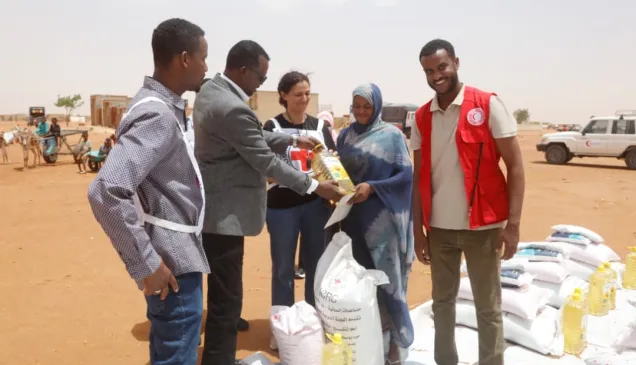
After all, it is civilians who are at the core of our work in Sudan. Together with the Sudanese Red Crescent Society, we are facilitating hundreds of phone calls for people in Tawila to help them stay in touch with their loved ones. We are sending medical supplies to the doctor and his clinic. We have provided cash assistance for more than 130,000 camp residents. But in a region reeling from such intolerable violence, I worry – in fact, I know – we will not be able to reach everyone.
If I could ask one thing of the public, policymakers, or journalists outside Sudan, it would be this: don’t forget about its people. Civilians must be protected, and the world must pay attention to their suffering.
This is the spirit of international humanitarian law (IHL), which places human dignity at its core. Those carrying weapons, no matter what side they are on, must respect IHL and take constant care to protect civilians. Unless all parties urgently recommit to the rules of war — and unless the world listens to the plight of civilians – I fear such patterns of violence will be repeated, and even more lives will be lost.
As I left Tawila to return to the ICRC office in West Darfur, I thought of the people I’d met - their quiet strength as they try to piece their lives back together. All of them wish for a better future. But until the fighting stops and civilians are protected, that will remain out of reach for many in Sudan.