Gaza: “Palestinians are wondering how they will get through the winter”

This article was originally published in French in Ouest France
ICRC Director of Operations Yasmine Praz Dessimoz has just returned from Gaza. She sounds the alarm regarding the situation there, where a fragile truce is in effect and 2.3 million Gazans are preparing to spend winter under terrible conditions.
Nearly two months after the beginning of a fragile truce in the Gaza Strip, the population of 2.3 million is trying to get back on its feet in this narrow strip of land – half of which is still occupied by the Israeli army.
Yasmine Praz Dessimoz, Director of Operations at the International Committee of the Red Cross (ICRC) has just visited Israel, the West Bank and Gaza for the first time since 7 October 2023, the day of the Hamas attack on Israel that plunged the Palestinian people into war. She told us about the situation in Gaza and the urgent need for humanitarian aid.
What is the situation in the Gaza Strip?
We’ve seen many photos of bombings and destruction. But it’s quite different being there, and seeing that there’s nothing left. Entire cities have been flattened.
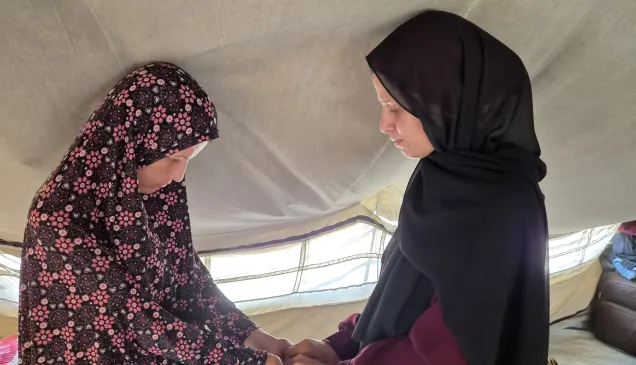
Palestinians have been able to re-enter Gaza City, some of them after being displaced a dozen times. Their houses have been destroyed, so they’re living in tents, under terrible conditions.
What are the consequences of the onset of winter, and the rain that has fallen in the last few days?
Many areas are flooded, and there’s no refuse collection or sewerage system. These factors are combining to create hygiene problems. The people there are in an alarming emergency situation.
Palestinians are wondering whether they’ll survive the winter and the illnesses it brings, with a health system that’s barely functional. Some hospitals are still standing, but they lack everything. Today, there’s a need for aid to enter Gaza – both equipment and medicines – if these people are to get through the winter.
When the ceasefire started at the beginning of October, humanitarian aid was being restricted. What is the situation now?
Eighty per cent of trucks entering Gaza are either commercial vehicles or carrying inter-governmental aid. Humanitarian aid has increased slightly, but the volume is tiny and far from sufficient. So yes, you’ll find food, some basic necessities and even brand-new e-bikes, at very high prices. But nursing mothers, old people, children and other vulnerable people don’t have access to any of that.
Market gardens are normally a source of revenue in Gaza, but they’re either contaminated by unexploded munitions, under Israeli army control or occupied by displaced persons. So they can’t be used to grow anything. Some fishermen still have their equipment, but they can’t operate more than 100 m from the shore, for safety reasons.
What do the people of Gaza need?
Everything. Ovens and firewood to bake bread, food, drinking water, medicines, petrol, diesel and, of course, a functioning health system.
Rather than distributing food, the ICRC is aiming to set up cash-based support systems, so that the people of Gaza can buy what they need at the market. The economy has to get going again.
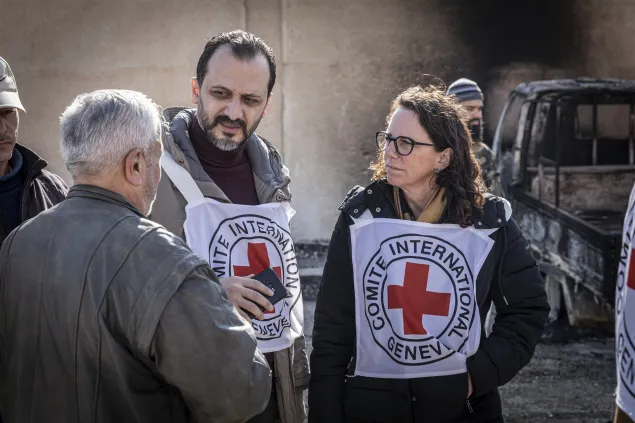
Al-Khafsah, Aleppo Governorate, Syria. Yasmine Praz Dessimoz, Director of Operations for the International Committee of the Red Cross (ICRC), visits a pumping station that forms part of a network supplying water to some three million people. ICRC, 7 January 2025.
It’s still early to be thinking about rebuilding Gaza, but is the ICRC already preparing for the future?
We have to respond to the immediate humanitarian emergency, but we are trying to work on both aspects. The top priority is to get the sewerage system working again. But before that can happen, it will be necessary to remove tonnes of rubble, while contending with the dangers of unexploded munitions throughout Gaza. My ICRC colleagues told me they were just starting to be able to discern the roads and roundabouts between Rafah and Gaza City, which had been buried by debris.
Ever since the truce started, the ICRC has been participating in the search for the bodies of hostages. Two bodies have still not been found and returned to Israel. What is your role in this operation?
We’re acting as a neutral intermediary, a highly complicated task intended to allow the search to proceed in complete safety. The ICRC is present, but we’re not actually digging through the ruins – the authorities and various parties are doing that.
It will also be our role to ensure that Hamas representatives have access to certain zones under Israeli control and to assure all parties of the intentions behind this action, in order to recover these remains. When a body is found, the ICRC transfers it to the Israelis, who identify the person. The same applies to the bodies of Palestinians handed over by Israel.
What about the missing Palestinians buried under the ruins?
Wherever you remove ruins, you discover a body. Most of them are unrecognizable. Working with the local authorities, the ICRC collects clothing and objects from the vicinity and catalogues them for identification. Some families have been able to recognize their missing relatives. This “not knowing” also applies to the families of Palestinian prisoners who have had no contact with them since 7 October 2023. The ICRC is working with the various parties to change this.
During these two years of war, humanitarian workers regularly expressed dismay at the situation. What is their mood now?
We have about 400 employees in Gaza. It’s quite extraordinary to see our international and local staff get up every morning and go out and help the population. Our local staff are Palestinians living in tents after having been displaced several times.
But when you take a bit more time and ask them how they’re doing, you realize that they’re subject to the same fears as the rest of the population. We lost a number of colleagues during the two years of war, and that’s something else we have to live with.
Did you have a sense of hope when you were in Gaza?
The Palestinians are there, and they’re still standing. They’ve been through a nightmare, and it’s not over yet, even if it is a tiny bit less acute now. Everyone has been traumatized, and they’re going to have to survive that. But they are hopeful. They want to rebuild, to be there, to live there. It’s their home. Despite everything, the scars run deep and those scars will remain. Everyone wonders what the Gaza of tomorrow will look like.