Lebanon: Maintaining water and essential lifelines as hostilities disrupt essential services

After years of compounded crises and recurrent hostilities, communities across Lebanon were already struggling to access basic services. Following the escalation of the conflict with Israel on 2 March 2026, many communities are facing deepened vulnerabilities. Hostilities are damaging critical water infrastructure and disrupting essential services, with serious consequences for civilians.
As systems break down and maintenance becomes difficult, access to safe water is increasingly compromised, raising public health risks and deepening humanitarian needs. In response, the ICRC rapidly scaled up its Water and Habitat activities to help ensure that civilians continue to access safe water and functioning medical care in affected areas.
The ICRC supported the continuity of water and sanitation services across Lebanon by providing fuel to one key wastewater treatment plant in southern Lebanon and 82 water pumping stations in Baalbeck, Hermel, Saida, Jezzine, Nabatieh, Tyr, Marajyoun and Hasbaya districts helping ensure access to water for over 896,000 people affected by conflict.
To respond to increased demand linked to displacement, repairs were carried out and boreholes were equipped in four areas in the Bekaa valley (Niha, Deir Al Ahmar, Nabi Shit and Hermel) and one in Nabatieh city serving 73,300 people. Additional repairs addressed conflict-related damage to water networks in two villages in the Bekaa valley (Britel and Nabi Shit) serving 45,000 people and one in Marjayoun in southern Lebanon serving 18,000 people. In parallel, repairs were conducted on main water distribution lines serving 13 collective shelters hosting about 2,000 displaced persons, as well as surrounding host communities in Jezzine district. These interventions help stabilize access to essential services in locations where infrastructure had been damaged or overstretched.
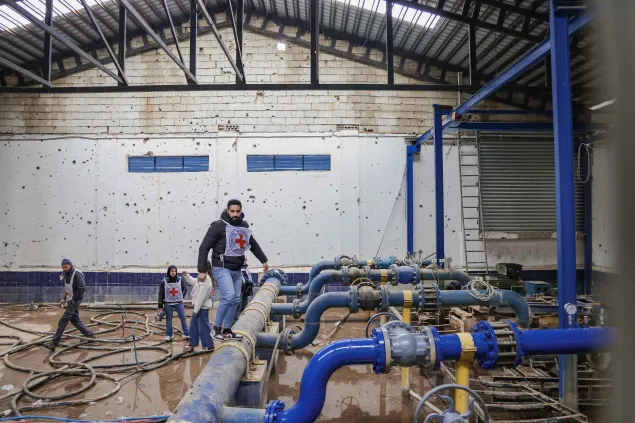
To reinforce local capacities, the ICRC provided tools, materials and consumables to South Lebanon Water Establishment (SLWE) and Bekaa Water Establishment (BWE) to support maintenance. These included 50 batteries and 5,000 litres of engine oil for generators, spare parts for repair and two 20,000 litres of fuel steel storage tanks to SLWE and a donation of hydraulic crimping tools, three electrofusion machines, and maintenance for 41 vehicles to BWE. These efforts strengthened the ability of water institutions to maintain reliable services despite the increased pressure caused by the displacement of families and the disruption of infrastructure.
Together with the Lebanese Red Cross, the ICRC conducted urgent water, sanitation and shelter repairs in 14 collective shelters in Aley, Hasbaya, Zgharta, Saida, Beirut, and Rachaya. The interventions ensured that 3,552 displaced persons can stay in safer and more dignified conditions while longer-term solutions are explored.

The ICRC supported the continuity of essential health services in Lebanon by providing fuel to critical hospitals, including 35,000 liters to the Rafik Hariri University Hospital, 18,000 liters to Tebnine Governmental Hospital, and 40,000 liters to four hospitals in conflict-affected areas. To sustain operations, 6,000 liters of water were trucked daily to Salah Ghandour hospital in southern Lebanon, while medical oxygen, oxygen cylinders, and other deliveries helped maintain life-saving services in nine hospitals. Spare parts, pumps, maintenance tools, anti-blast films, and generator consumables were also provided to strengthen infrastructure resilience in Tebnine Governmental Hospital, alongside the installation of one generator in Sohmor Hospital in the Bekaa governorate.
In addition, plumbing spare parts, passive security items, maintenance tools and materials, and consumables and maintenance for generators, were provided to hospitals including Rafik Hariri University Hospital, Tebnine, Hasbaya, Marjayoun, Sohmor, Jabal Amel, Hiram and Lebanese Italian Hospital. These measures helped sustain the continuity of health services for communities most affected by the hostilities.