Senior Workshop on International Rules Governing Military Operations (SWIRMO) in Riyadh: Humanitarian Law as part of the Military Doctrine

Over 125 senior military officers from more than 90 countries gathered in Riyadh on 1 November 2025, for the opening of the 18th Senior Workshop on International Rules governing Military Operations (SWIRMO) – a flagship global event organized by the International Committee of the Red Cross (ICRC) and co-hosted by the Ministry of Defense of the Kingdom of Saudi Arabia and Saudi National Committee of International Humanitarian Law (IHL).
The event was inaugurated by ICRC President Mirjana Spoljaric and Air Chief Marshal Fayyadh Al Ruwaili, at the Saudi National Defence University (SANDU). This marks the first time Saudi Arabia hosts SWIRMO, highlighting its growing role in advancing dialogue on IHL and responsible military conduct.
The 18th edition of the Senior Workshop on International Rules Governing Military Operations (SWIRMO) was held in Riyadh from November 1 to 6, 2025. During the event, two delegates from the International Committee of the Red Cross’s Armed Forces and Security Department revealed to “Al Insani Blog” how this annual meeting, like the ICRC’s work throughout the year, contributes to transforming the abstract legal principles of international humanitarian law (IHL) into operational plans that can be used by the military, and why the “decision taken solely by human beings” remains the decisive factor in contemporary wars.
In a closed room, far from the roar of artillery, senior military leaders from dozens of countries sit around the same table. Before them are maps of a complex strategic operation, but they are not looking into it solely through a military lens; rather, through what ICRC experts call “the green lens… the lens of humanity.”
The SWIRMO is a practical exercise in integrating law into the highest levels of military planning. Ashraf Kandil, ICRC Armed Forces Coordinator and an expert in IHL, explains:
What the participants are interested in is the practical application of IHL; how it is translated from theory into practical procedures within armed forces operations, whether at the strategic or operational level.
This workshop, a major annual event for the ICRC since 2007 which brings together high-ranking officers from colonel to brigadier general from over 90 countries, is a key part of the ICRC's mandate to promote and disseminate IHL. But, as Kandil points out, "What makes the difference" is the background of the trainers themselves; they are not academics, but rather "experienced retired officers." The ICRC's Armed Forces and Security Services (FAS) program relies heavily on former military and security officers, specialists like retired Major General Hani Nakhleh, who spent 30 years in the Lebanese Armed Forces and nine years as a UN military expert on security sector reform, ceasefires, and negotiations. Another is retired Brigadier General Ashraf Kandil, who brings experience from UN and African Union missions in the Democratic Republic of Congo and Burundi.
Nakhleh, the ICRC's regional delegate in Sudan, explains: "The ICRC's delegates to the armed and security forces wear two hats: a humanitarian hat and a military one. We translate the humanitarian concern into a military concept, and in return, we translate the operational dimension and military concepts into humanitarian concepts for our colleagues [in the ICRC]."
This dual “translation” is at the heart of their work. A platform like SWIRMO has three clear objectives, as Nakhleh summarizes:
First, to update senior leaders on the application of IHL in contemporary warfare, particularly in the planning and decision-making processes; second, to improve their understanding and acceptance of the ICRC’s mission and principles; and third, which is very important, is to strengthen communication and outreach networks.
These networks are not merely public relations; they are the infrastructure for future humanitarian impact. Nakhleh recalls a participant from Ghana, a country with whose armed forces the ICRC had no contact: “After he returned, he opened all doors for us. I met with the Chief of Staff, and then we developed an annual work program with the Ghanian Armed Forces.”
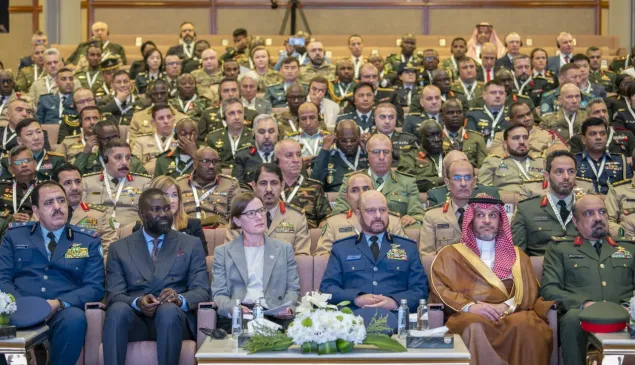
Over 125 senior military officers from more than 90 countries gathered in Riyadh on 1 November 2025, for the opening of the 18th SWIRMO – a flagship global event organized by the ICRC and co-hosted by the Ministry of Defense of the Kingdom of Saudi Arabia and Saudi National Committee of International Humanitarian Law (IHL).
Practical application in the SWIRMO
How are these training programs designed for different armies and doctrines around the world? The two delegates emphasize that the fundamental principles of IHL are non-negotiable. “The fundamental principles are indivisible: distinction, proportionality, and precautions,” says Kandil, but adds, “If it’s cold, you dress warmly… That’s how IHL should be adapted. This doesn’t mean changing the fundamental principles, but rather how the information is communicated and how it’s reflected in practice.”
This adaptation is key. “If the state, for example, is governed by Islamic law,” explains Kandil, “we focus on the individual’s inherent respect for their own Islamic law. If, however, the state is governed solely by secular laws, we focus more on these laws.” Sometimes, the approach might be to respect the leader or tribal chief. The goal is always to find the “appropriate approach” to ensure respect for the law.
This aligns perfectly with the ICRC’s research, such as the report “The Roots of Restraint,” which found that linking the law to local values and customs gives it far greater impact than simply focusing on the law as a rigid text.
This highlights the importance of the delegates’ military background. “A soldier in the field must first understand the law, then accept, in order to apply and respect it later,” says Nakhleh. He compares the principles of humanitarian law to classical military theories: “Clausewitz’s principles of war are 200 years old and still applicable, while Sun Tzu’s are over 2,000 years old. The difference lies in how these principles are applied.” This application is adapted not only culturally, but also according to the ranks of the participants in the training (between non-commissioned officers or senior commanders) and the context (theoretical training in peacetime differs from direct practical training during conflicts).
This adaptation has reached the point where many advanced militaries issue their own practical manuals on the “law of armed conflict.” “Some ask, what’s the difference?” says Nakhleh. “The content, spirit, and purpose are the same, but the difference is that this law of armed conflict is an applied system of IHL that takes into account the state’s capabilities, doctrine, equipment, education and training systems, and penal code.”
International Humanitarian Law and Artificial Intelligence
As the nature and characteristics of modern warfare evolve, so do the challenges. The ICRC today faces pressing questions about emerging technologies, autonomous weapons, and cyber warfare. Kandil emphasizes that the ICRC takes a “proactive” approach, citing Article 36 of Additional Protocol I to the Geneva Conventions, which obliges states to review new weapons to ensure their compliance with the law. “We keep track of all new developments in weaponry and modern warfare,” he says. “If we sense that a state possesses new weapons, we take a proactive step and discuss IHL in its modern forms.”
This proactive approach was recently exemplified in a specialized regional workshop held in Jordan in 2023, which focused exclusively on “Emerging Technologies and International Humanitarian Law” and brought together officers and legal advisors from 11 countries in the Middle East and North Africa.
Nakhleh explains that the ICRC has a dual approach to technology: “First, to leverage these technologies, such as virtual reality, to enhance training and make it more realistic, or to deliver online training in hard-to-reach areas. Second, to address technology as a challenge to the law and thus clarify how the law should be applied when it is used.”
When asked whether the law is still valid in the age of drones and artificial intelligence, his response is unequivocal: “The answer is always to return to the roots and foundations of IHL: the principles. Any weapon or method, whatever its type, must respect the principles of distinction, proportionality, and precaution, taking into account the principles of military necessity and humanity.”
Nakhleh goes even further, arguing that technology, if used correctly, can actually strengthen respect for the law. “Today’s technologies can distinguish and gather intelligence better, faster, and more accurately,” he says. “You can see the target with high precision and identify it.” But he concludes with a crucial warning: “All of this is on one condition: that the final decision remains with the human being, not the machine.”
SWIRMO: Impact and Challenges
But what is the real impact of dialogues and training? The impact is the story of Ghana mentioned above, where one workshop participant became a bridge for integrating IHL into the programs of a national army. The impact is the transition from theoretical lectures to “map-based training” and application during military operations, where the law becomes part of the strategic commander’s decision-making. The biggest challenge, as the delegates see it, is not in the texts of the law, but in the mindset and the will.
“The first challenge we face is the mixing of IHL with other laws,” says Kandil. “We must fight a mindset with a mindset.” He offers a powerful analogy: “When a driver makes a mistake and runs a red light, is the fault with the light or with the driver? The fault lies with the one who did not respect the law.” The problem isn't always with the law itself, but with states' willingness to implement it and integrate it into their national legislation.
Nakhleh agrees, pointing to a common misconception: "Some believe that the responsibility for ensuring respect for the law lies with the ICRC. In fact, it's the responsibility of the parties and states that have signed the Geneva Conventions. Our role is to help parties to conflicts to respect the law."
These practitioners don't seek to restrict armies, but rather to reframe the law as an element of power.
Nakhleh summarizes this philosophy by saying: "IHL doesn't prevent the achievement of military objectives. On the contrary, it promotes their proper achievement, respecting the rules of war such as economy of means and force, while simultaneously considering humanitarian values and aspects. For the ICRC, the law is a tool for assistance, not a tool for accountability."
As for Kandil, he succinctly summarizes the entire field in one word: "IHL is, in short, one word: humanity – how to be human during armed conflicts. And we are always and forever at the service of humanity and at the service of humankind."
About the Senior Workshop on International Rules Governing Military Operations (SWIRMO)
The SWIRMO is an outstanding event organized annually by the ICRC since 2007, targeting senior military officers. The first workshop was held in Switzerland, and since then it has evolved into a mobile global platform hosted in various countries across continents, including France, South Africa and Algeria, Malaysia and China, Colombia, and the United Arab Emirates. The workshop serves as a forum for discussing the integration of (IHL) into military planning, training, and operations. The 2025 edition of the workshop was co-hosted by the Saudi Ministry of Defense and the ICRC, and took place at the Saudi National Defense University in Riyadh from 1 to 6 November.