06:30 in Beirut. A little girl, a helium balloon, and a country facing displacement

Every morning, I leave home early to go to the office. Partly to avoid the traffic, but mostly because I enjoy the quiet drive along Beirut’s seaside.
Around 6:30 am, the city feels different. Beirut at that time is breathtaking. The sea is calm, the horizon endless, and the city seems suspended in a rare moment of serenity.
And the people you see.
The fishermen casting their lines, hoping for the first catch of the day. The runners finishing their morning routine (a discipline I have always admired from afar). Groups of elderly men stretching together. Migrant workers doing their daily aerobics. Friends playing badminton. Some sipping coffee while reading the morning paper. Others deep in conversation - sometimes calm, sometimes heated.
It has always been amusing to drive by the seaside. No morning ever felt exactly like the one before. The same faces, perhaps — but different stories, different moods, different expressions every day.

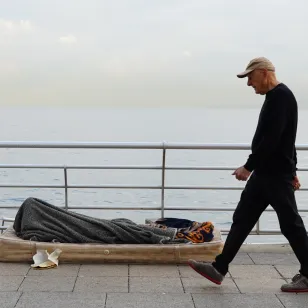
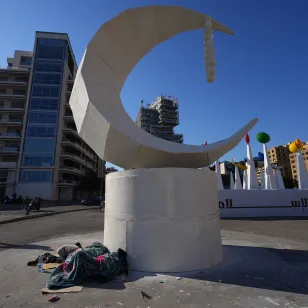
Displaced people sleep on Beirut's seaside Corniche in Beirut, Lebanon, on March 6, 2026, after fleeing southern Lebanon and Beirut's southern suburbs, with many saying they believe the waterfront is safer. Amid a new escalation in the Israel-Hezbollah conflict, residents have been newly displaced, fleeing southern Lebanon and Beirut's southern suburbs after Israeli evacuation warnings and intensified airstrikes.
But since Monday, 2 March 2026, the morning drive has changed.
Hundreds of thousands of people have been displaced following the recent escalation of conflict in Lebanon. Many have found temporary refuge along the seaside.
People who had to leave their homes abruptly - closing doors they are not sure they will ever open again.
They left behind clothes, belongings, and essential items. But they also left behind something far more difficult to replace: memories, safety, a sense of stability… they left behind home, with everything that word represents.
For many, this is the second time in less than two years.
And what lies ahead is uncertainty.
When will they return? What will they return to? Will their homes still be standing? Will their neighborhoods still resemble the places they once knew?
Uncertainty is a difficult word. It means having limited knowledge, living with doubt, being unable to predict what comes next.
But how do you cope with uncertainty when the outcome you are trying to predict is not just your future - but your past, your present, and your entire life?
I still drive to the office early every morning. I still pass by the seaside at 6:30 am.
But now it is no longer to avoid traffic.
Now it is to arrive in time for the security meeting. The operations task force. The crisis cell. Different names for the many platforms we humanitarians have created to coordinate responses to the essential needs of affected people - and to try to do so in a dignified way.
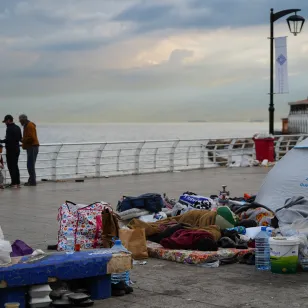
And as I drive by, the scenes are no longer the same.
People sleeping in tents. Others lying on thin mattresses covered with blankets, while the temperature outside drops below ten degrees.
You see jerry cans lined up. Food packages left from the previous night’s meal - or from iftar. Cars turned into temporary shelters, with back seats folded down to create makeshift beds.
People constantly on their phones, following the news minute by minute. Trying to understand what is happening. Trying to identify where the latest strike occurred. Trying to confirm whether it was their building that collapsed… their shop… their clinic… their livelihood.
You see gas cylinders tied to the roofs of cars. Prayer mats spread on the ground. Elderly men and women holding rosaries.
Young men and women gathered around small fires, blankets wrapped tightly around their shoulders, already deep in conversation at 6:30 in the morning.
You wonder whether they managed to sleep at all.
And then, among all of this, I saw something unexpected.
A helium balloon.
Bright, floating above the crowd, held tightly by a young girl. She was running, smiling, laughing — treating that balloon as if it were the most precious toy in the world.
At 6:30 in the morning.
And you cannot help but ask yourself:
What kind of memories is she forming right now? How will she remember these days when she grows older?

In conflicts, civilians always pay the highest price.
As humanitarians, we try to help - through food distributions, hygiene kits, mattresses, blankets, water, and whatever assistance and protection efforts we can mobilize.
We try to do it in a way that preserves people’s dignity.
But it never feels like enough.
We tell ourselves it is a drop in the ocean of needs. We tell ourselves we are doing our best, that we are doing what we can.
And then we go home. We open the door. We lie in our beds.
And before falling asleep we think about the next day.
What else can we do? What more could be done?
And sometimes another thought appears:
What would I do if I were in their place?
And then you realize something even more humbling.
Some of us are in that position.
Humanitarians who are themselves affected by the conflict. Displaced from their homes. Living with the same uncertainty - while still trying to serve others.
To all those who continue to serve humanity in these moments: respect.
To all those who have been displaced: you are not numbers, you are not statistics! May you return home soon - to your memories, your loved ones, and a life with less uncertainty.
And to the little girl with the helium balloon:
May you keep that beautiful smile!
Because behind every displacement statistic, there is a human being, sometimes holding a helium balloon.