Chad: A daily quest for water
For nearly three years, the conflict in Sudan has forced hundreds of thousands of people to leave their homes – and sometimes their families – to flee to neighbouring Chad. Close to 1.5 million Sudanese refugees and Chadian returnees from Darfur are struggling to survive in Chad’s arid eastern regions. Among them, women and children face a life-or-death daily mission: find water. A hunt that puts them in danger every single day.

There is an urgent need for water in the camps, which house tens of thousands in the sweltering heat. The people here need water to drink, but also to cook, bathe their children and maintain a basic sense of dignity.
The influx of refugees to Adré, a town on the Sudanese border, has put the area under enormous pressure. Before the war, it had a population of roughly 25,000. With more than 150,000 Sudanese refugees having arrived in just a few months, the same wells and pipelines are being used by six times as many people, turning the smallest everyday tasks into major hurdles.
Danger every step of the way
Aziza Abdulgadir fled El Geneina, Sudan, with ten family members and a heart full of fear and uncertainty. One day, her husband left on an errand and never came back. She would later learn he was in a displaced persons camp back in Sudan. For three years, Aziza has survived alongside her mother, sisters and six children in a transit camp in Adré.
When they first arrived, water was hard to come by. The only available source was an hour’s walk away under a blistering sun. Aziza was too ill to go herself, so her children had to make the daily trips.
“I’m not very well. I can’t carry a water jug. So my children had to walk all that way to get water. One hour there, one hour back, twice a day. That’s four hours’ walk every day, not counting time spent in the queue,” she said.
It is not unusual for children in the camps to take over when their parents are unable to make the trek. But each trip is an ordeal – and a gamble. The footpaths traverse isolated areas far from help or shelter, and children walking alone risk being harassed or even attacked. A child carrying an empty water jug at dawn or dusk can easily become a target.
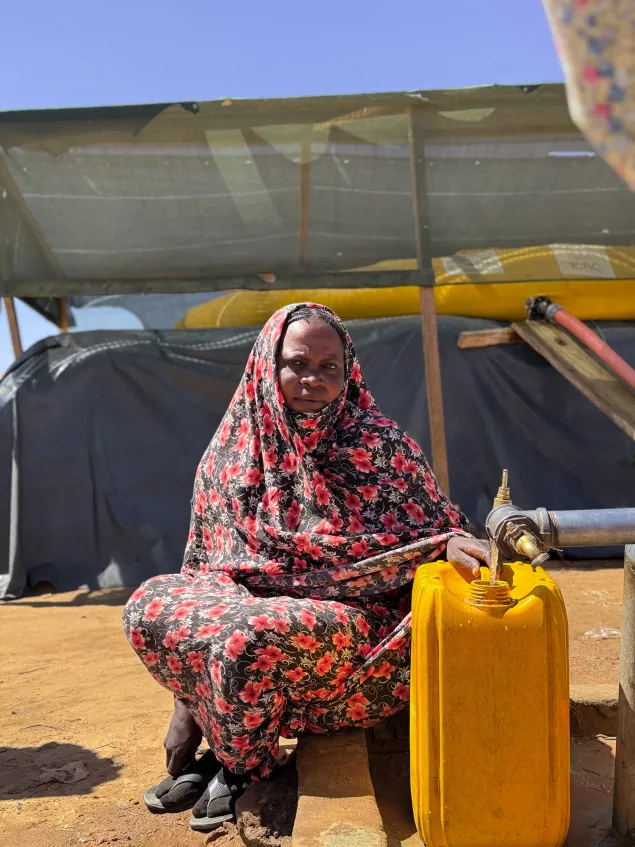
In 2024, the ICRC set up a water tap near Aziza’s home. Instead of two hours, the trip to fetch water now takes two minutes. For Aziza and her children, it was life-changing.
Long, dangerous treks in the hot sun are now a thing of the past. Aziza can’t help but smile as she watches her children fill their jugs so close to home.
“Now we have water on our doorstep. My children can go get it any time, without fear. We can shower, cook, drink… Water is the source of all life.”
The true price of water
Darassalam Abdallah left El Geneina on foot. The memory of her journey to Chad is seared into her mind and body: an odyssey of swirling dust and crushing fatigue.
“We left Sudan and walked all the way to Chad. My five children were with me. I have twins, so I carried one on my back and the other in my arms,” she said.
All day she carried the weight of her children and her worry.
Once she got to Adré, she learned to survive with close to nothing. The search for water took much of the day, putting her strength and limited resources to the test. Cooking the smallest thing for herself or her children meant finding water first.
“I’d take my twins, one on my back, one in my arms, with the water jug on my head. I’d walk for kilometres in search of water. I can’t walk fast carrying them, so I’d have to stop, take breaks. It was very hard.”
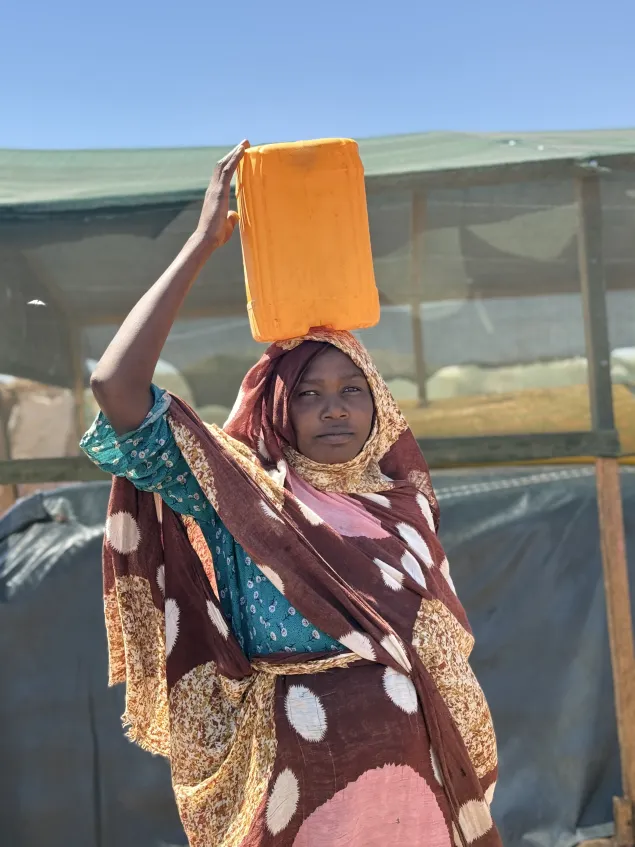
Wait times at the pump could reach an hour or more in the full sun. And the water was not free.
“It cost 250 Sudanese pounds per jug, twice a day. That was 500 pounds total, and I couldn’t even be sure the water was clean,” she said.
Now there is a ICRC water tap right across from her home.
“Since the ICRC brought water so close to me, I can rest a little in the mornings.”
For a single mother of young children living in a refugee camp, that says it all.
Emergency humanitarian response
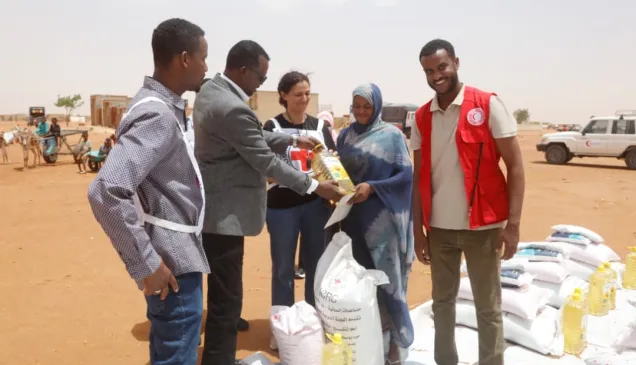
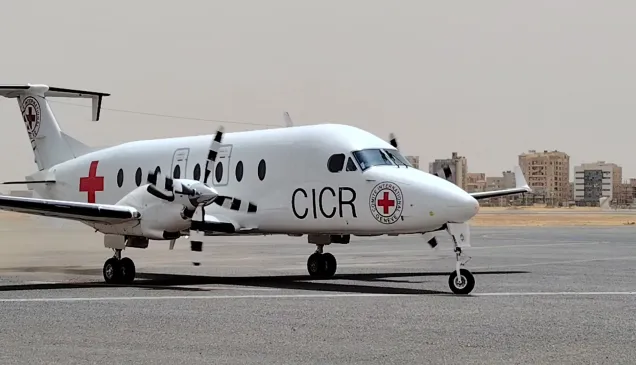
The ICRC has partnered with the Red Cross of Chad to meet the challenge of improving access to water in the Adré camps. The goal is clear: bring water closer to people so they can stay healthy and safe.
Mamadou Aliou Sow, an ICRC delegate in charge of water and habitat programmes for eastern Chad, explained how the strategic response was rolled out: “The first phase was to deliver and distribute water by truck. It was a temporary, emergency solution but necessary to meet the most urgent needs.”
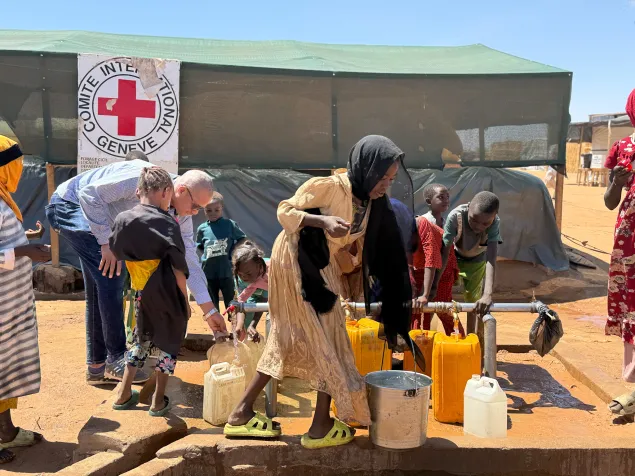
In the first quarter of 2024, the ICRC drilled four wells within the transit camp that run on solar power. All four are now operational, providing up to 140,000 litres of drinking water each day. “They provide enough to meet the needs of roughly 10,000 people, the equivalent of nearly 15 litres per person per day,” said Mamadou Aliou Sow. A fifth well is under construction, which will serve 2,000 more people.
While those numbers may seem impressive, they only represent 10% of the camp’s population. There is still a long way to go. And the ICRC wells are also being used by people living in the town of Adré: proof that the water crisis is affecting the entire community, and that the ICRC’s action benefits everyone.
But our work is not limited to emergency measures, as Mamadou Aliou Sow pointed out. “Once we renovate Adré’s water supply system and its 240-m3 water tower, refugees and locals alike will be able to share that resource, which should help ease tensions between the two communities.”
Meanwhile, more than a hundred latrines have also been built to improve sanitation and prevent the spread of diseases.
Aziza and Darassalam’s stories put a face on the ongoing humanitarian crisis that has shaken eastern Chad.
Behind the numbers are women fighting for their children, families struggling to survive without sacrificing their dignity. Water is more than liquid in a jug. It means health for a growing child, safety for a worried woman, rest for a mother so she can hold on for another day. It is – quite simply – the fundamental right to live with dignity.