The number of missing persons cases recorded by the International Committee of the Red Cross (ICRC) in Sudan has reached over 11,000, with an increase of more than 40% in the past year alone. Figures such as these illustrate the human cost of prolonged conflicts.
More than 11 million people have been displaced – some repeatedly – by shifting front lines. Of these, four million have fled the country entirely, seeking safety abroad.
With many communication networks destroyed, countless families have lost contact with their loved ones. Not knowing about their fate is causing deep and lasting psychological suffering.
“My children haven’t forgotten their father,” says Om Omar, a mother of four whose husband went missing over two years ago. “My eldest son cries and asks me about him. During the release of detainees, the children waited to see their father on television.”
The family scours lists of missing people and detainees on social media, she says. “We hope to hear good news about him and find out where he is, whether he is detained or not. Someone who can tell us where he is.”
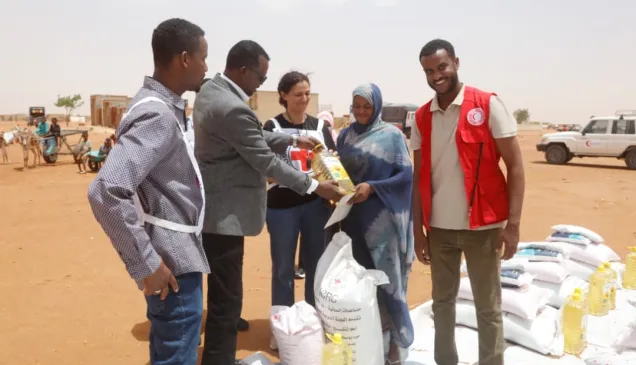
Despite enormous difficulties, hundreds of families managed to reestablish contact in 2025: more than 560,000 phone calls were facilitated by the Red Cross and Red Crescent Movement in Sudan, as well as from Egypt, South Sudan and Chad.
Restoring family links is a key pillar of the joint response by the ICRC and the Sudanese Red Crescent (SRCS) to what has become one of the world’s most severe yet least visible humanitarian emergencies. The ICRC also promotes knowledge of and respect for international humanitarian law (IHL) in a conflict that has witnessed widespread failure to comply with the rules of war.
Between 70% and 80% of health-care infrastructure in Sudan’s conflict areas is non-operational or critically under-resourced. Nearly 70% of the population rely on agriculture and livestock, which have been severely disrupted. Combined with loss of assets and repeated displacement, these pressures erode people’s ability to cope and rebuild their lives.
Similarly, sexual violence remains one of the most devastating and least visible consequences of the conflict, despite being strictly prohibited under IHL. Stigma and fear of rejection prevent many victims from reporting incidents, obscuring the true scale of the problem and prolonging the suffering of survivors.
At the same time, Sudanese communities are at the forefront of the humanitarian response. Despite immense challenges, people continue to support one another, share resources and maintain essential community networks, helping to preserve life and dignity under extreme strain.
This everyday solidarity reflects both the scale of needs and the determination of those most affected, who bear its heaviest consequences, including 22 SRCS volunteers who have lost their lives while helping others since the war began.
“The suffering caused by the war has reached new heights of agony for civilians, not least due to its impact on essential infrastructure: markets, hospitals, water treatment facilities and energy production plants. We see this in Darfur, the Kordofan, the White Nile, Blue Nile, Khartoum and the Northern State. The whole country has, at some point, been affected by indiscriminate attacks,” said Daniel O’Malley, head of the ICRC in Sudan.
“Stopping or resolving a conflict is the responsibility of those directly involved in the conflict and those who have a direct influence to do so. The cost of inaction today will be unbearably heavy in the future.”
Today the ICRC released a humanitarian report focusing on three areas where the protection of civilians is both urgent and feasible: safeguarding critical infrastructure that enables the provision of essential services; the situation of people separated from their families, missing or detained, as well as the dignified treatment of the deceased; and the prevention of and response to sexual violence.
About the ICRC
The International Committee of the Red Cross (ICRC) is a neutral, impartial and independent organization with an exclusively humanitarian mandate that stems from the Geneva Conventions of 1949. It helps people around the world affected by armed conflict and other violence, doing everything it can to protect their lives and dignity and to relieve their suffering, often alongside its Red Cross and Red Crescent partners.
For more information, please contact:
Adnan Hezam, ICRC Port Sudan, tel: +249 100 999 477 | +249 900 940 377, email ahizam@icrc.org
Mateo Jaramillo, ICRC Nairobi, tel: +254 716 897 265, email mjaramillo@icrc.org
Jean-Yves Clémenzo, ICRC Geneva, tel : +41 79 251 93 02, email jclemenzo@icrc.org