Frequently asked questions: ICRC's work in the Philippines
Our presence in the Philippines
-
We have been working in the Philippines since the aftermath of the World War II (more than 80 years now), with our permanent presence established in 1982. We support different authorities in integrating IHL (international humanitarian law) into national laws and military doctrine, systems and processes. We also visit various detention facilities in the country, working with detention authorities to secure humane treatment and conditions of detention for all detainees (or people deprived of liberty).
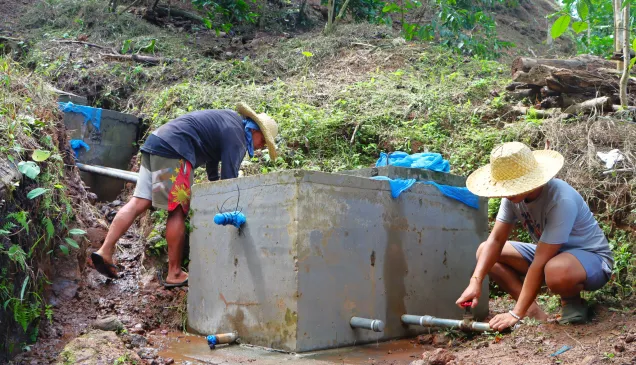
Together with the Philippine Red Cross, our primary humanitarian partner in the country, we help people affected by armed conflict by providing livelihood support, food and other basic needs, improving access to clean water and sanitary facilities, and supporting local health facilities.
In relation to armed conflict incidents in Mindanao and parts of Luzon and Visayas, we talk to government armed forces and non-state armed groups to remind them of their responsibilities under IHL and to discuss humanitarian concerns, including alleged IHL violations.
-
Aside from our delegation in Manila (Makati City), we have offices in Mindanao: in the cities of Butuan, Cotabato, and Zamboanga, to be closer to conflict-affected communities.
Butuan
Unit 1, Salcedo Commercial Building, Pareja Subdivision, 1st Street
Brgy. Bayanihan, Butuan City, 8600 Agusan del Norte
butuan@icrc.orgCotabato
Sunga Compound, Datu Udtog Matalam Street
San Pablo Village, RH XI, 9600 Cotabato City
cotabato@icrc.orgZamboanga
No. 359, Lot 571 B. D, Subdivision, Sta. Maria Street, 7000 Zamboanga City
zamboanga@icrc.org -
Yes, but we have a limited presence in Luzon and Visayas. We look at the humanitarian situation in communities affected by armed conflict by conducting field trips mainly in the Samar and Negros islands.
In Luzon, our activities are mainly linked to visits to detention facilities, particularly to persons deprived of liberty held in connection with the armed conflict, as well as to the most congested jails; IHL dialogue and its integration into training and doctrine, with weapon bearers; policy work with judicial and legislative authorities; and building awareness about IHL among the national authorities, armed forces, media, and the general public.
-
The ICRC started visiting Sulu in the last three years, and we are looking to strengthen our network there with the aim of better understanding the long-term humanitarian consequences experienced by communities that were affected by past armed conflicts; to promote IHL among weapon bearers; and its convergences with Islamic law, with religious groups. We also coordinate closely with the Philippine Red Cross, which has a chapter in Jolo.
Our modalities and work
-
Neutrality is one of the seven fundamental principles of the Red Cross and Red Crescent Movement, of which ICRC is part of, along with 191 National Societies and the International Federation of Red Cross and Red Crescent Societies (IFRC). We always maintain and show our neutrality because it allows us to reach those who are most in need, no matter which side they are on. Our neutrality enables us to hold sensitive discussions with parties to armed conflict and relevant authorities, maintaining channels of communication so that they can take critical steps in addressing urgent humanitarian needs.
For the ICRC, being neutral is an operational posture, not a moral stance. We take action, not sides.
Know more about how our neutrality has helped people affected by conflict: by reuniting families, bringing prisoners of war home, and ensuring safe passages for civilians.
-
In the Philippines, we have acted as a neutral intermediary in the release and handover of soldiers and police officers captured by an armed group. This intervention is done upon request to ICRC and in agreement with the parties to the conflict. We do not get involved in release negotiations.
In several instances, the ICRC has also been asked by non-state armed groups to provide medical transport for wounded fighters. In such cases, all parties involved in the conflict are notified and requested to respect the wounded and the evacuation team. The wounded are transported to the nearest health facility able to take care of them. This is part of ICRC’s neutral and impartial humanitarian action and in line with IHL principles to provide treatment for sick and wounded people, regardless of which side they are on.
At the height of the 2017 conflict in Marawi City in Lanao del Sur province, Mindanao, the Red Cross also safely transported 600 civilians from Marawi City to evacuation centers and neighboring municipalities. This was made possible because of our role as a neutral humanitarian actor.
-
In instances where it becomes difficult for government and other actors to respond to humanitarian needs, the ICRC—often together with the Philippine Red Cross—may provide support to affected communities. This can be through improving access to clean water and sanitary facilities, providing food, essential shelter and household items, livelihood assistance, or cash grants, or supporting healthcare facilities.
This depends on identified gaps and our resources and capacity. As a neutral, impartial, and independent humanitarian organization, we focus on the people most affected and most in need. The assessment of the general situation and needs is done together with community members and relevant authorities, and the selection criteria for beneficiaries are also defined together with them.
-
Part of our work is to support authorities in addressing the humanitarian consequences of overcrowding in places of detention. We work with authorities such as the Bureau of Jail Management and Penology (BJMP) and the Bureau of Corrections (BuCor) on improving infrastructure, strengthening healthcare services, ensuring respect for judicial guarantees, and promoting adequate management practices in places of detention.
In selected places of detention with extreme levels of overcrowding, we complement this cooperation with direct interventions carried out by our multidisciplinary team, consisting of health staff, engineers, lawyers, correctional professionals, and protection staff.
-
The ICRC respects the government’s “insurgency-free” declarations and we are not in a position to comment on such matters.
In parts of the country, the effects of armed conflict persist, and pockets of armed clashes still occur. We remain present in areas where we see that there are humanitarian consequences still being felt by communities affected by past clashes or by recent sporadic fighting.
We consider the government’s declarations in our independent assessments, but we also look at many factors: incidents referred directly to the ICRC or reported by local media or on social media, perspectives of authorities, weapon bearers, and community leaders, and the results of our own visits to the communities.
Moreover, even if there is no more armed conflict in an area, international humanitarian law (IHL) obligations continue. There are possible humanitarian consequences that can be felt for years, if not decades, even after clashes have stopped. The ICRC works with authorities and its primary humanitarian partner, the Philippine Red Cross, to address these needs. We focus not just on addressing the immediate effects and basic needs, but also on supporting affected communities in recovering from long-term issues such as loss of livelihood due to chronic displacement and determining the fate and whereabouts of missing loved ones.
Part of what we do is also to promote wider awareness and respect for IHL to help create an environment where people respect and understand the need to limit the humanitarian consequences of armed conflict and reduce human suffering.
-
As part of our purely humanitarian mandate, the ICRC may provide medical assistance without discrimination to wounded and sick people—whether they are civilians or weapon bearers—when the responsible authorities are unable to do so.
Under IHL, anyone who is wounded or sick—be they civilian, soldier, or fighter—has the right to receive medical care. Parties to the conflict must ensure that the wounded and sick, whether civilian or military, are collected, treated humanely, and provided with the medical care and attention required by their condition. Therefore, vehicles carrying wounded and sick people must not be held for a prolonged time at a checkpoint.
The ICRC does not usually transport wounded or sick persons but there are exceptional cases where we may be asked to transport wounded or sick members of non-state armed groups who need immediate medical intervention. The PRC, which has fully equipped ambulances, may be involved as our humanitarian partner in this activity.
If the Red Cross agrees to transport the wounded, all parties involved in the conflict will be notified and requested to respect the patient/s and the evacuation team. The wounded will be transported to the nearest health facility able to take care of them.
The ICRC will not block judicial processes that may take place after transporting the patient to a hospital but it will ensure that the patient receives the appropriate medical care first; and is treated with dignity and respect.
-
At the request of family members, the ICRC collects information about people who have disappeared because of armed conflict and other situations of violence, with the aim of restoring contact and bringing families together again. The request must come from the family member(s) of the missing person(s), and the assistance is done confidentially and with the informed consent of the family. More information can be found in the Family Links website.
If you would like to contact us regarding a missing loved one, you can message our Facebook page, text us at 0917-5437313 (Globe) or 0998-9600114 (Smart), or email us at manila@icrc.org
-
To donate to the ICRC, please visit our donation page. Please note that we do not accept in-kind donations. For donations related to disaster relief or response, please contact the Philippine Red Cross.
You can also support ICRC’s work in the Philippines by following our Facebook page and sharing our social media posts.
Our partnership with the Philippine Red Cross
-
The ICRC and the Philippine Red Cross (PRC) are different organizations, but both are part of the International Red Cross and Red Crescent Movement, along with the International Federation of Red Cross and Red Crescent Societies (IFRC).
The ICRC is focused on humanitarian protection and assistance for people affected by armed conflict and other situations of violence. The PRC as a National Society is an autonomous organization made up of a network of community-based volunteers and staff who provide a variety of services. It has a wider mandate, acting as auxiliary to the Philippine government in addressing humanitarian concerns and needs in the country, both in times of war and in peacetime. We work together with PRC in humanitarian emergencies that require a wider and stronger collaboration.
-
The PRC has a strong capacity to respond to emergencies, and its proximity to communities enhance and facilitate ICRC’s work especially in areas where we have limited presence.
Although they each conduct their own assistance activities and operate independently from each other, depending on humanitarian needs and the scale of humanitarian impact, they may jointly assist affected communities by improving access to clean water and sanitary facilities, providing livelihood support, giving food and other basic needs, and supporting public health campaigns.
We also support PRC in responding safely and effectively to humanitarian needs in insecure contexts. We provide financial and material support, depending on the needs of identified PRC chapters and available resources, and contribute to building the capacity of PRC volunteers and staff on restoring family links, water and sanitation, external communication, and dissemination.
-
The ICRC does not offer volunteer or membership opportunities. For questions or concerns related to volunteer or membership opportunities with the Philippine Red Cross, please message their Facebook page or email volunteer@redcross.org.ph (for volunteer opportunities) or maabrecruitment@redcross.org.ph (for membership opportunities). You may also call them at (+63 2) 8790-2373, (+63 2) 8790-2300 loc. 945 for volunteer opportunities or (+63 2) 8790-2396, (+63 2) 8790-2300 loc. 827 for membership opportunities. More information is available on the Philippine Red Cross website.
-
Depending on the humanitarian needs and the capacity of government authorities in responding to the impact of natural hazards, the Philippine Red Cross can provide emergency and medical support, search, rescue, and retrieval services, food and non-food relief assistance, shelter kits and livelihood assistance, and repair and rehabilitation of community facilities in coordination with local authorities or the LGU (local government unit).
For any inquiries, please contact the Philippine Red Cross chapter nearest you or contact the Philippine Red Cross through their Facebook page or their emergency hotline, 143.
-
If you have lost contact with a loved one due to a natural hazard, you may contact the Philippine Red Cross via email at sostracing@redcross.org.ph. You may also contact their central hotline number (143) or trunkline number (+63 2) 8790-2300 (available 24 hours a day, 7 days a week). More information is provided in the Family Links website.