Ukraine: “I don’t just want to get around. I want to walk properly again”

Oleksandr stepped on an unknown object whilst looking for a safer place near his home in Kupiansk during ongoing hostilities. Following his amputation, he became a participant in the International Committee of the Red Cross’ (ICRC) rehabilitation programme and is now gaining strength with every step he takes.
October 2025
In autumn of 2025, Oleksandr Konstantynopolskyi and his mother were still in Kupiansk, an area close to the front line, left devastated by hostilities. Living on the little food and drinking water they had left, they hoped that, sooner or later, the shelling would subside and the destruction would come to an end. They delayed the decision to leave their home until the last possible minute.
Once our flat had been damaged, my mum and I decided we had to move. We needed to find a safer place where there were other people. We thought we’d be able to evacuate from there.”
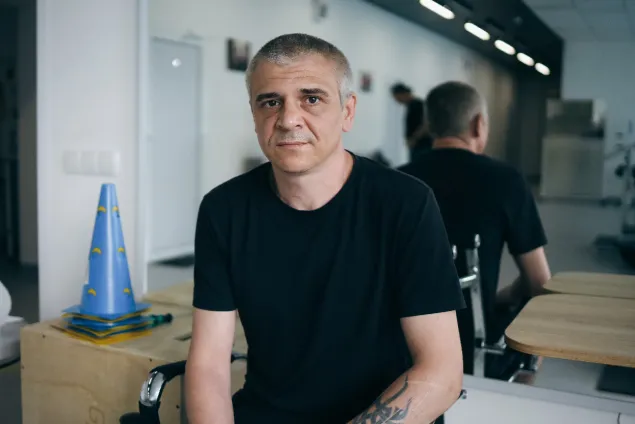
Oleksandr before being discharged from hospital.
They would have to walk one and a half kilometres under shelling and drones to reach a safer place. After five hundred metres, they needed shelter from drones and found a house with a basement. It was equipped with a heating stove and sleeping areas from previous occupants.
“I walked through the basement, wanting to have a look at what was inside. A moment later, I heard a loud explosion. I fell to the ground. I looked down — my foot had almost been blown off.”
Oleksandr crawled out of the house on his stomach. “I must have crawled about 400 metres, and then mum and I heard the drones flying again.” Nearby was a burnt house, with a cellar, the only place below ground level where they could take shelter.
When the drones flew over, we went down into the cellar and spent the night there. We didn’t even have anything to bandage my leg with. It was nothing short of a miracle that I survived until morning. The whole cellar was covered in my blood.”
The next morning, his mother ran for help. A few locals came with a bicycle – the only transport available. “They put me on the bike and that was how we got to the basement of another building where people were living.”
Oleksandr was eventually evacuated. With his leg bandaged in a sheet and in agony that even painkillers could not numb, he was taken to Kharkiv, where his leg was amputated below the knee. To this day, Oleksandr does not know what he stepped on in that basement.
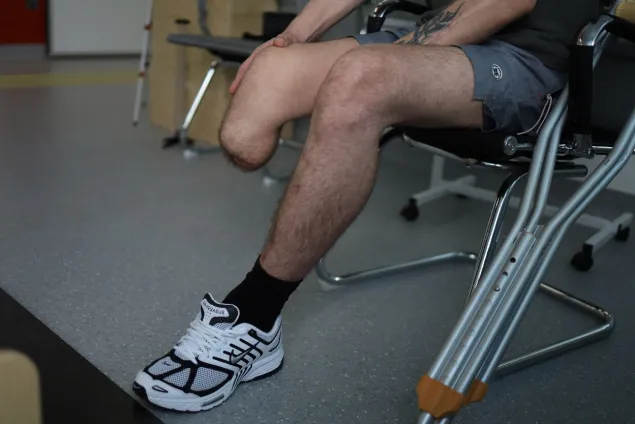
Once the wound had fully healed, Oleksandr began preparing for the fitting of his prosthesis.
July 2026
“After what I’d been through and the pain I’d endured, I was ready for the amputation.”
The doctor who performed the amputation told Oleksandr that he had survived by a miracle.
I realised straight away that I don’t just want to get around. I want to walk properly again. That’s my main goal.”
While still in hospital, he learnt about a physical rehabilitation programme run by the ICRC and the University Hospital in Kharkiv. Once his wound had healed, Oleksandr went there.
“First they showed me which exercises I needed to do at home, and then they called me and asked me to come in for the fitting of my prosthesis.”
That’s when his main goal started to become a reality. It was here that he stood on his own two feet for the first time since the operation. When Oleksandr talks about taking his first steps on his prosthetic leg, he can’t help but smile.
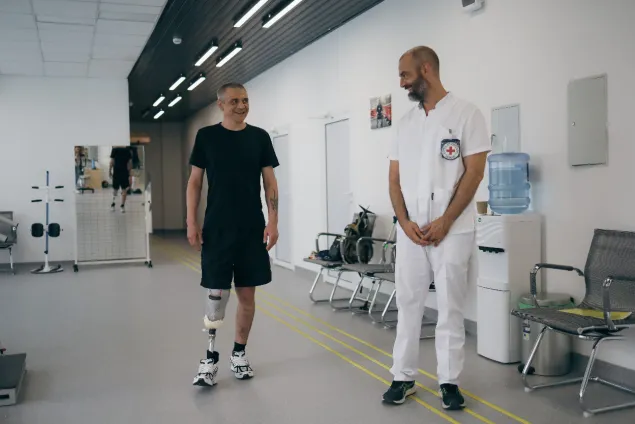
ICRC physical rehabilitation team Ricardo and Oleksandr after the prosthesis has been adjusted.
Until his trial prosthesis was ready, Oleksandr worked with physical therapists to strengthen and prepare his muscles. He also trained on his own. “Even the prosthetist, Ricardo, told me he’d never seen anyone get fitted with a prosthesis and start walking so quickly before,” Oleksandr shares. “When I took my first steps, it was as if I’d suddenly gained more strength.”
He realised that a large part of his rehabilitation depends entirely on him. And everyone in the hospital who has met him sees his determination.
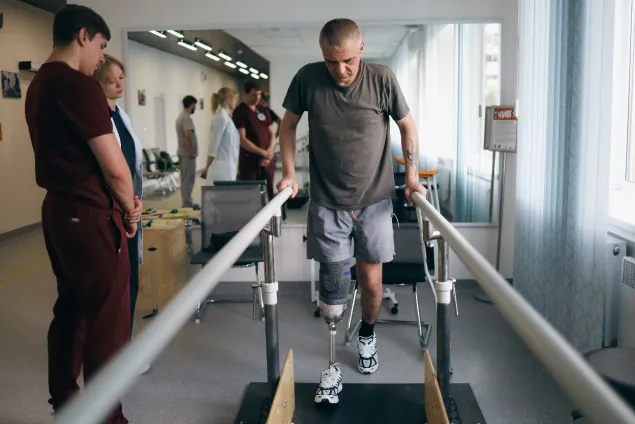
Physical therapy session at the hospital
“Receiving a prosthesis is not a one-time event,” says Ricardo Jorge Teixeira Fernandes, ICRC Physical Rehabilitation Programme Team Leader in Kharkiv. “It is a long process that requires regular adjustments, rehabilitation and follow-up. But no prosthesis can replace the patient's own determination. Oleksandr's progress is a reflection of the effort he has put into every stage of his rehabilitation.”
These days, Oleksandr can walk without crutches. He climbs the stairs on his own and can pop to the shop or go for a walk in the park.
“My mother came to visit,” says Oleksandr. “I wanted her to see me walking. She filmed it and showed it to my grandmother. My grandmother cried when she saw it.”