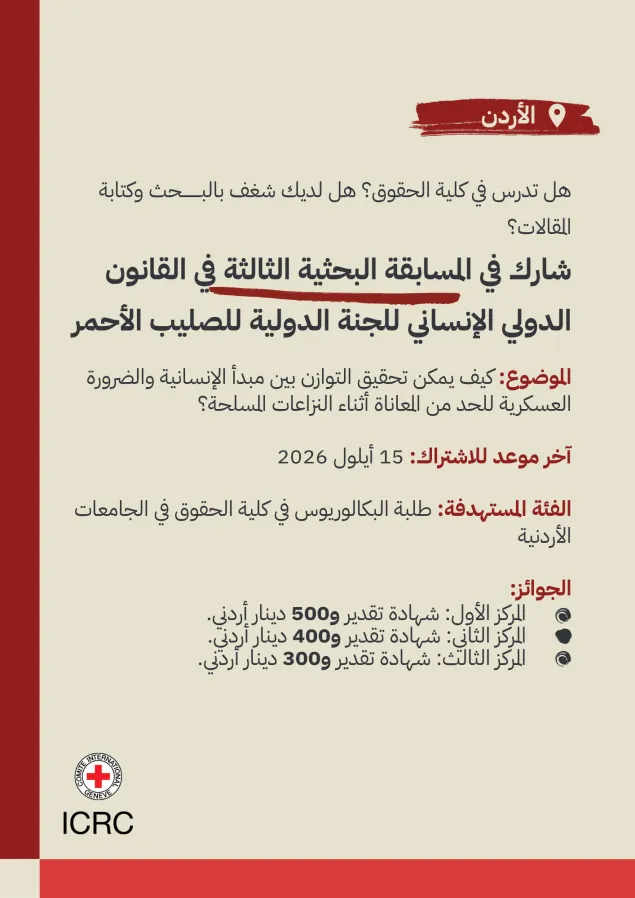
Jordan: The Essay Competition on International Humanitarian Law
The Delegation of the International Committee of the Red Cross (ICRC) in Jordan is happy to organize its Third International Humanitarian Law (“IHL”) essay writing competition to engage law students on relevant IHL discussions and to provide an academic platform for legal debates. For this year, students will be exploring the meaning and importance of upholding the principle of humanity during armed conflicts and how to balance it with the principle of military necessity.
The Topic:
IHL is a comprehensive body of law through its customary rules and treaty law. And for over three-quarters of a century, the Geneva Conventions of 1949 have served as beacons of hope amidst the darkness of conflicts. They stand as a testament to our collective commitment to mitigate human suffering, protect the vulnerable, and uphold the dignity of every individual affected by armed conflict. It listed fundamental principles to govern the conduct of hostilities and the balance between the principles of humanity and military necessity informs the entire normative framework of IHL and is essential for its application to limit the suffering during armed conflicts. However, despite the global consensus underpinning the Geneva Conventions, compliance with even the most basic norms is shockingly insufficient in war zones across the world today. Contemporary conflicts show, in appalling and devastating ways, that IHL faces enormous challenges to provide effective and meaningful protection for people in armed conflicts.
This is why on 27 September 2024 Brazil, China, France, Jordan, Kazakhstan and South Africa together with the ICRC have launched the Global Initiative to galvanize political commitment to international humanitarian law (IHL). This initiative seeks to reinforce the legal and moral imperative of respecting and ensuring respect for IHL across all continents. The initiative is structured around 7 workstreams: prevention, good practices, national IHL committees, IHL and peace, protection of civilian infrastructure, protection of hospitals and medical facilities, information and communication technologies and naval warfare.
The initiative will conclude in a landmark High-level meeting to uphold humanity in war by the end of 2026 in Jordan.
The Question:
The balance between the principles of humanity and military necessity informs the entire normative framework of IHL and is essential for its application to limit the suffering during armed conflicts. Discuss, in light of the Geneva Conventions, customary rules, and other relevant legal instruments, how this balance is achieved, and how these legal obligations can be translated into military practice. In your answer, you may focus on one or more of the following themes of the Global IHL Initiative:
Protecting civilian infrastructure.
Protection of hospitals and medical facilities.
information and communication technologies.
Naval warfare.
Language:
The essay should be written in Arabic Language.
Eligibility Criteria:
- The competition is open to undergraduate law students in Jordan.
- Co-authorship is not permitted.
- Essays written using AI will be disqualified.
Awards:
The first-place winner will receive a certificate and 500 JOD
The second-place winner will receive a certificate and 400 JOD
The third-place winner will receive a certificate and 300 JOD
Competition Rules:
- Defending the Essay: As a precondition for their qualification, students whose essays are nominated for the first three places must discuss their essays with the jury.
- Originality: This is a research article that requires an original research idea. It should include your personal analysis based on different academic research and data available
- Plagiarism: Avoid plagiarism, i.e. using other people’s ideas and information without crediting the source. Therefore, make sure you reference all ideas and information that are not originally yours - (Ref. below for guidelines on referencing)
- Font: Manuscripts should be submitted in Word format in 12 pt Times New Roman font with 1.5 line spacing (including for the footnotes).
- Length: Manuscripts submitted should be minimum 3,000 and maximum 5,000 words, footnotes included.
- Abstract: All manuscripts should be accompanied by a short abstract (less than 100 words) summarizing the main content/argument of the article.
- Keywords: A few keywords should be identified for easy web search and referencing.
- Highlighting: No highlighting (bold, italics, underlined) should be used within the text body, except for italics for foreign language terms: e.g. a limine. Foreign organisations should not be set in italics.
- Headings and sub-headings: Please do not use more than 3 different levels of headings and sub-headings: (this is not inclusive of the research paper title).
- Title Level 1
- Title Level 2
- Title Level 3
- Numerals: We use Arabic numbers not Hindi. Numerals below 100 should be spelt out, except for ages, which should always be given in digits.
- References and sources: Pick one referencing style and maintain it throughout the paper (footnotes, not in-text referencing). For references available on the internet please indicate “available at:” followed by the full website link and the date of the last visit to the reference. Example: …, available at: www.icrc.org/eng/resources/international-review/index.jsp (accessed in July 2025).
Deadline:
You are requested to send your essay to AMM_Legal_Department_Mailbox@icrc.org by 15th September 2026.