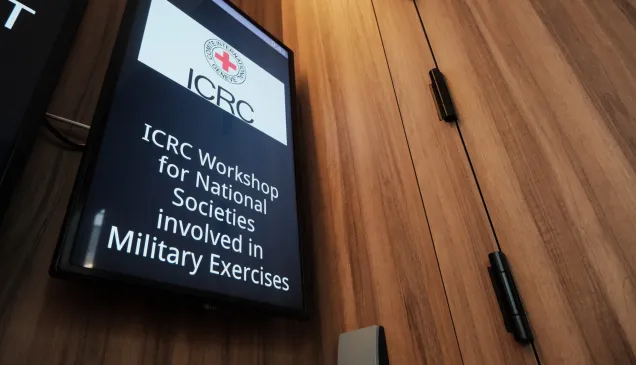
Poland: High level briefing on IHL for the Polish ministries

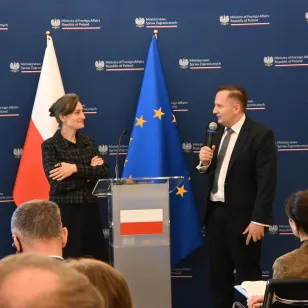
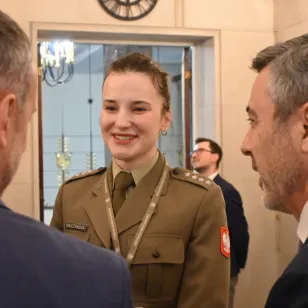
Warsaw, 12 May 2026 – The ICRC Warsaw Regional Delegation, at the invitation of the Polish Ministry of Foreign Affairs (MFA), held a briefing for representatives of Polish ministries. During this event representatives of different ministries – members of the National Committee on IHL - could learn more about the ICRC, the Movement and IHL, and receive answers to their questions on the ICRC’s mandate and international humanitarian law (IHL).
40 officials from the MFA, the Ministry of Defense, the Ministry of Justice and other ministries and institutions were briefed by Cordula Droege, the ICRC’s Chief Legal Officer and Head of the Legal Division about ICRC mandate and role, international humanitarian law, and the challenges of contemporary armed conflicts. The event has provided a useful platform for a high-level exchange of views between Poland and the ICRC.
During her speech, Dr Droege emphasized that IHL is a key tool for protection of human life and dignity in armed conflicts. She outlined the contemporary challenges to IHL, and what can be done to strengthen its respect and to uphold its norms. One of the examples given was the Global Initiative, that Poland has joined, which aims to galvanize political commitment to IHL.
Dr Droege referred to the long history that the ICRC shares with Poland, starting from WWI, when delegates were active in Warsaw until 1925, "helping, inter alia, in the repatriation of former PoWs held in Germany and Russia”. She mentioned the ICRC’s activity in Poland during WWII, as well as visits to leaders and members of the Solidarnosc movement who were deprived of liberty - including former president Lech Walesa - during the martial law period between 1981-1983, and the relief work that was conducted with and by the Polish Red Cross (PRC) in that period.
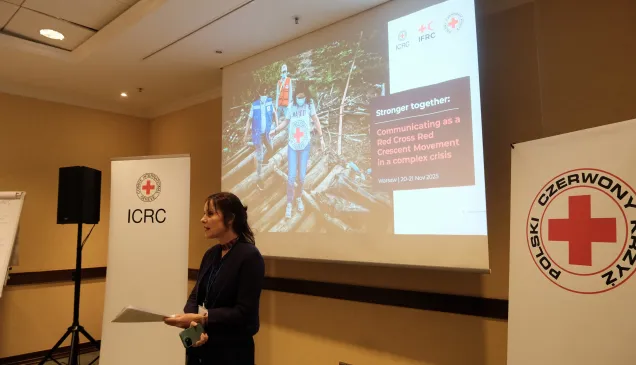
As the ICRC returned to Poland in 2022, following the escalation of the international armed conflict (IAC) between Russia and Ukraine, its work has continued. With the PRC as the convenor in Poland, common activities include work on restoring family links, National Society Development, communication, prevention and crisis preparedness.
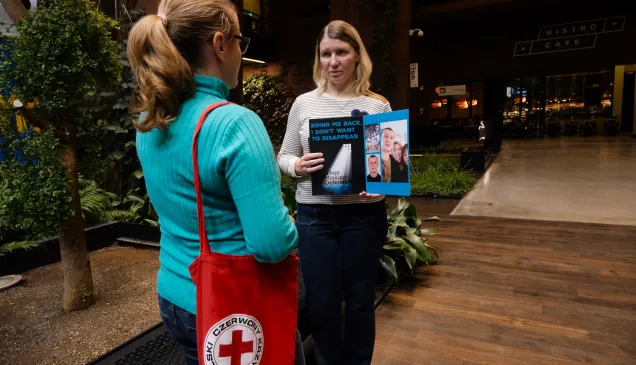
“The ICRC in Warsaw carries out important activities in support to persons affected by the IAC, in cooperation with the PRC, including the tracing of missing persons and the safe border passage program for stranded vulnerable people, wishing to be reunited with relatives in their home country,” said Dr Droege.
The ICRC currently classifies more than 130 armed conflicts around the world, more than it was recorded in previous decades. “We see an increase in wars between states, tectonic political shifts, blurring alliances, and rapid technological advancements, which together exacerbate the risk for more high-intensity conflicts with devastating humanitarian consequences,” said Dr Droege. “At the same time”, she added, “respect for IHL is in crisis, and with it, our shared humanity. Much of this suffering could be prevented if the rules of war are better respected”.
She concluded that in this environment, the ICRC, an organization responding to the horrific consequences of armed conflicts, “has the responsibility to encourage states to de-escalate and not lead the world towards limitless war. However, it is our duty to remind states that responsible conflict preparedness is not measured solely by firepower but demands sustained investment in IHL during peacetime to ensure compliance with it in wartime”.