Russia-Ukraine Armed Conflict: What happens in winter when the power goes out

On both sides of the front line in the armed conflict between Russia and Ukraine, millions of people rely on the provision of essential resources such as water, heating and electricity to survive. As winter sets in, damage to those services endangers lives.

Iryna Shtypa, Deputy Director of a heating company in Chernihiv Oblast, Ukraine.
Heat
Iryna Shtypa describes cold as a lack of colour.
“You don’t enjoy life, you walk all huddled up, your mind doesn’t function properly,” she says.
“When it’s warm, you are fully capable of thinking, you perceive the world differently, in all its colours – rather than black and white.”
Shtypa is the deputy head of a heating company in Chernihiv Oblast, Ukraine. Here, with winter temperatures dropping below zero, heating is a vital service.
To be without heating is a catastrophe. We make the lives of 170,000 people warmer.
With the escalation of armed conflict in February 2022, Shtypa and her husband were forced to leave their home and seek shelter. In the fighting, a boiler house – a critical piece of infrastructure in city heating systems – was destroyed.
It was April. Shtypa knew that rehabilitating a boiler house could take at least six months. The ‘heating season’ began in October. If it wasn’t fixed soon, thousands would be exposed to the bitter cold in their own homes.
But she found a way, explaining the urgent need to a humanitarian organisation that was able to help replace the boiler house just in time – this was how Shtypa first met our colleagues at the ICRC.
“We may just be a technical service,” Shtypa says, “but I believe the fact that we carry on gives hope to all the people who live here.”
In this armed conflict – from Chernihiv to Mariupol, Donetsk to Odesa – the power, heating and water systems that people rely on have faced strike after strike.
These systems are interconnected – heating systems rely on water or gas systems, while all rely on electricity. Damage to one affects another.
Some communities close to the frontlines have gone without basic services for months or years; in cities, electricity is rationed to ensure supply in winter.
“When power is supplied according to a schedule, people often have to wake up at night to start a washing machine, to iron their clothes, to dry their hair with a blow dryer, to cook,” Shtypa says. “Your life turns into a nightmare.”
Shtypa tells us that she, too, has learned to store diesel in jerrycans, chop firewood, use portable gas stoves, keep an emergency ‘grab bag’, store documents in one place and ensure reserves of medicine and water are on hand.
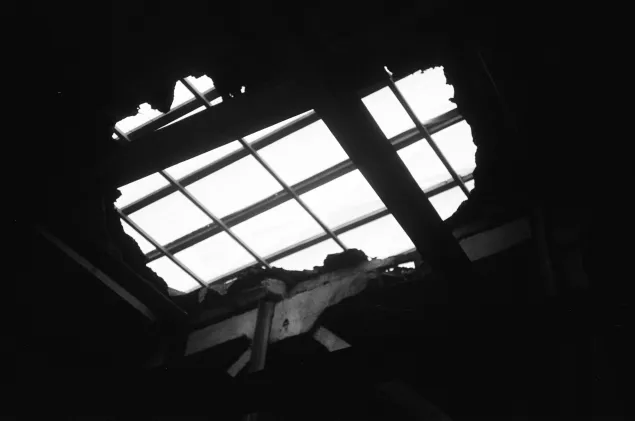
A hole in the roof of a boiler house in Ukraine after being struck by a drone.
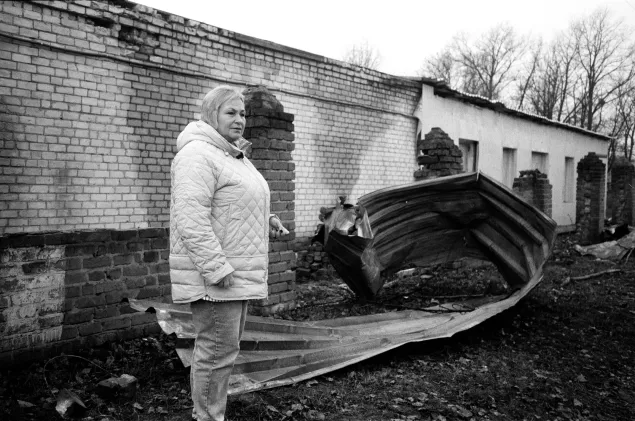
Tetiana Pasmor, Director of a water company in Chuhuiv, Kharkiv Oblast, stands beside wreckage caused by a strike across the road from her office.
Water
Tetiana Pasmor, who heads a local water company in Chuhuiv, Kharkiv Oblast, speaks to us standing in front of broken bricks and twisted metal.
The walls and windows of her office were recently shattered by an explosion across the road. More than 30,000 people rely on the work done from here for water.
Utility systems – like the pipes and pumps of a water company – are as vast as the city they service. In the fighting around Chuhuiv, damage to these systems was widespread.
With the help of others, including the ICRC, that damage was repaired. But, in times of armed conflict, these systems remain vulnerable, often strained to breaking point as the impact of damage compounds over time.
Even when they are spared and it is other essential services that are damaged, water companies feel the consequences.
“When energy infrastructure is hit, there is low voltage in the system and water pumps cannot operate,” Pasmor says. “We have to wait until the voltage stabilises and then start our equipment.”
"For the hours or days when utility providers are prevented from functioning in this armed conflict, backups like generators for electricity are used. But fuel for generators is expensive.”
Pasmor tells us of another challenge: wastewater. “Sewage should be disposed of somehow,” she explains. “Before it is released… it is treated and sanitised. Otherwise, we would be contaminating the environment.”
For some remote communities on either side of the front line, toilets that flush or taps that flow remain a luxury. Many rely on bottled water that can be hazardous to collect and heavy to carry – especially for elderly residents.
Rosa Banos, an ICRC water and habitat specialist working in Donetsk, sees these challenges on the other side of the front line. Over the past months, her team has delivered more than 500,000 litres of potable water to affected communities, as well as pipes, pumps, generators and welding machines to support the rehabilitation of water supply systems.
These efforts are not just about infrastructure—they are about restoring dignity, hope and the basic human right to clean water.
Water is the most important thing for people. Water is life.
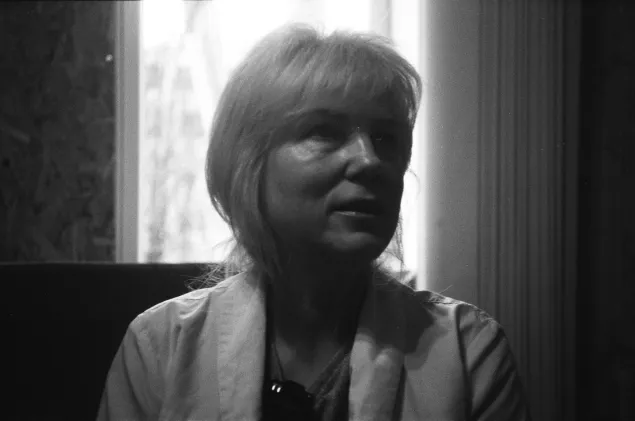
Nina Aleksandrova, director of a primary health centre in Petropavlivka, sitting in front of boarded up windows and with a damaged hospital visible in the background.
Health
In Petropavlivka, the dull thud of explosions echoes out from the distant frontline.
Through the window behind Nina Aleksandrova, we see the ruined roof of a hospital. Damaged in a recent strike, the building is now unusable.
The blast shattered windows in the neighbouring primary health centre where Aleksandrova sits. “My first thoughts were about what could be done to repair the damage,” she says.
Aleksandrova, as a paediatrician by training, has been director of the centre since 2021. More than 10,000 people across more than 30 villages rely on it for primary medical care.
This part of Dnipropetrovsk Oblast in Ukraine is full of farms and coal mines. Common issues at the centre include musculoskeletal problems from years of hard work and, more recently, needs related to mental health.
Removing shattered window frames and boarding them up, staff at the centre were able to reopen and admit patients the first weekday after the strike. Broken glass swept up into piles still lines the walkways outside.
If this building had collapsed, we would have found another place where our work could be organised. The most important thing is that all our employees are alive.
During air alerts, staff at the centre take patients to a nearby underground bomb shelter and continue to treat them there. The work doesn’t stop.
Beyond the impact of ongoing hostilities, Aleksandrova also needs to think about the demands of winter.
Seeking self-sufficiency, the centre relies on a borehole for water and generators for electricity when there are power cuts from the central grid. Local ICRC teams provided fuel to help with heating.
“There are challenges but, as director, I’m supposed to help people,” she says. “After all, there are thousands of people who depend on us.”
In the damaged hospital behind Aleksandrova’s centre, flocks of pigeons now roost.
And the first snow of winter has already fallen.

Pigeons roost in the wreckage of a hospital damaged by strikes in Petropavlivka, Ukraine.