Since December, the ICRC has been providing more tents to boost the capacity of Fizi General Referral Hospital to treat wounded people. On 10 January, an ICRC emergency surgical team was sent to the hospital to help local staff cope with the influx of wounded people.
“On 18 January 2026, 115 wounded people were admitted to the hospital, despite its initial capacity of just 25 beds. Most of the new patients had infected wounds because they had not been seen sooner. Many of them had not received proper treatment to stabilize their condition in the other health facilities they had gone to first,” said Dr Richard Lwandja, a doctor in the hospital.
Such delays are symptomatic of the breakdown in health-care provision in facilities close to combat zones. Many of these front-line facilities, which should be able to treat the wounded, have been paralysed by the fighting and the lack of security in the area, an area characterized by looting, severe shortages of medicines and a lack of health workers, who have been forced to flee for safety.
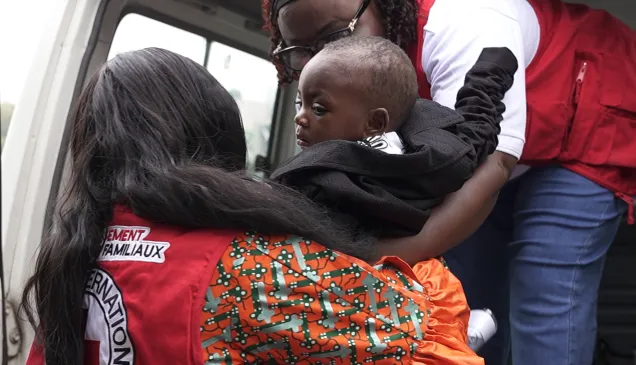
The challenges of transferring wounded patients from one facility to another for treatment are another reason for their late arrival at the hospital. Teams from the ICRC and the Red Cross Society of the Democratic Republic of the Congo had received dozens of requests for the medical evacuation of wounded people stuck near the town of Uvira and in the mountains of Fizi Territory. “It often took our teams several hours to reach the evacuation zone, especially when we couldn’t get security guarantees quickly – which matters, because when it comes to treating wounded people, every minute counts,” said Wendy Fleury, the head of the ICRC’s subdelegation in Bukavu, South Kivu.
The difficulty of getting security guarantees from parties to the conflict can be a major obstacle, preventing humanitarian workers from accessing people in areas affected by the conflict. It can also seriously undermine humanitarian operations. “That’s what happened to one of our surgical teams. They had to travel by road to Fizi from Uvira. It took them six days, when they could have got there in three hours if they’d been allowed to take a boat across the lake. Because we had to take a detour, it cost valuable time before we could treat the wounded,” said François Moreillon, head of the ICRC’s delegation in the country.
The ICRC reminds all parties to the conflict that, in accordance with international humanitarian law, they must:
- facilitate sick and wounded people’s access to health care, which includes the medical evacuation of the sick and wounded, including members of the adverse party
- facilitate access to health facilities
- permit the transport of essential medical supplies
- authorize and facilitate rapid and unhindered humanitarian access to people in need.
In this deteriorating humanitarian situation, the ICRC will continue to work with the parties to the conflict as a neutral intermediary to promote and ensure the existence of a more open humanitarian space and more effective humanitarian access.
What the ICRC did in Fizi Territory in 2025
Since May 2025, the ICRC has been providing a surgery programme in Fizi General Referral Hospital, in particular in response to the lack of access to treatment for wounded people who could not get to the ICRC-supported Provincial General Referral Hospital in Bukavu. Over the past few months, the ICRC’s surgical teams have trained local staff in managing and treating wounded people. Other ICRC teams are renovating hospital wards and an operating theatre, including fixing its wiring. The ICRC is also providing medicines, medical supplies and a salary contribution to staff for six other health facilities in Fizi Territory to make it easier for pregnant women, children and other vulnerable people affected by the armed conflicts to get health care.
In 2025, the ICRC:
- provided support for Fizi General Referral Hospital to treat more than 175 wounded people
- supported six health facilities (Lubichako Health Centre, Niakele Health Centre, Niakele Hospital, Milimba Health Centre, Milimba Hospital and Lulimba Hospital) to:
- treat more than 42,600 patients free of charge
- deliver nearly 1,800 babies free of charge
- transfer more than 2,200 sick people from health centres to hospitals
- donated a motorcycle ambulance to the Red Cross Society of the Democratic Republic of the Congo to facilitate medical evacuations.