The ICRC in 2025: On the front line for humanity, always

In September 2025, the ICRC assisted some 1,200 households of returnees, majority of them being women and children, with essential household items such as sugar, soap, blankets, mosquito nets, cooking oil and beans. More than a million refugees and returnees have arrived in different parts of South Sudan since 15 April 2023 when war broke out in Sudan, putting enormous pressure on the meagre resources available, particularly food and water, but also education and healthcare services.
In 2025, armed conflict continued to shape the lives of millions of people across the globe. Wars dragged on with little respite, new crises emerged, and civilians found themselves trapped in violence that destroyed homes, disrupted essential services and separated families. In many contexts, respect for the rules of war remained fragile, with devastating consequences for people already struggling to survive in unthinkable conditions.
Throughout the year, the International Committee of the Red Cross (ICRC) has worked to help these people. While some crises dominated international attention, many others unfolded far from the headlines. In these often overlooked conflicts, the humanitarian consequences were no less severe.
Whatever the context - whether widely reported or largely forgotten - the ICRC’s approach has remained the same: to stay close to affected communities, alleviate suffering, and uphold the Fundamental Principles of neutrality, impartiality and independence that enable humanitarian action in war.
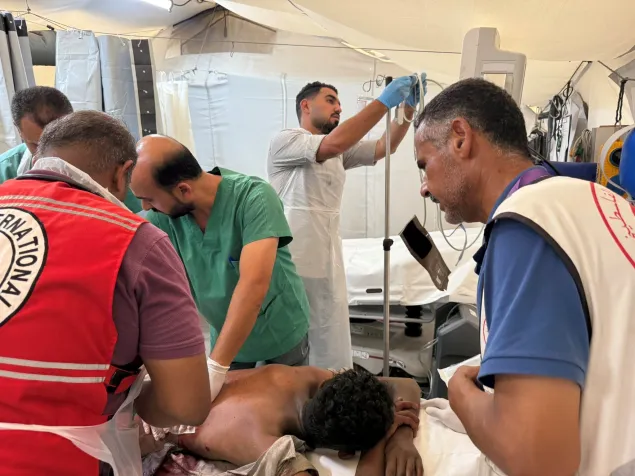
Inside the emergency department of the Red Cross Field Hospital in Gaza during a mass-casualty incident. In the ‘Red Area’, patients in need of immediate, life-saving care - such as to control severe bleeding - are stabilised before being triaged to an operating theatre, another medical facility or a hospital ward.
Delivering health care where it is needed most
In 2025, ensuring access to health care has remained a central pillar of the ICRC’s work for people affected by armed conflict, particularly where health systems have been damaged, overwhelmed or deprived of essential resources.
Across contexts such as Gaza, the Russia-Ukraine international armed conflict, Sudan, South Sudan, eastern Democratic Republic of the Congo and many others, the ICRC has supported hospitals and health-care facilities through the provision of medical supplies, equipment, training and direct operational support. Surgical teams have treated people wounded by weapons, often in facilities operating under extreme pressure, while primary health-care services have continued to reach communities with few alternatives.
In Afghanistan, long-term support to health care and physical rehabilitation services has continued to help people living with disabilities - many as a result of years of conflict - regain mobility and independence. In Myanmar, health support has remained essential amid ongoing violence and access constraints, particularly following the earthquake that further damaged already fragile services.
Our work to support health care for people affected by conflict

25 September, 2025, the ICRC supported Al-Shifa Medical Complex in Gaza City with vital medical supplies and disposables including dressings, stabilizing kits, and infusions - these items are vital for treating those who are weapon-wounded or sick.
Reuniting families and helping people find answers
Helping families stay connected and find answers when loved ones are missing has remained at the heart of the ICRC’s humanitarian mission in 2025.
Through our restoring family links services, the ICRC has facilitated contact between relatives separated by conflict in every corner of the world. For many families, a phone call, a message or confirmation that a loved one is alive has brought relief after months or years of uncertainty.
The ICRC has also continued our work to clarify the fate of missing persons, supporting families in their search for answers and engaging with authorities and parties to conflict on the humane handling of the dead. These efforts have addressed one of the most enduring and painful consequences of armed conflict.

Displaced women and children shelter together in Tawila camp, Sudan, where families have fled to escape fighting, many separated from loved ones and unsure when - or if - they will be reunited.
Visiting and monitoring conditions for people held in places of detention
Everybody has the right to be treated humanely and to live in dignified conditions in places of detention, no matter the reason for their arrest or detention.
In 2025, the ICRC has continued our work for people deprived of their liberty in connection with armed conflict and other situations of violence. Our teams have visited places of detention to assess conditions of detention and treatment, interview people deprived of their liberty, and to engage confidentially with detaining authorities.
These visits have focused on practical issues that directly affect detainees’ lives, including access to food and water, health care, hygiene, accommodation and contact with family members. The ICRC has also facilitated the exchange of family messages and other forms of communication, helping detainees maintain links with their relatives during detention.
Through sustained, confidential dialogue with authorities, we have sought to address concerns identified during visits and to support improvements over time. For people held in detention and for their families, this work has helped ensure that conditions and treatment are monitored by an independent humanitarian actor and that their situation is not overlooked.
Our work to help people deprived of their liberty

ICRC staff on a visit to detainees at Kasnazan Prison in Erbil, Iraq, engaging with authorities to assess conditions of detention and treatment, in line with our mandate to promote humane treatment and maintain contact between people deprived of their liberty and their families.
Restoring water, shelter, power and essential services
In many conflict-affected settings, damage to water systems, housing and basic infrastructure has left people without safe living conditions. In 2025, the ICRC has continued to support access to water, sanitation, shelter and essential services in areas where conflict has disrupted daily life.
In some of the most difficult-to-access places in the world, our teams have repaired water networks, improved access to safe drinking water and supported heating and electricity where possible. These interventions have reduced health risks and helped communities cope with prolonged displacement and instability.
In Myanmar and Afghanistan, earthquake response has been integrated into broader humanitarian activities, addressing immediate needs while reinforcing longer-term support for communities already affected by conflict and other situations of violence.
Our work to safeguard public health

Valentyna Nazaruk, 79, lives in Sukha Kamianka village in Izium district, where only four people remain. Since April 2022, the village has been without electricity after power lines were destroyed during the fighting. Water access is also unreliable, as the river often dries up in summer, leaving wells empty. Valentyna lives with her daughter and grows vegetables in a small garden and a greenhouse provided by the ICRC, helping them meet their daily needs.
Reducing risks from weapon contamination
Long after fighting subsides, explosive remnants of war continue to threaten civilians. In 2025, weapon contamination has remained a major concern.
The ICRC has supported risk-awareness activities, engaged directly with communities on safe behaviour and worked with authorities and partners to reduce the dangers posed by unexploded ordnance and other explosive hazards. These efforts have helped prevent injuries and deaths and enabled safer access to homes, fields and essential services.
Our work to reduce risk from weapon contamination

Schoolchildren at Al-Rawda Al-Muhammadiya Primary School in Ramadi, west Iraq, take part in a session on the dangers of weapon contamination. Many of the students come from families displaced by the 2014–2017 armed conflict and continue to live in areas affected by explosive remnants of war.
Supporting livelihoods and economic security
Beyond immediate relief, the ICRC has continued in 2025 to support people’s ability to meet their basic needs and sustain themselves amid conflict.
In contexts such as Sudan, South Sudan and Afghanistan, economic-security activities have included cash assistance and livelihood support for displaced people, returnees and host communities. These interventions have helped families cope with prolonged instability and regain a degree of self-reliance.
Our work to support people whose livelihoods have been impacted by armed conflict and other situations of violence

Residents in Ethiopia’s Tigray region receive poultry as part of an initiative to promote safer farming and livelihoods in areas affected by weapon contamination.
Protecting civilians through respect for international humanitarian law
Throughout 2025, the ICRC has continued to promote respect for international humanitarian law (IHL) - the legal framework that protects civilians, detainees, medical services and humanitarian workers during armed conflict.
Through confidential dialogue, operational engagement and global advocacy — including the Global Initiative to Galvanise Political Commitment to IHL — the ICRC has worked with States and parties to conflict to reinforce the rules that limit suffering in war.
Our work to uphold the rights of people affected by conflict

Chawky district, Kunar, Afghanistan, the ICRC supports the Afghan Red Crescent Society (ARCS) in its humanitarian response efforts following the deadly earthquake. Assistance has been provided in several key areas, including water supply networks, provision of shelters and tents, and generators of different capacities.
Acting as a neutral intermediary when trust is scarce
Alongside these activities, the ICRC has continued in 2025 to act as a neutral and independent intermediary - a role that often makes humanitarian action possible in the first place.
In the context of Israel and the occupied territories, the ICRC has played a critical role in humanitarian operations related to hostages and detainees, including acting as a trusted intermediary in transfers carried out under extremely sensitive conditions. In the Democratic Republic of the Congo, the organisation has facilitated humanitarian gestures such as the release and transfer of detainees and the safe movement of people across frontlines.
In the Russia-Ukraine international armed conflict and many other contexts, sustained confidential dialogue with the parties has remained essential to enable humanitarian activities and promote respect for international humanitarian law. While often invisible, this intermediary role has had direct consequences for people’s safety and well-being.
Our work as trusted neutral intermediary

Disarmed members of the Democratic Republic of the Congo’s government forces and their families arrive for onward transport from Goma to Kinshasa, a journey of some 2,000 kilometres across the front line, made possible by the ICRC’s role as a neutral intermediary.
Remaining present
As 2025 draws to a close, the ICRC has remained alongside people affected by armed conflict and other situations of violence, continuing our work to protect lives, alleviate suffering and preserve dignity. In conflicts that dominate global attention and in those that remain largely unseen, the organisation’s focus has remained on the people who need our help and the humanitarian principles that guide our action.

Goma, DRC, February 2025