International Day of Persons with Disabilities: Stories of Survival and Rehabilitation in Myanmar
In Myanmar, thousands of people live with the physical and emotional consequences of war-related injuries. Landmines, explosive remnants of war (ERW), and armed violence continue to cause life-changing harm, especially in remote and conflict-affected areas, where access to health care remains extremely limited.

On the International Day of Persons with Disabilities, the ICRC is spotlighting the experiences of people living with disabilities in Myanmar and the long-term support required to help them recover, adapt, and move forward. Many face lifelong social, physical, and economic hardship and require long-term rehabilitation to regain mobility and prevent further complications.
“I Don’t Want Anyone Else to Go Through What I Did”
Ma Myint Myint Khaing, a mother of two from Bago Region, was injured when a landmine exploded while she was picking beans near her village.
“At first, I didn’t realise what had happened. I just felt something sticky on my leg. Then I saw that my foot and part of my leg were gone,” she recalls.
“No one dared to help at first. I had to hop alone to the embankment. Only later at the hospital did I learn that my eye had also been injured.”
Now undergoing physical rehabilitation at the Hpa-an Physical Rehabilitation Centre, she has been fitted with a prosthetic leg and is slowly regaining independence.
“Now that I have a leg, I’ll try my best.”
Daw Nang Htay was injured in a landmine explosion while showing a friend’s house for sale to a group of guests in Hsihseng Township.
“There were more than 20 of us that day. I was the only one injured. I stepped on a landmine near a water tank while washing my hands. The blast left me with injuries to my leg, hand, and forehead.”
She is now receiving physical rehabilitation at the Kyaing Tong Physical Rehabilitation Centre, supported by the ICRC.
“Now that I have a leg, I feel relieved. I plan to work again. I can no longer do hard labour, so I’ll try to sell things at the market. I won’t give up.”
Myanmar: One of the Most Heavily Contaminated Countries in the World
Myanmar remains one of the most heavily contaminated countries in the world, with landmines and explosive remnants of war continuing to cause civilian harm. Monitoring of landmine and other explosive ordnance incidents in the first half of 2025 indicates a total of 357 civilian casualties (killed and injured)—already accounting for 33% of the total recorded in 2024 (1,082 casualties).
Children represent 27% of the reported casualties, highlighting the severe risk these weapons pose to the most vulnerable. Beyond the physical injuries, contamination also limits access to essential services, farmland, and safe movement—deepening humanitarian needs in affected areas.
“They stepped on it and ran…”
In Myitkyina, U Zahkung La is caring for his seven-year-old son, who lost a limb when a landmine exploded as he and his cousin were playing just outside their home.
“They found it and played with it. Nothing happened at first,” he said. “Then they stepped on it—and it exploded. It changed everything.”
His son is now receiving care at the Myitkyina Physical Rehabilitation Centre.
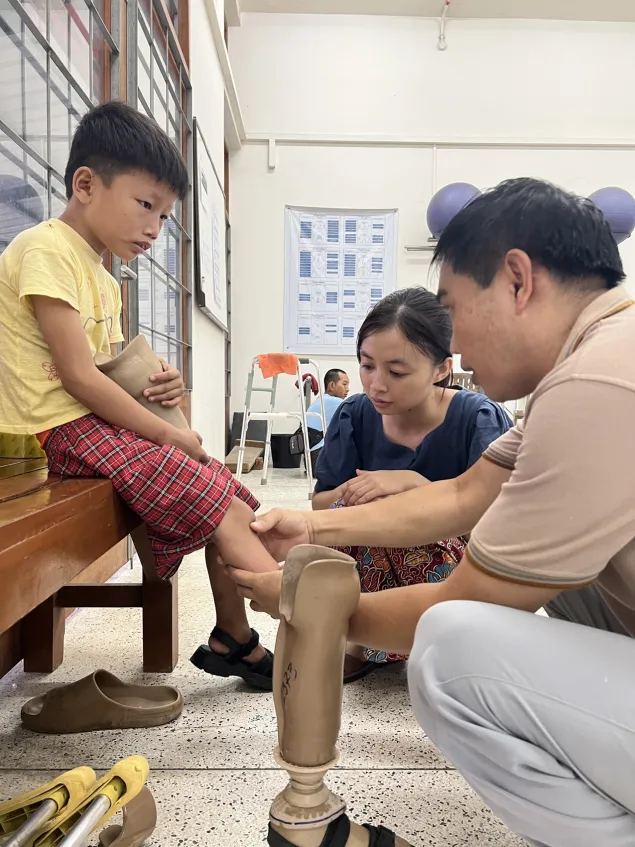
Seven-year-old Hkam Je is quietly fitted with a new prosthetic leg at the Myitkyina rehabilitation centre. Injured by a landmine blast while playing outside his home, he is now learning to walk again with the support of his father U Zahkung La and the ICRC team.
Restoring Movement, Rebuilding Lives
The ICRC supports several physical rehabilitation centres across Myanmar, including in Yangon, Myitkyina, Kyaing Tong, and Hpa-an, in partnership with the Ministry of Health, the Myanmar Red Cross Society, and others, to enhance staff capacity and improve the quality of rehabilitation services.
Since 2021, more than 19,000 people with disabilities—including landmine survivors, weapon-wounded individuals, and those affected by natural disasters—have received care through these facilities. This includes a dedicated response to the March 2025 earthquake, which injured hundreds and damaged essential infrastructure. In its aftermath, the ICRC deployed prosthetics and rehabilitation specialists, delivered emergency mobility devices and physiotherapy kits, and helped train local staff to support recovery efforts in Mandalay.
Support at these centres includes prosthetics, orthotics, wheelchair services, mobility aids, psychosocial assistance, and social inclusion support, including sports, education, and vocational support. The ICRC also invests in local production and technical training to ensure continuity of care.