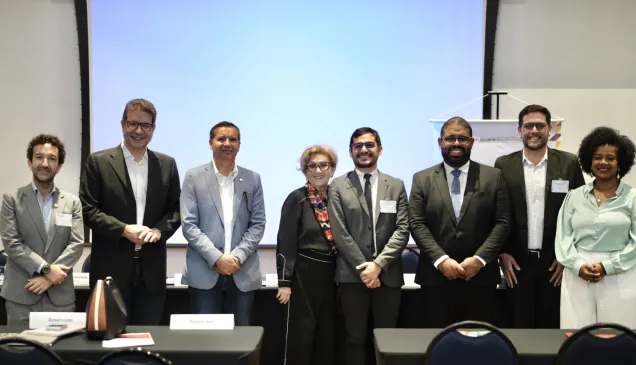
High-level meetings took place with Chief Advisor to the Presidency Celso Amorim, Ambassador Marcio Cozendey from the Ministry of Foreign Affairs (MFA), Minister of Justice Wellington César Lima e Silva and Minister of Human Rights and Citizenship Janine Melo.
The director-general had the opportunity to interact with families of missing persons as well as professionals from the Access programme, an initiative implemented by the ICRC in areas affected by armed violence to improve access to essential services and foster resilience within vulnerable communities.
“Communities should be spared from confrontations. Access to basic services such as health or education should be preserved,” said Krähenbühl. “Seeing the interest in other parts of Brazil to replicate the Access programme is a testament to its impact to protect lives and dignity in the face of armed violence.”
Pierre Krähenbühl participated in events organized in partnership with the BRICS Policy Center/PUC-Rio and the Institute of International Relations (USP-SP) to reflect on the intersection between geopolitics, humanitarian action, and the challenges of multilateralism. “We need to pursue sustained efforts to prevent and resolve conflicts, alongside respect for international humanitarian law, to reduce the human cost of war and its long-term impact on societies”, said Krähenbühl.
He also highlighted Brazil’s role as a leading country in the Global Initiative to galvanize political commitment to international humanitarian law, noting the importance of committed states in strengthening protection for those affected by armed conflicts.
About the work of the ICRC in Brazil
The ICRC has worked in Brazil since 1991. Its regional delegation for Argentina, Brazil, Chile, Paraguay and Uruguay, based in Brasilia, works to strengthen relationships with those countries’ governments.
The ICRC works in Brazil in collaboration with the federal and local governments, organizations and communities to strengthen the response to the humanitarian consequences of armed violence. It provides support to families searching for their loved ones and promotes enhancing mechanisms for their identification and protection.
For more information, please contact:
Fabíola Góis fgois@icrc.org + 55 61 8248-7600