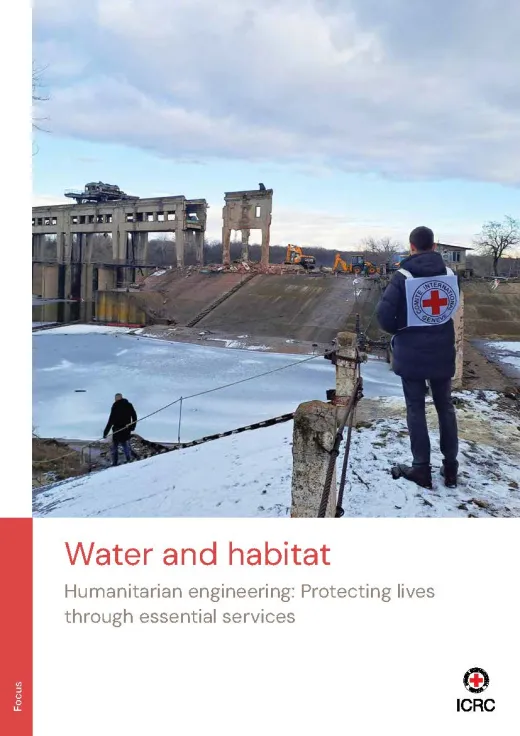
For over 40 years, the ICRC’s Water and Habitat (WatHab) programme has worked at the frontline of armed conflict, where survival depends not only on medical care, but on water, sanitation, energy, and functioning infrastructure. This photobook traces that evolution—from emergency relief in the 1980s to today’s complex, system-wide interventions in urban wars and protracted crises.
Through powerful field examples—from Iraq and Syria to Gaza, Ukraine, and beyond—it shows how engineering becomes a form of protection: keeping hospitals running, restoring water to cities under fire, and ensuring humane conditions in places of detention. It also highlights WatHab’s unique role as a neutral intermediary, bridging technical expertise and humanitarian diplomacy to safeguard essential services.
Blending narrative, field insights, and forward-looking approaches, this publication offers a clear perspective on why protecting infrastructure is critical to protecting civilians today—and how humanitarian engineering is adapting to a world shaped by conflict, climate change, and growing urban fragility.