China: High-Level Dialogue Examines Middle East Crisis and International Cooperation

The International Committee of the Red Cross (ICRC) and the Global Governance Institution (GGI) held a closed-door exchange on February 4th to discuss humanitarian challenges in the Middle East and potential pathways for international cooperation.
The event, titled “Humanitarian Action in Conflict: Middle East Realities and International Cooperation,” convened approximately 20 participants, including experts, researchers, and international practitioners from the China Academy of International Trade and Economic Cooperation, Peking University, the University of International Business and Economics in Beijing, Tongji University, Sichuan University, the Peaceland Foundation, and the Eternal Love Foundation.
ICRC provided a first-hand understanding of ground realities of several conflicts currently affecting the Middle East, situating humanitarian issues within the broader context of regional security and major power dynamics, and identifying shared interests and potential avenues for collaboration between China and international humanitarian organizations.
Crises managed, not resolved
Moderated by GGI Vice President Shen Weizhong, the event opened with a multi-faceted briefing on the humanitarian landscape, spillover effects of conflicts, and ICRC operations in the Middle East by Nicolas von Arx, ICRC Director for the Near and Middle East.
Citing first-hand experience in the field in the Middle East, Von Arx began by describing the security challenges and volatile operating environment for the ICRC and other humanitarian organisations in the Middle East, referring to armed conflicts in Gaza, Yemen and Syria and the huge gap in humanitarian response due to the departure of most humanitarian organizations.
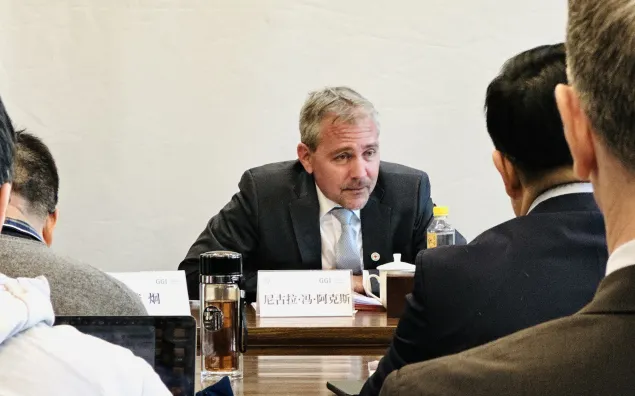
Nicolas von Arx, ICRC Director for the Near and Middle East, gave a multi-faceted briefing on the humanitarian landscape, spillover effects of conflicts, and ICRC operations in the Middle East.
“What is happening is that these crises are being managed, and not resolved,” he said, calling for increased international political action and will to address the increasing humanitarian needs and dwindling funding.
He pointed out that the erosion of respect for international humanitarian law (IHL) has led to more dire consequences on the ground, noting that the world faces the risk of being reduced to the law of the jungle.
Role of principled humanitarian action
Von Arx emphasized that adherence to the principle of neutrality is a prerequisite to operating safely and effectively in contexts with complicated power structures.
The ICRC frequently plays the role of a neutral humanitarian intermediary in armed conflict. For example, it recently completed a months-long operation to facilitate the return of Israeli hostages and detainees, as well as deceased Palestinians.
‘However, principled humanitarian action is under increasing pressure. Neutrality is often misunderstood or demonized,’ he said, adding that the ICRC was frequent attacked on social media, via email, and in person, further endangering humanitarian actors on the ground.
He also pointed towards an increasing tolerance of blatant violations of IHL; the killing and maiming of civilians, attacks on hospitals and schools, the destruction of civilian infrastructure – a dangerous and worrying trend which, he observed, “will haunt us for generations”.
China’s evolving role
The exchange also highlighted China’s long-standing concerns in the Middle East, including regional stability, civilian protection, and multilateralism. John Gong, GGI Research Fellow, and Balthasar Staehelin, Head of the ICRC Regional Delegation for East Asia in Beijing, explored how China’s diplomatic mediation and development assistance can support humanitarian efforts.
In light of the diminishing respect for IHL, Staehelin commended China for joining the Global Initiative on IHL launched in September 2024 alongside Brazil, France, Jordan, Kazakhstan, and South Africa, and the ICRC. The global initiative aims to galvanize political commitment in support of international humanitarian law. This joint effort to strengthen IHL complements a renewed global focus on advancing peace agendas, reinforcing civilian protection, and strengthening global governance systems, thus ensuring more effective international cooperation and protection for those affected by armed conflict.
The commentators encouraged China, to step up its financial and political support for global humanitarian action, and to apply its substantial weight and influence to promote respect for IHL in armed conflicts worldwide.