Jordan: Facts and Figures - January to December 2025

The ICRC delegation in Jordan continued to play a vital role in addressing the humanitarian needs of vulnerable communities and promoting the principles of International Humanitarian Law (IHL).
2025 Overview
The Delegation specifically focused on supporting families of missing persons, refugees, detainees, and other affected populations, particularly in the context of the Syrian conflict and broader regional challenges, in close collaboration with partners and stakeholders, including the Jordan National Red Crescent Society (JNRCS) and relevant governmental, diplomatic, humanitarian, and security actors.
In addition to supporting families of missing persons in their search for answers and clarification of the fate of their loved ones, the delegation accompanied affected families by providing psychosocial support, legal and financial assistance, and livelihood support to help them cope with the profound challenges they endure.
The delegation also worked to uphold the dignity of detainees through conducting regular visits to places of detention, maintaining detainees’ family links, and enhancing healthcare services in correctional facilities.
The ICRC delegation in Jordan remains a regional hub for promoting IHL and humanitarian principles. As an important step in deepening cooperation between Jordan, the ICRC, and Arab States, and in reaffirming the shared responsibility to uphold humanity during armed conflicts, a high-level regional conference on IHL was organized in Jordan. This conference marked a key milestone in the Global Initiative to Galvanize Political Commitment to IHL; a joint initiative launched by Brazil, China, France, Jordan, Kazakhstan, South Africa, and the ICRC to make respect for IHL a political priority amid an estimated 130 ongoing armed conflicts worldwide.
Additionally, various workshops and training sessions were held for military personnel, legal professionals, students, and government officials. These initiatives aimed to enhance the understanding and implementation of IHL at both national and regional levels. At the same time these efforts highlighted Jordan’s pivotal role as a key partner in advancing humanitarian diplomacy and fostering capacity-building across the region.
Throughout 2025, the ICRC has sustained its collaborative partnership with the JNRCS, focusing on capacity-building efforts to strengthen the JNRCS's preparedness capabilities and its auxiliary role with local authorities. Additionally, the ICRC has supported key communication initiatives to enhance the visibility of the JNRCS as a strategic humanitarian partner.
The Amman Logistics Support Center continued to serve as a crucial regional hub for the delivery of humanitarian aid and essential supplies, including medical consumables and equipment, relief items, and other goods to conflict-affected areas such as Gaza, Yemen, Syria and beyond.

Highlights of our work in Jordan - January to December 2025
Supporting families of missing persons
- 1,188 beneficiaries were visited jointly with the Jordan Red Crescent Society (JNRCS), and 50 sessions were organized with Community-Based Organization staff/volunteers in host communities and refugee camps to explain the ICRC activities and available services for families of missing persons as a result of the conflict in Syria.
- 2,100 enquirers were contacted either by phone or through home visits to exchange news about their missing relatives: 1,998 contacts linked with the conflict in Syria and 102 related to other related circumstances outside the Syrian context.
- 384 beneficiaries were visited in their homes across the country to assess their situation and needs.
- 279 new missing cases were collected from families of missing persons: 231 linked with the conflict in Syria and 48 related to other related circumstances outside the Syrian context.
- 1,045 individuals improved their livelihoods by receiving Micro Economic Initiative (MEI) grants to start income generating activities as part of the families of missing persons Accompaniment Programme.
- 738 individuals received unconditional cash in the startup phase of the livelihoods project to meet their basic needs.
- 1,319 individuals received winterization support to help cover heating expenses and other essential needs.
- 144 individuals received business management training, including a legal session on the new work permit and business registration regulations, to improve their management skills.
- 314 families of missing persons as a result of the conflict in Syria received advice and support to meet their administrative, legal, financial, psychosocial, and other needs, including 238 families that were assisted with emergency cash.
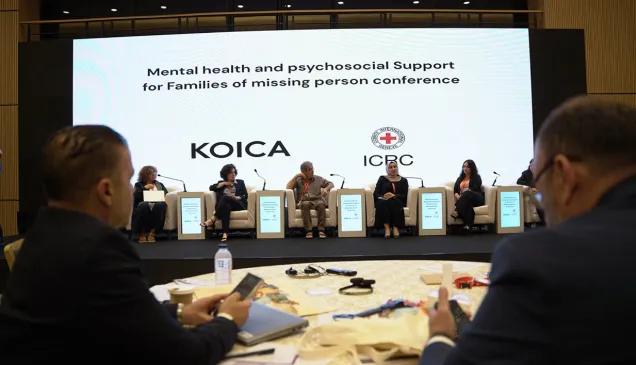
- 176 Mental Health and Psychosocial Support (MHPSS) sessions were delivered in Amman and other Governorates for 442 beneficiaries, family members of missing persons as a result of the conflict in Syria.
Ensuring respect for the dignity of people deprived of their liberty
- 231 detainees were followed up individually, including 174 who were registered during 26 visits carried out across 15 places of detention.
- 81 foreign detainees were notified to their respective embassies, UNHCR or UNRWA.
- 70 Red Cross Messages were collected and distributed to detainees from their families.
- 32 visits were conducted in places of detention and 5 workshops with the Ministry of Health (MoH) and Correctional and Rehabilitation Centers Directorate (CRCD) Penitentiary Health focal points have been completed to strengthen and improve the health system in CRCs.
- 67 Health Care Workers from CRCs across the country benefited from capacity building training during 2 workshops.
Refugees right
- 18 family visits were facilitated from Azraq Camp to CRCs as part of protecting family links program.
- 32 families were referred to external service providers to address their specific needs, with some families receiving more than one referral, resulting in a total of 68 referrals.
- 237 people participated in 24 focus groups discussions aiming at understanding the motives and barriers behind refugees’ intention of return as part of the ICRC’s evidence-based engagement to ensure that returns are voluntary, safe, dignified, and sustainable.
Promoting respect for International Humanitarian Law (IHL) and other humanitarian principles
- 15 Arab States participated in a high-level regional conference held in Jordan on the Global IHL initiative in close collaboration with Jordan Ministry of Foreign Affairs and Expatriates and the Arab Leagues of states.
- 14 Jordanian universities participated in the National Moot court competition on IHL.
- 1 regional experts' meeting was held on the legal status of the missing.
- A memorandum of understanding (MoU) was signed with the Judicial Institute of Jordan (JIJ) aimed at strengthening collaboration on the dissemination and implementation of IHL in Jordan.
- 66 students from the Judicial Institute of Jordan (JIJ) attended two IHL workshops.
- 30 senior judges and prosecutors attended an IHL workshop on the legal and humanitarian constraints facing IHL.
- 55 lawyers attended a 2 -days workshop on IHL in collaboration with Jordan’s National Commission of the International Humanitarian Law (NCIHL).
- 4 NCIHL members attended the Thirteenth Regional Meeting for Arab National Committees on IHL.
- 3-day IHL workshop was conducted in collaboration with the Qatari and Jordanian NCIHLs.
- 351 law students from public and private universities in Jordan attended IHL sessions and seminars.
- 2 academic professors participated in the regional IHL course in Egypt.
- 25 persons from the Ministry of Interior attended an IHL dissemination organized in collaboration with NCIHL.
- 1 session was held with Justice Center for Legal Aid lawyers on the legal challenges faced by families of missing persons.
- 40 students attended an online IHL training.
- 1 high-ranking officer from the Public Security Directorate (PSD) participated in the Senior Workshop on International Rules Governing Police Operations (SWIRPO) Conference held in Bogotá, Colombia.
- 2 common curricula were developed as part of the integration of international human rights law — the legal use of force, search and seizure — and were officially presented during the training of Trainers Course for the second curriculum, which included (16) trainees, where these trainers were involved in holding 4 workshops with the participation of 70 officers (30 Female), and 4 technical meetings of the committee of the third curriculum on" Arrest and Detention" were held, which expected to be completed in the first of 2026.
- 863 officers from the Public Security Directorate (PSD), including 121 females, took part in 59 events and workshops on International Human Rights Law (IHRL).
- 71 officers participated in 5 joint events conducted with the Syrian Refugee Affairs Directorate (SRAD) on the protection of refugees’ rights, family links, and missing persons.
- 2 PSD senior officers participated in the IHRL course in San Remo-Italy.
- 21 senior officers representing 13 countries participated in the Regional Consultation Roundtable on the Integration of IHL in the Military Decision-Making Process for the NAME and North Africa regions, hosted jointly with the Jordan Armed Forces (JAF).
- 802 JAF Personnel including 126 females, took part in 17 events (sessions, Workshops and training for trainers’ courses (ToT) on IHL.
- 47 JAF officers participated in 3 workshops conducted with the Military Judiciary Directorate for unit commanders and Operations Legal Advisors (OPLEGADs).
- 36 participants from Peace Operations Training Center attended 2 ToT courses on IHL challenges and updates.
- 12 IHL sessions were conducted for different JAF training centers and colleges.
- 5 JAF officers participated in IHL courses in San Remo/Italy.
- 2 JAF officers participated in the Global Initiative to galvanize political commitment to International Humanitarian Law (GIIHL).
- 1 Colonel participated in the Regional IHL course in Luxor, Egypt.
- 1 JAF Colonel participated in the Senior Workshop on International Rules Governing Military Operations (SWIRMO) Conference held in Riyadh, Kingdom of Saudia Arabia.
- 30 Defense Attachés and 20 senior officers from JAF and PSD attended a session on IHL and the ICRC’s operations in the region organized with the Swiss Embassy in Amman.

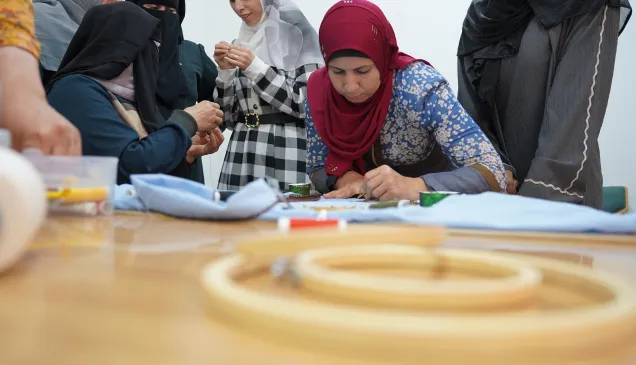
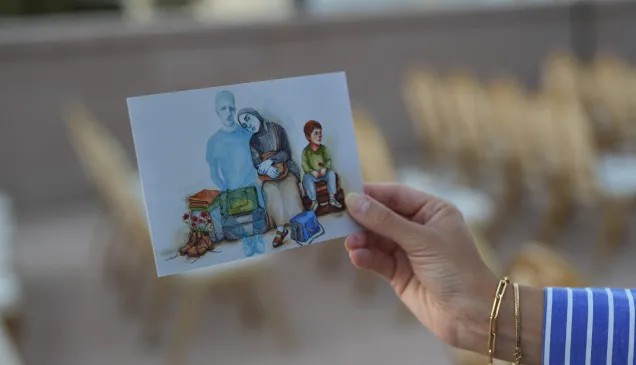
Families of missing persons due to the conflict in Syria during an MHPSS activity to gather belongings of their missing loved ones in a memory box to keep these memories alive.
Partnership with the Jordanian National Red Crescent Society (JNRCS)
- 200 Red Crescent Action Team (RCAT) volunteers were deployed at 9 national events with first aid services provided for 496 medical cases.
- 107 community members, including ICRC staff and Teachers, received basic first aid training toward strengthening community first aid capacity in Jordan.
- 90 military nurses at the Princess Muna Academy were trained on first aid level 1 as part of the Royal Medical Services compulsory graduate learning curriculum.
- 43 volunteers from 7 governorates in the south and central regions were trained as RCAT members in emergency preparedness techniques including practical field scenarios.
- 1,788 phone calls facilitated for refugees residing in Azraq and Zaatari camps to connect with their families abroad in an action implemented jointly.
- 4 Protection of Family Links Open Days were jointly organized in the southern governorates to raise community awareness of JNRCS and ICRC PFL services available to affected populations.
- 19 volunteers from different governorates participated in a Protection of Family Links (PFL) workshop to refresh their knowledge, exchange updates, and share lessons learned and experiences.
- 8 visits to JNRCS branches took place to meet with the heads of branches and PFL volunteers to exchange on the protection of family links needs of affected populations and PFL activities carried out at branch level.
- 60 volunteers from the middle, northern, and southern regions of Jordan were reinforced through the Red Cross Red Crescent Movement (RCRC) Induction courses.
- 65 focal point volunteers from the central and southern regions of Jordan were trained to build their capacity in content creation through the mobile journalism workshop.
- 168 school students were sensitised on the International RCRC Movement, as well as the role and activities of the JNRCS across the country.
- 30 master’s degree students at the Jordan Media Institute were introduced to the International RCRC Movement and the activities of the JNRCS across the country.
- 35 representatives from ministries, government and security institutions, and the PSD were sensitized on the International RCRC Movement and the auxiliary role played by the JNRCS, in coordination with local authorities and the RCRC partners in Jordan.
- 25 journalists were trained on the use of artificial intelligence tools.
- 26 JNRCS staff attended a dissemination session on IHL.
The Regional Logistics Support Center
- 29 million CHF worth of goods and services—including 8,422 tonnes of humanitarian aid and supplies were shipped primarily to Gaza, Yemen, Syria, and other countries, from the Regional Logistics Support Center in Amman.