Afghanistan: Father embraces son-in-law for first time in years

"My heart is melting when I think I am going to see my son-in-law for the first time in six years." Jamal Sardar, Afghanistan
Jamal Sardar recently travelled to Pul-i-Charkhi prison, Afghanistan, with Shah Nazar and his brother Noor Allah. All three are from Farah Rod village in Bala Buluk. With the help of his son, Jamal cultivates a piece of land that is only just sufficient to sustain the family of 25 souls living on the farm.
One of his sons-in-law was arrested six years ago and spent five years in Herat prison before being transferred to Pul-i-Charkhi a year ago. The family was not able to spare enough money for the short trip to visit him in Herat, so travelling to Kabul was unthinkable.
"Recently, I met an employee of the Afghan Red Crescent who told me the ICRC could help me visit my son-in-law," Jamal explains. Subsequently, the ICRC office in Farah organized a trip to Kabul, paying for his travel, accommodation and food.
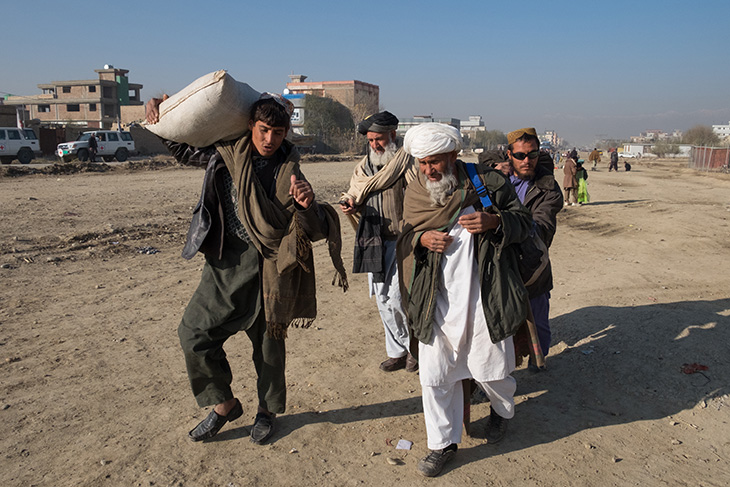
Allah Noor, Haji Shahzada, Jamal Sardar and Shah Nazar (left to right) arrive at Pul-i-Charkhi prison after a taxi ride from Kabul, Afghanistan. CC BY-NC-ND / ICRC / Olivier Moeckli
On the day of the visit, Jamal left with Shah Nazar and Noor Allah at five in the morning, travelling by taxi to Farah, from where they took a bus to Kabul – a 17-hour journey that is both exhausting and risky. "On the way, the bus was stopped by thieves who boarded the bus," says Jamal. "Luckily, just at the same moment, a vehicle from the Afghan army arrived and the thieves left in a hurry before they had time to harm or rob anybody."
Upon his arrival in Kabul the day before the visit, Jamal was exhausted, but he did not care. "I made a long trip, but I am so happy. My heart is melting when I think I am going to see my son-in-law for the first time in six years."
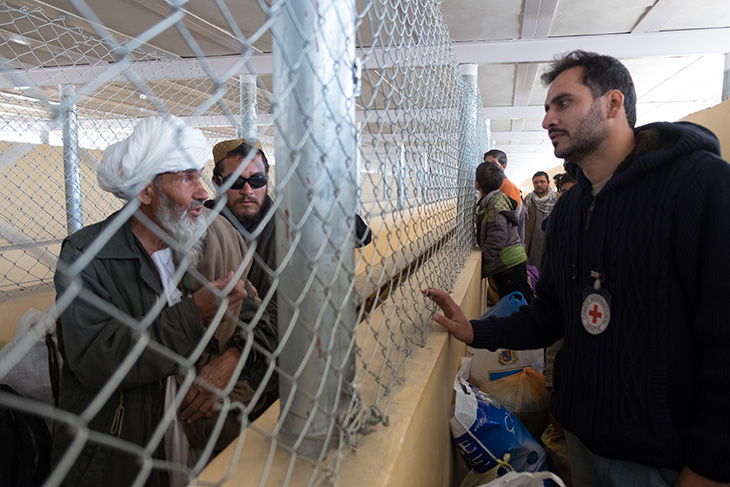
Jamal Sardar talks with Fawad, the ICRC employee who organized their visit. The waiting area was built this year by the ICRC. Before its construction, people had to walk a long distance and queue under the sun or in rain or snow. CC BY-NC-ND / ICRC / Olivier Moeckli
On the day of the visit, Jamal kept quiet most of the time, patiently guiding the blind Shah Nazar all the way to the prison block. After embracing his son-in-law, Jamal had to sit and started crying, overwhelmed by emotion.
After the visit, while he was describing all the details of the conversation to Shah Nazar walking behind him, Shah Nazar laughed: "Oh, uncle! Now you can't stop talking, but all the time you were inside you did not say a word!"
"Well, inside, I could not stop crying! I am an old man and I thought I would never have a chance to see him again in my life."