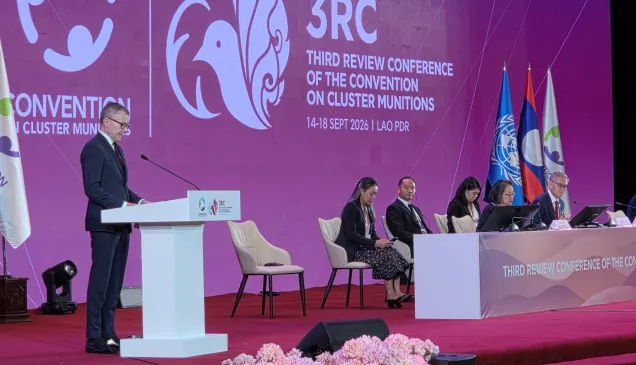
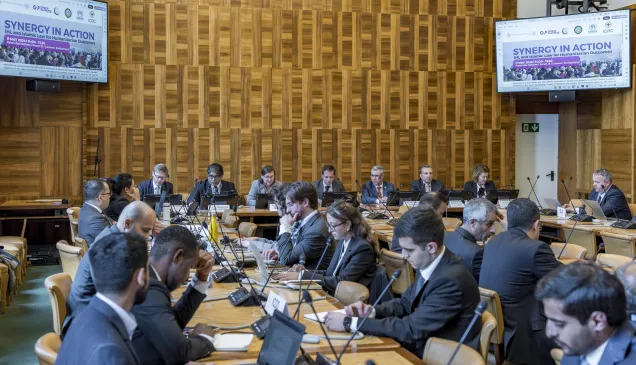
These weapons do not just kill; they leave scars that last for decades, denying people access to farmland, schools and hospitals, and forcing entire communities to live in fear.
In northern Iraq, 16-year-old Sirwan Nabi was herding sheep near his home when he noticed a small, shiny object on the ground. Thinking it was harmless, he picked it up – and it immediately exploded in his hand. The explosion cost him his right hand and left fragments of metal in his legs.
“This incident changed 90 per cent of my life,” Sirwan says. “I can’t do many things like before. Writing is hard. Eating is hard. But I am grateful to be alive.”
Now 18, Sirwan is determined to continue his education, though he remains years behind his classmates. His story highlights the long-term human impact of explosive remnants of war.
From Southeast Europe to Southeast Asia, these weapons remain a daily threat. Mines from the 1990s are still being cleared in the Balkans. In Cambodia, contamination dates back to the 1970s. In Laos, unexploded ordnance from conflicts over half a century ago still endangers civilians. Alongside landmines, other explosive munitions that failed to detonate continue to contaminate the land, hindering recovery and reconstruction while underscoring the need for sustained clearance, risk awareness and prevention efforts.
Despite claims of military utility, history shows that landmines are ineffective in modern warfare. During the Gulf War in 1991, Iraq planted nearly 9 million landmines, believing they would slow advancing forces for days. In reality, those minefields were breached in just hours using modern equipment, while the deadly legacy for civilians has lasted decades.
“There is no such thing as a ‘safe’ anti-personnel mine,” said Fahad Ahmed, an ICRC legal adviser. “These weapons are victim-activated, cause indiscriminate harm and leave deadly hazards for generations. Compared to the massive human suffering they cause, one can question whether these weapons retain any operational relevance. These weapons belong in the past and must stay in the past.”
The Anti-Personnel Mine Ban Convention (APMBC) has been a global success. Since its adoption, it has dramatically reduced casualties, destroyed more than 55 million stockpiled mines and established a near-universal rejection of these weapons. Today, 161 countries are party to the Convention, proving that progress is possible. The recent accession of the Marshall Islands and Tonga in 2025 further highlights the treaty’s continued relevance and the growing global commitment to a world free of anti-personnel mines.
But this progress is fragile. Any step back risks reversing decades of humanitarian gains and condemning future generations to live in fear of these indiscriminate killers.
The global community must act now. States that have joined the treaty must fully implement their obligations. Those that have not yet joined must do so without delay. Protecting civilians today – and safeguarding future generations – depends on maintaining and strengthening the global ban.
Note to Editors: The ICRC distributes information exclusively through its website and official ICRC channels. To avoid unverified and manipulated content, journalists and readers are encouraged to carefully consider and verify the source of all images, videos and eyewitness accounts attributed to the ICRC.
About the ICRC
The International Committee of the Red Cross (ICRC) is a neutral, impartial and independent organization with an exclusively humanitarian mandate that stems from the Geneva Conventions of 1949. It helps people around the world affected by armed conflict and other violence, doing everything it can to protect their lives and dignity and to relieve their suffering, often alongside its Red Cross and Red Crescent partners.
For more information, please contact:
Press Office, ICRC Geneva, email: press@icrc.org