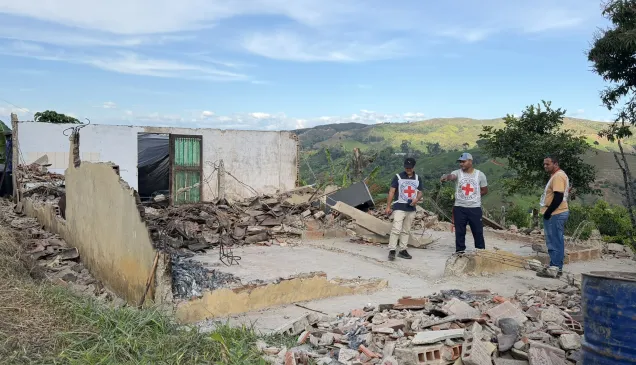
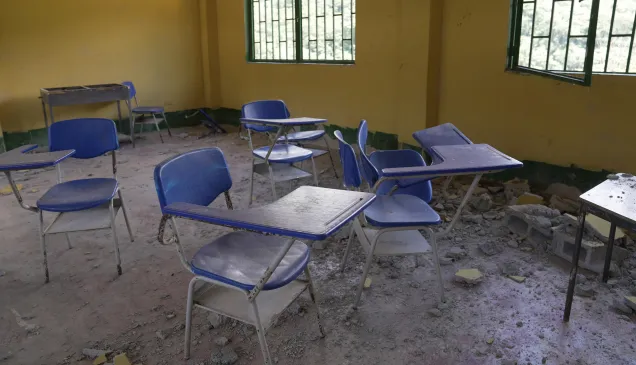
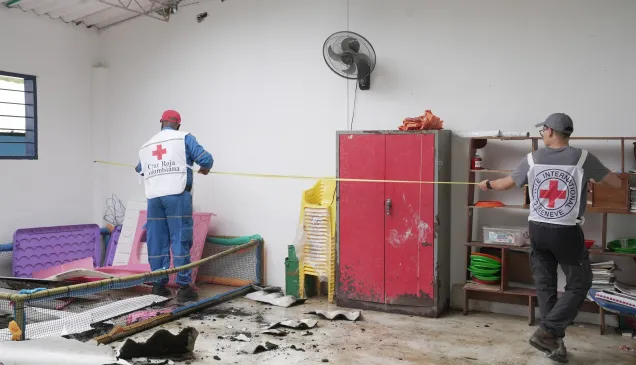
The ICRC's annual report on the humanitarian situation in Colombia contains alarming figures: for 2025, it documented 965 people killed or injured by explosive devices – most of them civilians – a third more cases compared with the previous year. The number of individual disappearances doubled to 308 in 2025, while alleged violations of international humanitarian law documented by the ICRC reached 845 cases.
"The humanitarian situation in 2025 is the result of a progressive deterioration that the ICRC has warned about since 2018," said Olivier Dubois, head of the ICRC regional delegation in Bogotá. "Civilians are experiencing increasingly serious consequences as a result."
In several areas, fighting repeatedly occurred in populated areas, putting communities directly in the line of fire. This caused deaths, injuries, displacement and lack of access to essential services. There was a rise in the use of explosive devices and drones, creating fear among rural and urban communities.
Civilians also faced killings, disappearances, threats and sexual violence, while children and adolescents were recruited and used in the armed conflicts.
The crisis was concentrated in specific regions. Almost half (46%) of those killed or injured by explosives were recorded in Cauca, while two thirds of mass displacement cases were concentrated in Norte de Santander.
The 845 cases of alleged violations of international humanitarian law recorded in 2025 are only those ICRC has directly documented.
Most violations occurred outside the conduct of hostilities, and affected civilians or persons deprived of liberty. Other cases happened during hostilities, when parties failed to take necessary precautions to protect civilians.
"In armed conflicts, the impact on civilians depends largely on the decisions made by the parties to the conflict. When humanitarian law is not respected, those decisions cause direct harm to people's lives and dignity," Dubois said.
The ICRC emphasizes that respect for international humanitarian law is not optional. Parties to a conflict should avoid, as far as possible, fighting in populated areas, take all feasible precautions to protect civilians, and refrain from using means and methods of warfare with indiscriminate effects or that cause excessive harm or unnecessary suffering.
Parties to a conflict must also respect and protect those who do not, or who no longer, take part in hostilities, and avoid any form of violence against them.
Download the report here.
About the ICRC
Since 1863, the International Committee of the Red Cross (ICRC) has worked to relieve suffering and preserve human dignity during war and armed violence. Alongside our Red Cross and Red Crescent partners, we deliver life-saving aid across front lines and strive to reconnect families and locate missing people.
Engaging with authorities and armed forces on all sides, often confidentially, we advocate for humane treatment of detainees and urge compliance with international humanitarian law to protect civilians from harm, including online.
For more information, please contact:
Lorena Hoyos, ICRC Bogotá, tel: +57 310 221 8133, bhoyosgomez@icrc.org