Democratic Republic of the Congo: Shwandezi, the baby without a name

Gisenyi, Rwanda. It’s 10:30 in the morning when the Land Cruiser – the kind that the International Committee of the Red Cross (ICRC) often uses in the field – pulls out of the parking lot of the La Corniche border crossing between Rwanda and the Democratic Republic of the Congo (DRC).
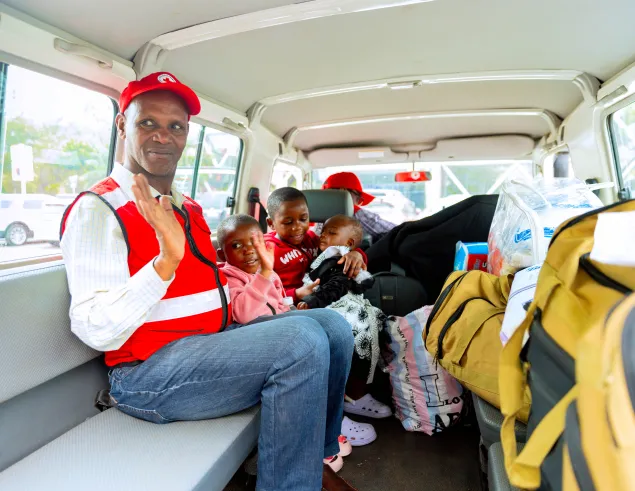
Béatrice Ayimana and Patience Tshibangu, two members of the ICRC protecting family links team, cast a final look at the car. It’s carrying three siblings from Goma, a city in the eastern region of the DRC, to their grandparents in Mudende, a town in the Rubavu District, not far from Gisenyi, in the western part of the Republic of Rwanda.
Béatrice Ayimana has been involved in every chapter of this extraordinary story. Now a new chapter is about to begin for the three siblings as the vehicle drives away from her and Patience. Like the rest of her colleagues, she is proud of the work she has accomplished.
“I’m proud of the team. We overcame the odds of finding the family of a less than twelve-month-old baby when there was so little information available and we succeeded in safely reuniting her with them,” said Béatrice beaming, a big smile on her face. “The authorities didn’t think we would be able to find the family of a baby we knew nothing about.”
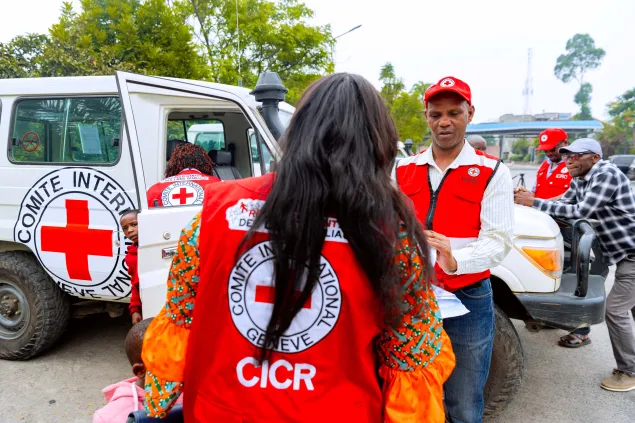
Béatrice Ayimana has followed every step of this family’s story. She is now handing over to her colleagues at the border between the Democratic Republic of the Congo and Rwanda.
A baby without a name
The story began five months ago when the lifeless body of a woman with a gunshot wound arrived at the CBCA Ndosho Hospital in Goma. She was accompanied by a baby who was around nine-months old, the link between mother and daughter forever shattered.
When the baby was born, she was named Shwandezi, but her foster family called her Murielle. To the protecting family links team who is in charge of helping family members maintain contact and reuniting those who have been separated, she was a little miracle.
The nurses who looked after her recounted how for the first three days, the baby cried day and night, refusing bottles, porridge or any form of treatment. Nothing could calm her down.
“She was suffering from a brutal separation. She tried to put her hand on the breast of every woman who held her, hoping to find the comfort of breast milk,” said Ruth Kapinga, a psychosocial worker at the hospital. “She was in a strange environment, surrounded by so many new faces. Nothing was familiar to her. The tragedy of her situation made us all sad.”
The baby had a fever. She needed to be fed and treated. Once she recovered, she could be placed temporarily with a foster family.
A temporary home
As soon as hospital workers informed the ICRC of the child’s existence, the ICRC’s teams took over the case.
“I expected it to be a routine case with a name and an address that would be easy to locate. Imagine how surprised I was to find a baby without a name, with no known family. We knew nothing about her, not even her age. It seemed to be a hopeless case and I was at a complete loss,” said Béatrice, who was the first team member to meet the baby.
All attempts to place the baby in a transitional centre while the team searched for her family were abandoned. The team’s leaders were afraid that she would remain in such a place forever if they couldn’t locate her family, especially given how few leads they had. Ultimately, a foster family from the local Red Cross took the baby in, offering her a temporary home.
Even with 16 years of experience in searching for separated family members, Béatrice had never encountered such a complex and bewildering case. How could she find the family of a nameless baby who was alone, in a city where her mother didn’t seem to know anyone?
The reunion
As the baby girl – now named Murielle by her foster family – began to adapt to her new life, the good news started to come in. Thanks to the efforts of Red Cross volunteers in the north of the city, the ICRC team was finally able to locate a friend of her mother’s. That friend directed the team to Rwanda where part of her mother’s family lived.
“Based on the information we obtained and sent to our colleagues in Rwanda, we were able to find the baby’s grandparents” said Béatrice. “We informed them that their daughter had died but had left behind a little baby in Goma.”
The grandparents were overwhelmed with emotion. They told the ICRC that Murielle’s real name was Shwandezi, which means “she who is loved for the hope and blessings she brings (after challenging times)”. They also mentioned that Shwandezi has a brother and sister. Last they had heard, the two siblings were living somewhere in Nyiragongo in North Kivu, in the eastern part of the DRC.
Finding Shwandezi’s brother and sister was no easy task due to the Ebola outbreak, which led to travel restrictions. Red Cross volunteers needed permission from local authorities to carry out their activities. Ultimately, their efforts paid off. A seven-year-old boy and four-year-old girl were located in Kibumba. The pair were reunited with their little sister, and all three were taken in by her foster family.
For the protecting family links team, who had been searching for the baby girl’s family for three months, witnessing the moment when the three siblings were finally reunited was a poignant experience.
“Murielle was dozing off in the arms of one of her foster family’s daughters,” said Béatrice, who remembers that moment as if it were yesterday. “As soon as she heard her older brother call her by her real name, Shwandezi, she jolted awake.”
The three siblings lived with the foster family for two months before they could be reunited with their grandparents in Mudende.
It has been a long and challenging journey for the three siblings. First, they lost their parents and were separated. Then they were reunited, thanks to support from the foster family and the hard work of the Red Cross teams. Now a new chapter is unfolding and a new life together as a family.
Shwandezi’s story reminds us that every action to protect family links takes a great deal of time and patience. There are many obstacles and uncertainties along the way. It requires collaborations between Red Cross teams, volunteers, foster families, entire communities and local authorities. Such work is often carried out in the shadows. It requires both perseverance and a sense of humanity. It also carries a deeper mission: to restore the identity of people and reunite those who have been separated from their loved ones by crises. Shwandezi appeared to have lost everything. But in the end, hope won the day. The baby without a name not only has a name again. She has found her family.
CICR
La fratrie, en route pour retrouver leurs grands-parents.
Pour cette fratrie, le chemin n'a pas été simple. Il a commencé par la perte tragique de leurs parents, s'est poursuivi grâce à la solidarité d'une famille d'accueil et au travail acharné des équipes de la Croix-Rouge, et s'ouvre aujourd'hui sur une nouvelle étape : celle d'une vie, à nouveau, tous réunis.
Cette histoire rappelle que derrière chaque intervention de protection des liens familiaux se cache un travail de longue haleine, patient, souvent complexe, parfois semé d’incertitudes ; mobilisant des équipes, des volontaires, des familles d'accueil, des communautés entières et des autorités locales.
Un travail de l’ombre, fait de persévérance et d’humanité, qui rappelle une mission profonde : redonner un visage, retrouver un nom et réunir ceux que les crises ont séparés. Et pour Shwandezi, alors que tout semblait perdu, l’espoir a fini par triompher.
Aujourd’hui, le bébé « sans nom » d’hier a retrouvé bien plus qu’une identité. Il a retrouvé les siens.