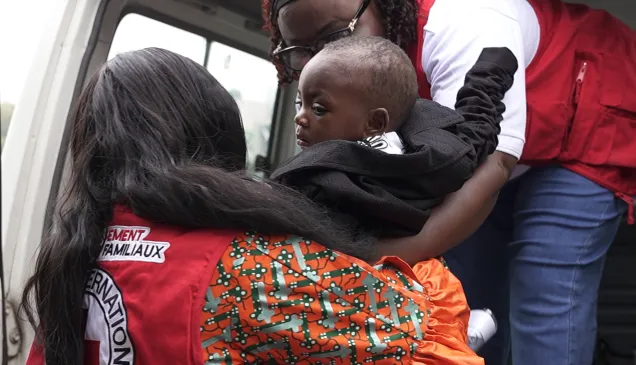
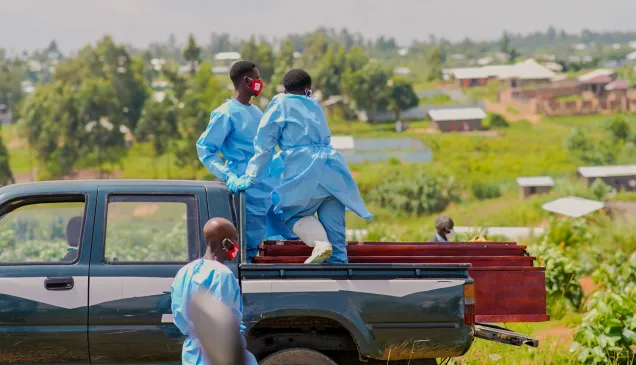
The International Committee of the Red Cross (ICRC), working closely with local Red Cross teams to carry out these distributions, has had to adapt its operating procedures in order to distribute items while strictly adhering to Ebola prevention measures. The number of people invited each day has been halved in order to maintain correct social distancing; public health messages have been communicated in cooperation with local health authorities; and anyone receiving assistance has been required to wash their hands and have their temperature checked before entering the distribution site.
“Implementing humanitarian programmes in eastern DRC is currently challenging because of the Ebola outbreak. Our priority is to find a balance – we need to continue life-saving activities and comply with health measures – so that we can provide critical assistance to families who have already suffered greatly,” explains Abdoule Karim Diomande, the ICRC’s head of programmes in the DRC.
Some 80,000 people – comprising more than 13,300 displaced, returnee and host families – have received various types of assistance depending on their status and circumstances. In Ituri, 4,350 families received support, while in North and South Kivu provinces, the number of families was 3,724 and 5,265 respectively. Families have received agricultural support in the form of seed for food crops such as maize, beans and peanuts and cassava cuttings; seed to grow vegetables such as amaranth, cabbage and aubergine; and farming tools as well as food. They also received basic household items such as blankets and kitchen utensils.
“This assistance will help thousands of families to meet their immediate needs, restart their agricultural production and rebuild their livelihoods,” says Abdoule Karim Diomande.
Democratic Republic of the Congo: More than 80,000 people receive food and seed

Kinshasa (ICRC) – The distribution of food and seed in eastern Democratic Republic of the Congo (DRC) has resumed after some activities were suspended for several weeks because of the Ebola outbreak. More than 80,000 people in the provinces of Ituri, North Kivu and South Kivu received assistance between mid-July and the end of July this year.
Beyond the violence, it’s a stark choice between Ebola and hunger
Armed conflict and other violence in the provinces of Ituri and North and South Kivu have resulted in repeated displacements and greater food insecurity. Many families have tried to reduce the dangers they face by abandoning their remotest fields in favour of subsistence farming close to their homes. This has reduced the total area of land being farmed and led to a decline in agricultural production, which in turn is limiting the availability of food in markets.
According to the Integrated Food Security Phase Classification Framework, between January and June 2026, more than 8.6 million people in these provinces were facing acute food insecurity.
“Before the war, we used to eat at least three times a day. Since our return, we’ve had to make do with just one meal a day. Everything we left behind in our fields has been eaten by those who got back before we did,” says Bayavuge Uwimana, a widow and mother of ten children who recently returned to North Kivu with her family.
In Ituri – the epicentre of the Ebola outbreak – the situation has been made worse by restrictions on cross-border trade, which were introduced as part of the efforts to combat the virus.
“It is true that Ebola kills but, as the saying goes, you can’t reason with a person who is starving. Working with the ICRC, we have put processes in place to carry out the distribution while complying with preventive measures, and this support will enable everyone to continue to comply with those measures,” says John Kabarole, the head of a chiefdom in Ituri that was selected to receive assistance.
People should, as much as possible, be free to access their fields, as well as water sources, markets and other basic means of subsistence so that food insecurity does not get any worse.
“Suspending assistance activities for a prolonged period of time could put people at greater risk of hunger and malnutrition, and damage their livelihoods. It is paramount that all parties to the conflict take all possible measures to limit the impact of military operations on civilian populations, particularly to prevent their forced displacement, and that they also facilitate the rapid and unimpeded delivery of humanitarian assistance to affected people,” states Abdoule Karim Diomande.
About the ICRC
Since it was founded in 1863, the ICRC has been working to alleviate suffering and preserve human dignity during armed conflict and other violence. Together with our Red Cross and Red Crescent partners, we provide vital assistance, work to reunite separated families and search for missing persons.
In our dialogue with authorities and arms bearers of all categories – which is often confidential – we advocate for the humane treatment of detainees and insist on compliance with international humanitarian law, to protect populations affected by armed conflict.
For more information, please contact:
Francine Kongolo, ICRC Kinshasa, tel: +243 (0) 81 992 23 28, email: fkongolo@icrc.org
Jean-Yves Clémenzo, ICRC Geneva, tel: +41 79 251 93 02, email: jclemenzo@icrc.org
or visit our website: www.icrc.org
To preview and download the latest ICRC video footage in broadcast quality, go to
www.icrcvideonewsroom.org
Follow the ICRC on Facebook, X, Instagram, TikTok and YouTube