First to Arrive, Last to Leave: Stories from Iran’s Red Crescent Responders

During the hostilities that affected Iran in 2025 and 2026, the Iranian Red Crescent Society`s (IRCS) volunteers and staff responded to people injured or trapped in damaged buildings and other emergencies. Nine IRCS humanitarian workers lost their lives while carrying out their duties, while humanitarian facilities and essential civilian infrastructure were also damaged.
Humanitarian needs remain high in the country and the work of the IRCS volunteers – very relevant. These are the experiences of two responders, drawn from their own accounts.
“Help me, help me”
Majid, an IRCS responder, was part of an assessment team sent to a damaged residential building after reports that someone might be trapped inside. Together with a firefighter, the team entered the unstable structure and heard a cry for help.
For the rescuers, finding that person became the priority. The team coordinated with firefighters and moved carefully through the structure, eventually crawling through a window to reach the trapped man.
Then another explosion occurred.
The blast caused additional debris to fall and forced the rescuers to retreat. The danger had become too great to continue safely at that moment. The man did not survive. The following day, Majid returned to the site and recovered his body.
The experience stayed with him. After two days of rescue operations, the emotional pressure became overwhelming.
“I just sat somewhere by myself and cried,” Majid recalls. “Why did this happen? Why couldn't I bring him out alive?”
His testimony reflects a reality faced by many emergency responders who continue working despite the extreme emotional and mental pressure, even when rescue attempts end in loss. They must make rapid decisions in unstable and dangerous environments, while witnessing injuries, deaths and the suffering of families.
Yet they continue to return to the scenes where people need help.
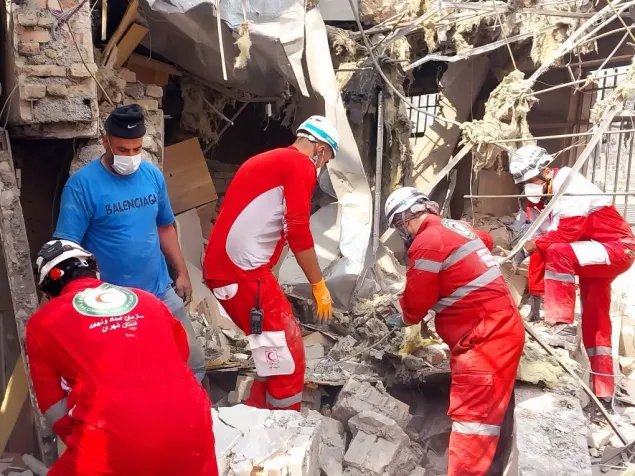
IRCS Rescue and Relief staff at work at the site of a damaged building in a neighborhood of Tehran, 2026.
“We are from the Red Crescent. We are here to help you”
Jalil, another IRCS responder, was dispatched with his team following an early-morning attack that affected a residential area. They found severely damaged buildings, injured people and families gathered at the scene.
A six-storey building had partially collapsed. The aid workers began searching the damaged apartments and found an injured woman, too afraid to move.
Jalil tried to reassure her by saying: “Don't worry, we are from the Red Crescent. We are here to help you.”
The words were simple, but in that moment, they signalled that help had arrived and calmed down the woman. She started to move, and Jalil managed to save her from the damaged building. The responders continued their work while ambulances transported the injured to the hospital.
Among those rescued was a young girl, around six or seven years old. Her mother had been sleeping besides her when the building was hit and had used her own body to protect her daughter. The mother was killed, but the child survived.
For Jalil and his colleagues, saving the child meant confronting both sides of their work: they had succeeded in getting her to safety, but could not prevent the loss of her mother.
As Jalil and his colleagues continued to carry out their rescue operation, they heard of a person trapped beneath the rubble in another part of the same area.
They were unable to remove the debris quickly without knowing what lay underneath or how the remaining structure might react. Instead, they worked carefully, removing the rubble piece by piece.
Eventually, they reached the man and brought him out alive.
But the operation also brought significant loss. Eleven people were killed at the site. Four people were rescued by Jalil’s team, while other rescue workers managed to save several more.
The numbers tell only a part of the story. The aid workers remember the people, the voices they heard, those they managed to rescue, and those they could not.
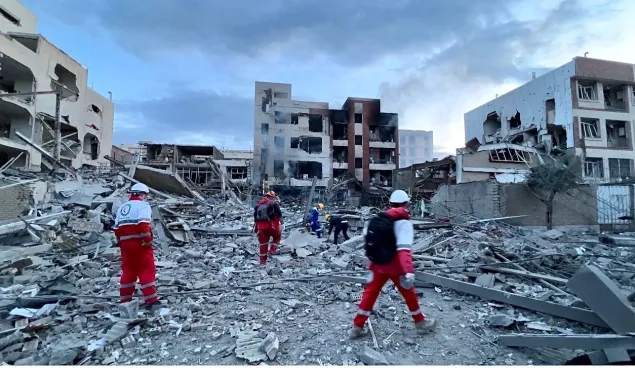
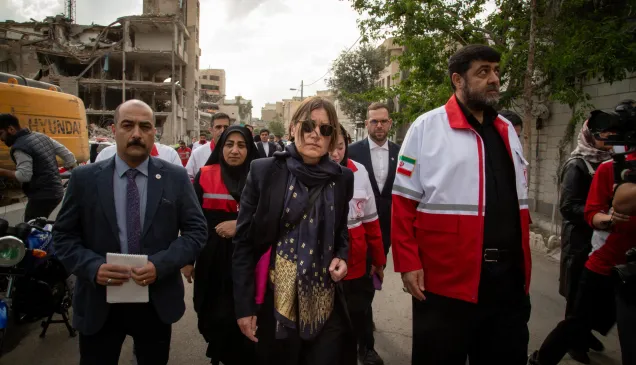
IRCS Rescue and Relief Organization first responders provide assistance at the site of a damaged residential area in western Tehran, 2026.
Supporting the IRCS response
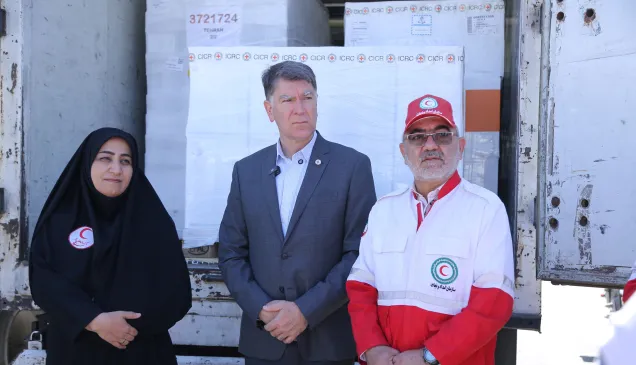
The International Committee of the Red Cross (ICRC) continues to support the IRCS through the delivery of humanitarian supplies and operational assistance. Following the February - April 2026 escalation of hostilities, the ICRC delivered 171 tonnes of essential relief items, enough to support nearly 25,000 people, as well as 200 generators and 100 motor pumps for rescue and relief operations. In June, it delivered more than 18 tonnes of additional supplies, including medical items and personal protective equipment for first responders. Further deliveries of humanitarian aid are also being planned to support the IRCS`s humanitarian response and action.
The ICRC also continues its bilateral dialogue with all parties to remind them of their obligations under international humanitarian law, including the need to protect humanitarian workers and enable them to carry out their life-saving work.
For responders such as Majid and Jalil, humanitarian action is about the people they helped, the injured they evacuated and the lives they saved. In the most difficult moments, their presence can make the difference between life and death.