ICRC voices: How physical rehabilitation is changing lives in Somalia
Value for money, sustainable manufacturing, reducing costs: not the usual kind of vocabulary you would expect of humanitarian aid. But this is how Philip Morgan, ICRC Physical Rehabilitation Manager, speaks about his work. For him, these ideas are not about cutting corners. They are about improving quality of care as efficiently as possible.

Originally from Cardiff, Wales, Morgan has worked with the ICRC on physical rehabilitation projects around the world for nearly two decades.
One of his earliest missions was in 2005, when he arrived in Pakistan following a devastating earthquake. The ICRC was establishing an artificial limb and rehabilitation clinic and needed specialists to run it.
It was there that Morgan received a piece of advice he never forgot.
“A colleague of mine said ‘it’s our job to make ourselves redundant as quickly as possible.’ That was the best piece of advice I ever heard. As humanitarians, we’re there to help in emergencies, but we can’t stay indefinitely. We need to build resilience within the existing health systems so that projects can be handed over to local actors, whether it’s governmental authorities or the national Red Cross or Red Crescent society.”
“Since then, I’m always looking for efficiency and value for money. Because it’s not my money I’m spending – it’s that of donors. I have a responsibility to use it carefully.”
Tweet: https://twitter.com/ICRC_uk/status/2036394730875961460
Supporting physical rehabilitation in Somalia
With this mindset, Morgan joined the ICRC Somalia delegation to support its physical rehabilitation programme there in 2023 - run in partnership with the Somali Red Crescent Society (SRCS).
Together with 56 SRCS staff – including prosthetists, orthotists, assistants, bench workers and physiotherapists - they are responsible for meeting the physical rehabilitation needs of the entirety of Somalia with only three clinics. They serve an estimated 200,000–250,000 people living with illness or disabilities who would otherwise struggle to receive support.
“It was a little daunting at first,” Morgan said. “But our partnership with the Somali Red Crescent made it possible.”
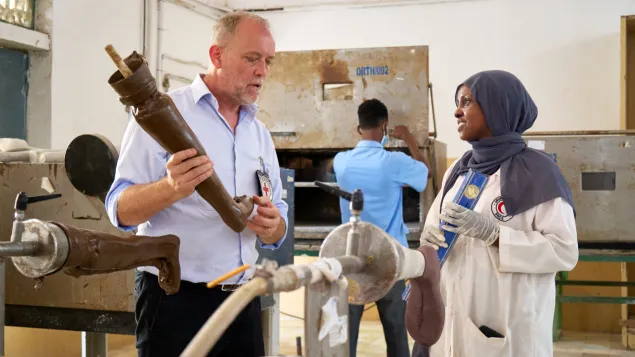
Working closely with the teams in Somalia, Morgan tasked himself with ensuring that everything ran as efficiently as possible, delivering the best possible outcomes in a cost-efficient way, and in the process helping to safeguard the programme’s longer-term future.
“Our colleagues working locally to deliver the services have decades of experience and a lot of expertise. Using their knowledge, we have a programme that can continue to respond to the needs of the disabled population of Somalia, which gives a great return on investment to donors who want to see tangible impact.”
The challenge of rising needs
Decades of violence have left hundreds of thousands of Somalis in need of physical rehabilitation – many wounded by gunshots, landmines, or explosions. Others have become indirect victims of conflict.
Prolonged instability has also disrupted Somalia’s health system. Vaccination campaigns are inconsistent, contributing to outbreaks of preventable diseases like polio that result in physical disabilities. Access to maternal and antenatal care is also limited, with many women lacking comprehensive pregnancy care, increasing the risk of poor health outcomes for mothers and their newborns.
Against this backdrop, the physical rehabilitation clinics in Somalia see large numbers of children with long-term physical conditions, including cerebral palsy and clubfoot.
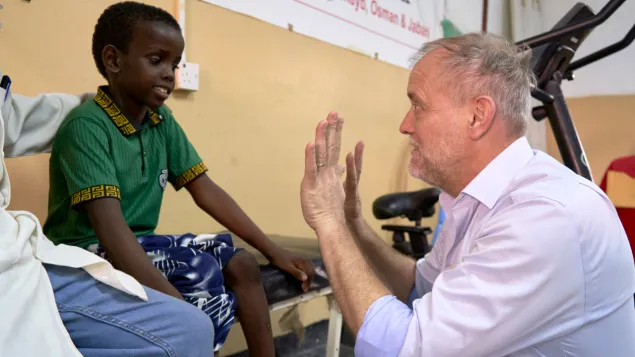
The ICRC is the only organisation in Somalia that sees patients from the moment they are wounded or ill, all the way through to receiving healthcare, physical rehabilitation and social inclusion services and support.
“The programme helps ensure that people are not only safe to go home, but have livelihood opportunities when they leave and can become active participants in society. That holistic approach is embedded to support societal reintegration,” Morgan explained.
But while needs in Somalia – like in many other countries that have suffered from years of protracted conflict - are enormous, humanitarian resources are stretched thin.
“My objective is to continue to strengthen the programme’s financial sustainability while maintaining service quality,” he said.
“I said to our partners and centre managers – ‘let’s be more efficient, let’s reduce errors, let’s speed things up and make the quality of care as good as it can be.”
Polypropylene technology
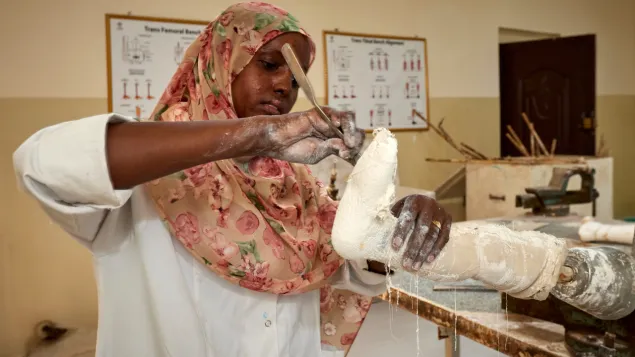
Unlike most humanitarian organisations, the ICRC has manufactured its own polypropylene prosthetic components since 1988. Designed to be low-cost, durable, and easy to produce at scale, they are manufactured in Switzerland and shipped to countries where the ICRC operates, to be assembled on site at physical rehabilitation clinics like those in Somalia.
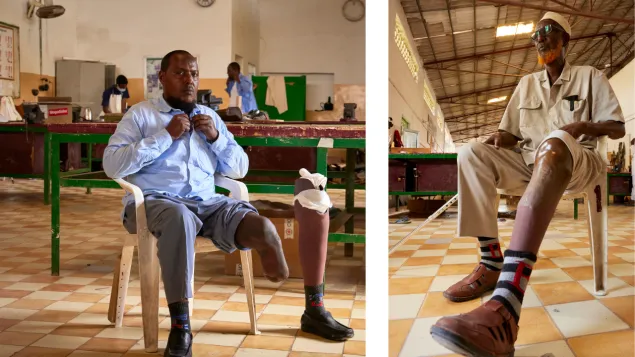
Each standard prosthetic produced using these components costs less than 100 USD - far cheaper than commercial alternatives. But Morgan saw room to reduce costs even further.
“Every assistive device produced in Somalia requires components – feet, knee joints, prosthetic kits - ordered from Geneva each year. By improving our forecasting and more accurately ordering the right amount of material we need, we’ve made savings without any impact on the end service or product.”
Moving towards total sustainability
“The next step towards sustainability, I think, would be investing in local training for rehabilitation professionals,” Morgan said.
Today, there are just 15 physiotherapists with bachelor’s degrees working in Somalia - roughly one for every 1.3 million people. All of them were trained abroad, with support from the ICRC and other aid organisations.
Morgan believes this model, while necessary in the short term, could be improved. Training physiotherapists locally at the Somali National University in Mogadishu would reduce long-term costs and dramatically strengthen national capacity. Over time, it would enable the Somali Red Crescent to take greater ownership of physical rehabilitation services, easing pressure on the country’s three centres and laying the groundwork for a durable handover.
“The ICRC already has the technical expertise, partnerships with European universities, and links with the World Physiotherapy Congress to make this happen,” he explained. “But what we don’t have is the funding to get it off the ground.”
That constraint reflects a broader reality.
“This is a difficult moment financially for the aid sector,” he said. “That’s why work to streamline manufacturing, rationalise production, and reduce costs continues to be essential. It makes us more flexible and agile - which is exactly what we need to be in today’s climate.”
“It’s a real achievement, and we’re moving in the right direction. But there’s still a lot more to do before I can hand this project over - and finally say that I’ve made myself redundant.”