Lebanon: Humanitarian needs remain acute amid continued uncertainty

After months of hostilities, many families across Lebanon are returning to find their homes damaged, services such as health care disrupted, and their sources of income lost.
For some, current conditions still make return impossible. Entire towns and villages in Lebanon have suffered widespread destruction and remain largely inaccessible following intense hostilities and destruction.
As of 26 August 2026, more than 334,000 people remained displaced, unable to return because of security concerns, damage and limited access to essential services.
The International Committee of the Red Cross (ICRC) is scaling up and adapting its response to the evolving situation by continuing to help address the immediate needs of the affected population, while supporting the restoration of services, early recovery and livelihoods to help communities return and recover.
Bringing health care closer to communities
Access to health care remains limited, particularly in areas of return where services have been disrupted.
Only 4% of households surveyed by the World Health Organization in southern Lebanon and Beirut’s southern suburbs reported full access to health care following the closure of dozens of primary health-care centres and several hospitals during the escalation. Medical facilities have also faced shortage in essential supplies and damage to infrastructure with attacks affecting health-care personnel and services being reported.
Since April 16, the ICRC has supported more than 70 medical and health care facilities and services, including 12 hospitals, 21 primary health-care centres, 4 mobile medical units, 23 emergency medical service centres, and physical rehabilitation centres, with essential medical supplies, medications, consumables, equipment and other critical support. This assistance has been essential in helping these facilities remain operational and continue providing essential health-care services to conflict-affected communities.
Capacity-building activities have also been resumed to enhance emergency preparedness of key health care facilities.
In areas where communities have no direct access to health-care facilities and medical personnel are unable to reach those in need, the ICRC stands ready to operate mobile medical units to bring health care closer to those in need. Meanwhile, ICRC is still supporting the mobile medical units deployed by the Lebanese Red Cross in the Tebnine catchment area, and the Ministry of Social Affairs in the Marjayoun catchment area.
These efforts aim to help ensure that lack of essential health-care services does not become another obstacle for families trying to rebuild their lives.
Supporting families to regain their livelihoods
The consequences of the conflict are also economic. Many families have lost businesses, agricultural equipment, livestock, or other sources of income, leaving them dependent on assistance even after returning home.
The impact has been particularly severe in agricultural communities, with an estimated 72% of farmers reporting losses of income and a drastic decrease in agricultural production according to the Ministry of Agriculture.
The ICRC has started livelihood assessments of conflict-affected communities to better understand their needs and identify opportunities to help families restore their sources of income and regain greater independence.
Supporting sustainable livelihoods is an important step towards moving from immediate relief to longer-term recovery.
Strengthening access to clean water
For returning families, functioning water networks, health-care facilities and other essential services are fundamental to making their return sustainable.
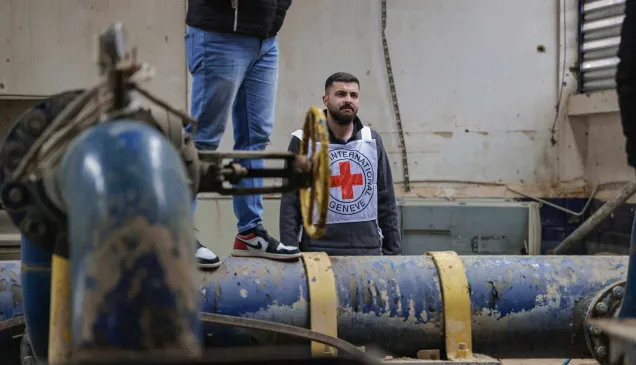
The ICRC strengthened access to essential water and health services across affected areas by repairing and rehabilitating pumping stations, boreholes and water networks; installing and donating pumps, generators, solar systems and other critical equipment; and delivering more than 135,000 litres of fuel to 70 water stations in the south.
The ICRC also supported water establishments by maintaining 41 vehicles, providing essential equipment and tools, and facilitating access for technical teams to carry out urgent repairs. In the health sector, the ICRC helped maintain the continuity of hospital services by delivering nearly 240,000 litres of fuel, as well as oxygen, LPG and water; providing generators, maintenance materials and other essential supplies; carrying out urgent maintenance and repairs, including to conflict-related damage; and improving hospital infrastructure through the installation of cold storage and storage facilities, solar systems. The ICRC further supported municipalities and the Lebanese Red Cross by providing search and rescue equipment, fuel and solar lamps, and improving water and sanitation systems in six collective shelters.
Together with the South Lebanon Water Establishment, the ICRC built a remote monitoring and operation centre for pumping stations serving southern Lebanon. That system enables engineers to remotely monitor and operate connected water stations, receive real-time alerts and respond more quickly to equipment failures, leaks and power cuts. By improving the management of the network, the system helps strengthen the reliability of water services for communities across southern Lebanon.

Supporting return and recovery
Today, the ICRC's work in Lebanon combines continued assistance and protection to restore essential health care, water services and support livelihoods in communities affected by the conflict. For families returning home, these efforts are about being able to live in their communities again, access basic services, earn an income and begin rebuilding their lives with dignity.
In parallel, the ICRC continues its bilateral confidential dialogue with the parties to the conflict on the protection of civilians, health-care services and critical infrastructure essential to the provision of basic services.
The ICRC also continues to support families searching for missing relatives.
For tens of thousands of people across Lebanon, recovery has only just begun. For many others, the path to recovery remains challenging, as conditions continue to affect their return home and their ability to rebuild their lives.
“I would like to walk again along the beach in Tyr, and to feel the sense of safety we used to feel before, without the fear that a missile might target us at any moment, or that we go out and return only to discover that those we love, or our family members, are no longer there.” – Rita from Tyr in southern Lebanon