Who Helps the Helpers? Mental Health and Psychosocial Support for Frontline Responders in Northeast Nigeria
When the triple explosions ripped through the evening calm of Maiduguri, breaking the fast for many residents during Ramadan, Babagana Shehu and his fellow volunteers from the Nigerian Red Cross Society didn’t hesitate. They left their meals unfinished. They ran toward the smoke, the chaos, and the screams.

“The explosion occurred during breaking of fast, which many of us did not have time to complete because we had to deploy to the scene,” recalls Babagana, a veteran volunteer of the Nigerian Red Cross Society (NRCS).
“There were challenges like pandemonium, noise everywhere from bystanders.” In the aftermath of such mass casualty events, the priority is always the victims. But who tends to the tenders? Who looks after those caring for others? And who helps the helpers?
An initiative by the International Committee of the Red Cross (ICRC), in partnership with the NRCS, is providing an answer. Through its Mental Health and Psychosocial Support (MHPSS) programme, emergency support sessions were conducted to equip frontline staff with the tools not just to save lives, but to safeguard their own wellbeing.
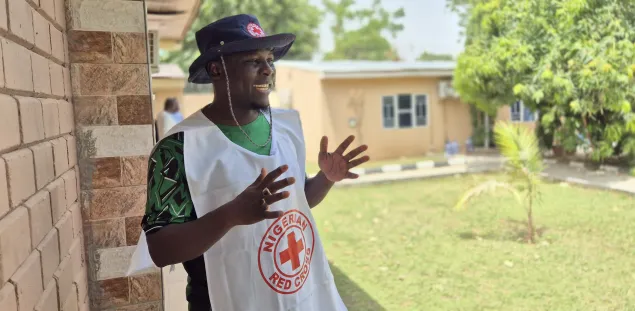
Babagana Shehu, volunteer from the Nigerian Red Cross Society
The Invisible Wound
For health workers and first responders in northeast Nigeria, where a 15-year armed conflict has left deep scars, exposure to traumatic events is not an exception - it is the routine.
The MHPSS sessions focused on practical psychosocial support, stress management, and self-care. Over three weeks, 103 participants took part, including NRCS members, medical staff from the State Specialist Hospital of Maiduguri, and the University of Maiduguri Teaching Hospital. They were trained in trauma handling and, crucially, in processing their own distress.
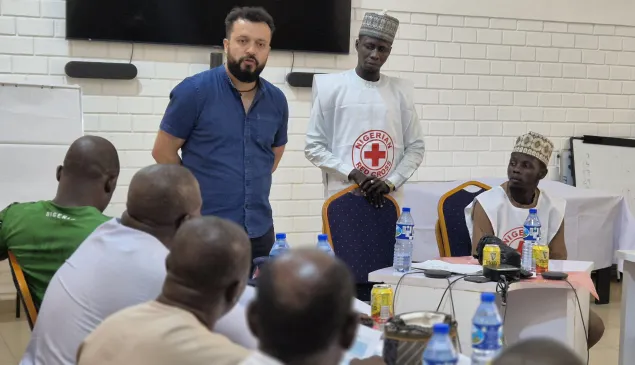
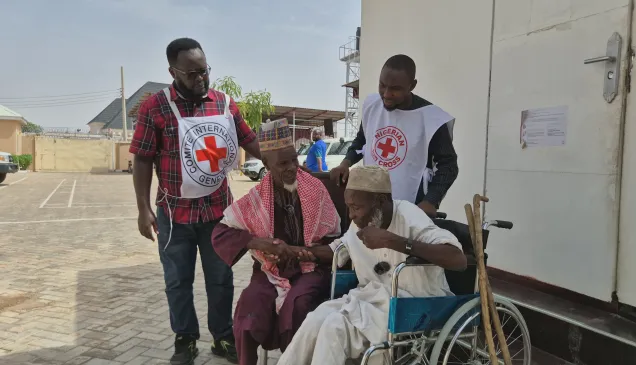
Juan Carlos with NRCS members, and medical staff from the State Specialist Hospital of Maiduguri
“The wellbeing of responders is integral to the quality of care provided to those affected by armed conflict and violence,” says Juan Carlos, ICRC MHPSS Delegate.
The aftermath of a stressful emergency response takes a heavy toll on workers. When emergency incidents happen, they will have the basic skills to help themselves - before, during, and after they help others.”
From Chaos to Purpose
Babagana Shehu admits that before the training, the weight of leadership during emergencies was heavy on him. But the sessions taught him a lesson: letting go.
I learned to share responsibilities with my team and guide them, which has significantly reduced my stress,” he says. “They perform the tasks just as well as I would.”
More than that, the training changed how he interacts with patients. “I now know how to calm victims down from the shock during the confusion and pain. I adopted this method recently on a fractured patient while coming to the sessions. He almost forgot about his pain and listened to our conversation all the way to the hospital.”
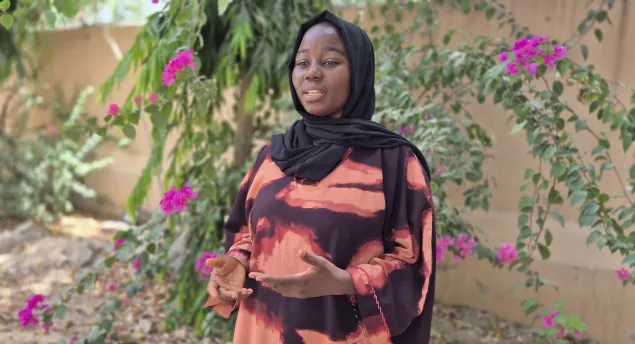
Deborah Christopher Waba, a nurse at State Specialist Hospital, Maiduguri
Deborah Christopher Waba, a nurse who worked for two years in the weapon-wounded ward at the State Specialist Hospital, Maiduguri knows the feeling of being overwhelmed all too well. During the last mass casualty incident, she and a single colleague were left to face a sudden flood of victims.
“We were only two nurses on duty, and this made the wards overcrowded instantly,” Deborah says. “We found it difficult to concentrate. Controlling people going in and out made it impossible to attend to patients properly.”
The MHPSS sessions became a turning point. “I had the opportunity to tell my colleagues my stressors. There are negative and positive coping mechanisms,” she explains. “The positive is to have time for yourself, rest, and talk with your family. Negative coping? Some of us do it without knowing - like self-medicating with paracetamol for a little headache or doing things that can harm our health.”
Now, Deborah practices deliberate recovery. “When I go home, I take my bath, rest a little, and chat. Sometimes I sit alone, read, and meditate. That is how I cope.”
Finding Work-Life Balance
Across the sessions, participants identified common workplace risk factors: burnout, flashbacks, hallucinations, and disconnection from loved ones. They learned assertive communication, setting boundaries, and the fundamental idea that rest is not weakness - it is operational necessity.
Madu Adamu Mshelia, a 25-year veteran of the accident and emergency department at a specialist hospital in Maiduguri, has seen more weapon-wounded victims than most. “We go through a lot of stressors,” he admits. “But with coordination with ICRC teams, the job goes smoother. We usually mobilize other nurses and doctors from other wards to help.”
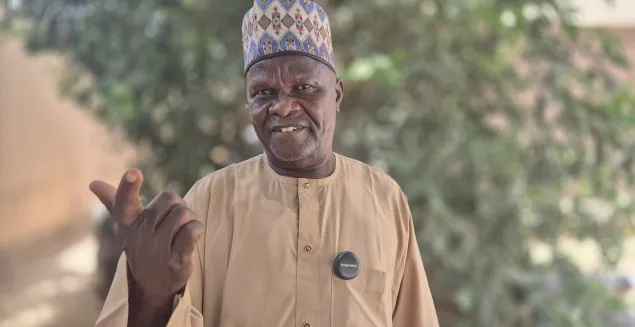
Madu Adamu Mshelia, a 25-year veteran of the accident and emergency department at a specialist hospital in Maiduguri
Crucially, the training gave him permission to switch off. “We are given a day off to relieve stress. I rest at home and do not go anywhere. When we go home, we should forget about hospital work and concentrate on home management.”
A Simple Equation
The conclusion reached by the participants is simple yet hopeful: without positive stress management, patients will not receive proper care. Assertiveness during conversation, listening, and empathy redirect a patient’s focus away from pain. But those skills are impossible to offer when the helper is broken.
The ICRC and NRCS initiative underscore a simple truth: self-care is not selfish. It is the essential ingredient for proper patient care. Most importantly, the training has taught them that caring for themselves is just as important as caring for others.
As Babagana Shehu puts it, summarizing the spirit of the training:
“Be well, be alive, and be a helper.”