From celebration to scarcity – Palestinian farmers and the increased challenges during the 2025 olive harvest

The olive harvest across the occupied West Bank used to be a time of joy for Palestinian farmers. Starting early each morning, they would pack their things and travel across the sun-kissed hills and valleys of the West Bank to reach their groves. For hours on these days, hundreds of farmers – and at times their friends and family – would go tree to tree, where olives would be devotedly picked by all. They would then take them to get pressed into the golden liquid of olive oil that is not only an essential item on every Palestinian table but also a vital lifeline for farmers’ livelihoods.
This year, however, the olive harvest has been beset on all sides with challenges. Whether due to restrictions of movement, difficulty accessing land, or even the safety of the farmers themselves, the time of celebration during harvests feels distant.
This holds particularly true in the village of Mughayyir where, in August, an Israeli military operation took place. This operation included the uprooting of thousands of trees – the main source of income for the village.
“There were more than ten thousand trees, all of which [would] produce around 40,000 litres of oil,” says Abu Wahid, a member of Al-Mughayyir’s village council. He adds that, “you are not allowed to replant what has been uprooted. You are not even allowed to access the land.”
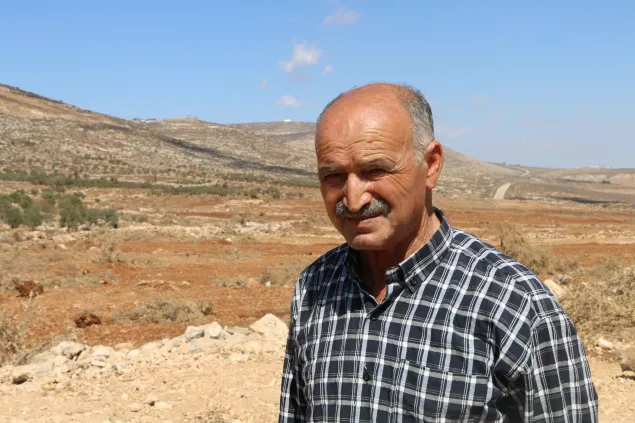
Abu Wahid standing in front of a plot of land where thousands of olive trees were uprooted.
Every season, volunteers approach the village council to offer support during the harvest. However, this year there are simply no olives to harvest. Akram Kamal, the owner of Mughayyir’s olive press was one of the villagers directly affected by the destruction of the trees.
“They uprooted 1,600 of my trees, and there are thousands of others that I can no longer access,” Kamal expressed in frustration. Shrugging under the sun, he adds that, “Today, we need to buy olives from other villages if we want to operate the press, even though we used to produce 40,000 litres of oil each year.”
Kamal’s olive press used to employ more than 30 people during the harvest season. But as thousands of trees have been uprooted, and many of the village’s land are inaccessible, his olive press is not capable of hiring many workers. This year, he can only afford one.
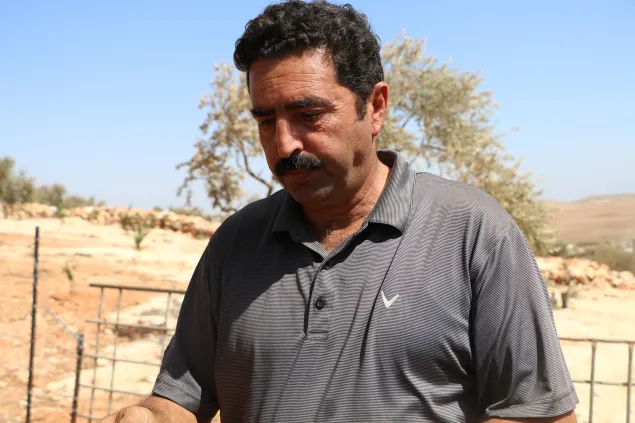
Akram Na’asan (Kamal) used to run the Mughayyir’s only oil press is unable to sustain it after the village lost most of its olive trees.
The International Committee of the Red Cross (ICRC) has provided support wherever possible to olive farmers for years, and staff have seen the tangible consequences of smaller and smaller yields.
“We have witnessed the profound impact of farmers losing access to their lands, to have their olive trees damaged or destroyed. It is not only devastating for their own livelihoods, but it reaches further than that – it impacts entire surrounding villages,” says Vanessa Parada, ICRC’s field team leader in the Central West Bank.
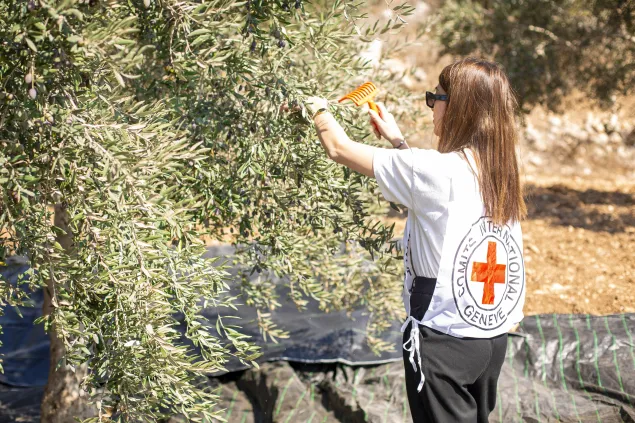
A member of the ICRC working with Palestinian farmers during a previous olive harvest season in the Sinjil village of the West Bank.
To the west of Mughayyir, one such village can be found. Sinjil sits nestled on a hill across from Highway 60 and is surrounded by a high metal fence. The farmers of this town are also facing a difficult harvest season. Marouh Abdelhaqq, who has been attacked by settlers multiple times, had around 20 dunams of land (approx. 5 acres). However, for the third year now, he is unable to access his land.
“The purpose of the farmer is not only to pick olives,” explains Abdelhaqq. “He needs to care for them, water them, prune them, and care for them. The relationship with the land must remain continuous and the farmer must remain in contact with his trees.”
Owning about 150 olive trees, Abdelhaqq says he inherited this land from his father and wants to preserve this trust to pass it on to his grandchildren.
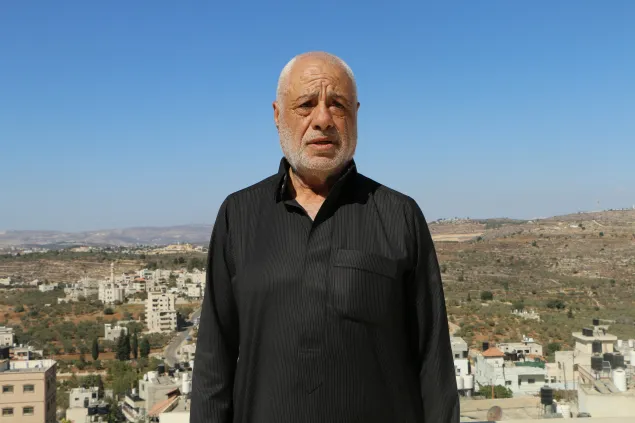
Mraweh Abdelhaqq had farmed his lands for decades before being unable to reach them today.
“My family and I considered it a festival. You take your family with you, and it makes you feel like a true Palestinian farmer clinging to his land,” says Abdelhaqq as he reminisces fondly on previous harvests.
Those days have become a distant memory for him.
“When you visit the tree, you know every detail about it,” he muses. Returning to reality Abdelhaqq adds, “Being cut off from them for three years? That affects your soul, emotionally and psychologically. You cannot do anything about it, you are helpless.”
The ICRC has several different programmes that support farmers in the West Bank. In Sinjil, we provided biotraps to 118 farmers. In the Jordan valley, we provided technical and material support to Ein Al-Beida Village Council in the Jordan valley to enhance access to electricity for 1,750 farmers. We have also worked to support over 31,000 Palestinian farmers in the West Bank through helping the Palestinian Water Authority in the West Bank to enable improved water access.