Thailand: Asia-Pacific states chart path to strengthen international humanitarian law and preserve humanity in conflict

Senior legal and policy advisers from 22 Asia-Pacific states gathered in Bangkok from 18 to 20 August 2026 for the Asia-Pacific Regional Conference on International Humanitarian Law. Jointly organized by the Ministry of Foreign Affairs of Thailand and the International Committee of the Red Cross (ICRC), the three-day event brought together 40 delegates. The theme of the conference was “Navigating Contemporary Challenges to Preserve Humanity in Conflict.”
Setting the tone for the regional dialogue, H.E. Mr Vijavat Isarabhakdi, Vice Minister for Foreign Affairs of Thailand, emphasized the region’s unique position: “Asia-Pacific has an important contribution to make in this journey. Our region not only has diverse experiences, cultures and legal traditions, but also a shared commitment to preserving humanity in conflict.”
Grounded in this shared commitment, the region confronted a stark global reality. With over 130 armed conflicts recorded globally, the discussions focused on integrating legal obligations into national frameworks long before conflict arises. “The scale of the human suffering in today's armed conflicts must never be accepted as inevitable. We need to work proactively to secure a future where the fundamental rules of war will be upheld,” said Mr Régis Savioz, the ICRC Regional Director for Asia and the Pacific.
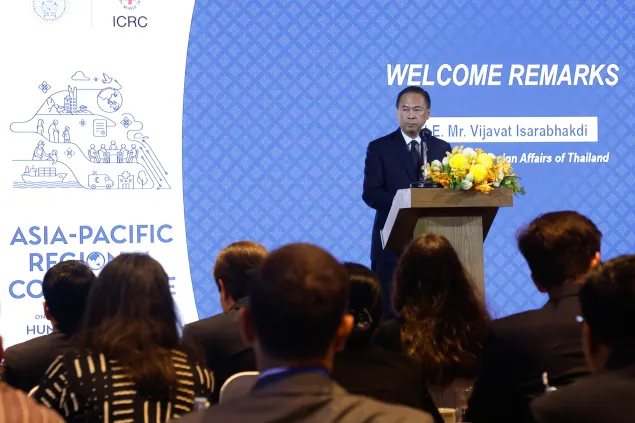
H.E. Mr Vijavat Isarabhakdi, Vice Minister for Foreign Affairs, Thailand, emphasized the region’s unique position and reaffirmed Thailand’s commitment to promoting regional dialogue on IHL.
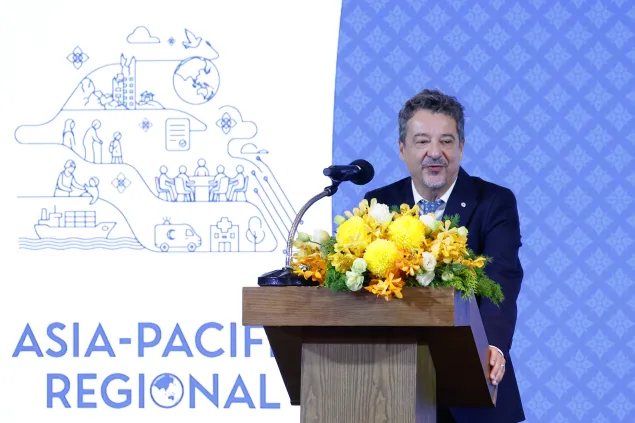
Mr Régis Savioz, ICRC Regional Director for Asia and the Pacific, delivered the opening speech at the Asia-Pacific Regional Conference on International Humanitarian Law.
To translate these imperatives into concrete humanitarian protection activities in situations of armed conflict, delegates examined practical measures for incorporating international humanitarian law (IHL) into domestic legislation, military doctrines, operational planning and administrative practices. They highlighted the crucial role of national institutions, supported by strong and sustained political will and technical capacity, in ensuring compliance with IHL. Throughout the plenary discussion and breakout sessions, delegates examined a broad spectrum of contemporary challenges to humanitarian protection: the relationship between IHL and peace; protecting civilian infrastructure and medical facilities during armed conflict; the potential humanitarian consequences of using information and communication technologies in armed conflict; and search and rescue operations, including searching for and collecting shipwrecked people under IHL and the law of the sea. Delegates also discussed other initiatives and national developments aimed at building a culture of upholding IHL; shared examples of good practices for preventing IHL breaches; and highlighted the role of national IHL committees in implementing IHL within their own countries.
Underscoring the urgency of efforts to implement IHL in practice, Mr Jürg Montani, Head of the ICRC Regional Delegation in Bangkok, noted: “The world is facing an immense humanitarian challenge. But we can act to reverse this worrying trend. We have heard from the discussions throughout the conference that there are ways to do so, and that it is not only a legal obligation but a moral imperative.”
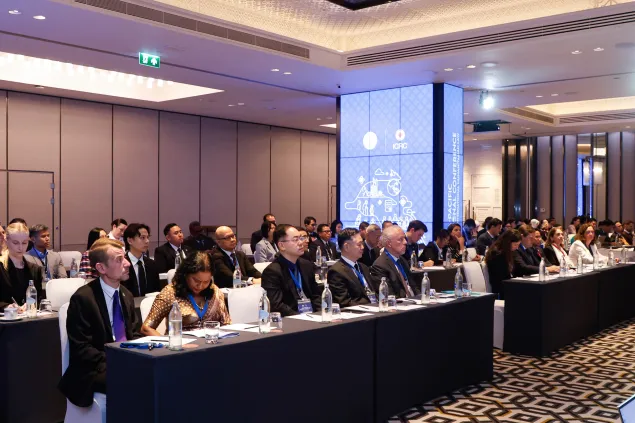
The conference brought together senior legal and policy advisers from 22 Asia-Pacific states to strengthen dialogue and cooperation on IHL.
Beyond regional strategies, the Bangkok conference also served as a critical stepping stone in aligning local efforts with wider global frameworks. It provided a vital platform for ensuring that regional priorities are in line with the Global Initiative to Galvanize Political Commitment to International Humanitarian Law, launched in September 2024 by Brazil, China, France, Jordan, Kazakhstan, South Africa and the ICRC to keep IHL at the top of global political agendas.
The Asia-Pacific region continues to play an active role in driving this global agenda forward, with Australia, Bangladesh, Indonesia, Pakistan and the Philippines serving as workstream co-chairs, while states including Cambodia, Fiji, Japan, the Lao People’s Democratic Republic, Malaysia, the Marshall Islands, Mongolia, Nepal, New Zealand, Sri Lanka, Thailand and Timor-Leste have formally joined the initiative. During the conference’s opening session, representatives from five of the founding states – Brazil, China, France, Kazakhstan and South Africa – and the ICRC delivered panel remarks on the “Global IHL Initiative: Prioritizing IHL at All Levels”. The session was attended by the diplomatic community in Bangkok. Most importantly, outcomes from the Bangkok conference will directly feed into regional perspectives on the initiative ahead of the High-Level Conference on Humanity in War, taking place in Jordan on 7 December 2026.
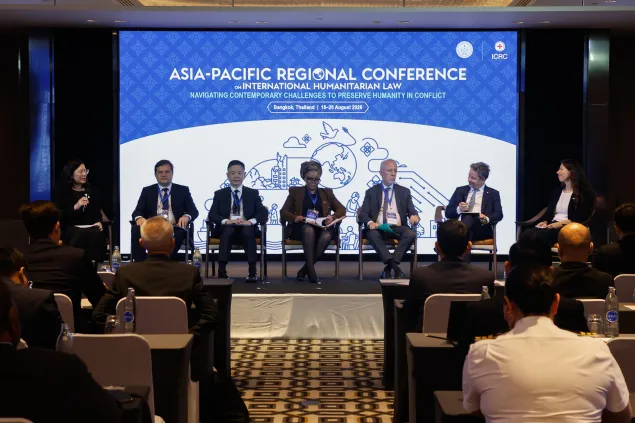
Representatives from five of the six founding states of the Global Initiative to Galvanize Political Commitment to IHL, alongside a representative from the ICRC, shared their thoughts on the subject of the conference’s opening session: “Global IHL Initiative: Prioritizing IHL at All Levels”.
In her closing remarks, Ms Pinsuda Jayanama, Director-General of the Department of International Organizations at the Thai Ministry of Foreign Affairs, reflected on the road ahead. “I trust this conference will further inspire us to continue our commitment to advancing the principles of IHL through the Global Initiative and respective national policies, as well as in preparation for the High-Level Conference on Humanity in War in Jordan later this year,” she said.
As delegates depart Bangkok, the conference leaves behind a clear path forward: transforming regional dialogue into concrete domestic action. With the High-Level Conference on Humanity in War on the horizon, the commitments and shared approaches forged over these three days will play a critical role in ensuring that IHL is not merely preserved on paper but actively upheld to protect human dignity where it is needed most.
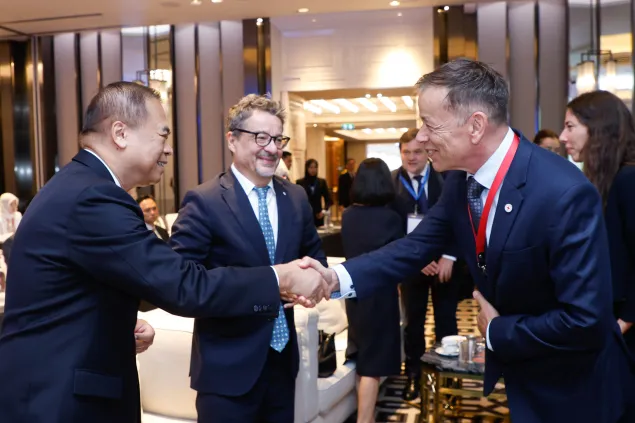
The ICRC and Thailand’s Ministry of Foreign Affairs came together to advance dialogue and cooperation on IHL.