Thirty-one years apart: A mother and son find each other again

In the Kyaka II refugee settlement in western Uganda, time had not erased the memory of a six-year-old boy left behind in the chaos of flight.
Nkundwanabake Anesia, aged 58, fled Burundi in 1994 when the early years of the conflict devastated her community. As she made her way to Uganda via Tanzania, she carried with her a wound that would take decades to heal: the separation from her young son, Ntahimpera Jean Marie Eric.
With no way of tracing him across borders and years of silence stretching into decades, Anesia feared the worst.
Anesia lived in Itambabiniga, Ruchinga village, Kyaka II. Over time, she learnt about a service offered by the Uganda Red Cross Society (URCS), with support from the International Committee of the Red Cross (ICRC), that helps trace missing persons.
In July 2025, she came forward and opened a tracing request – her first formal step in more than 30 years towards finding out the fate of her son.
On 12 March 2026, an ICRC team in Burundi, working alongside the Burundi Red Cross Society, located Anesia’s missing son, who had sent her a Red Cross message containing his contact details and asking to be reunited with his mother.
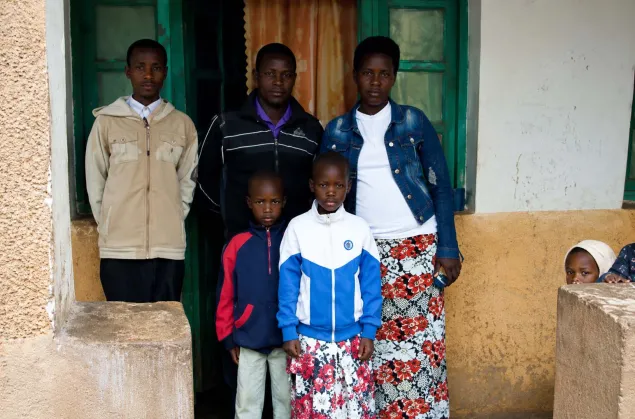
Ntahimpera Jean Marie Eric (center, back row) stands with his family in Burundi.
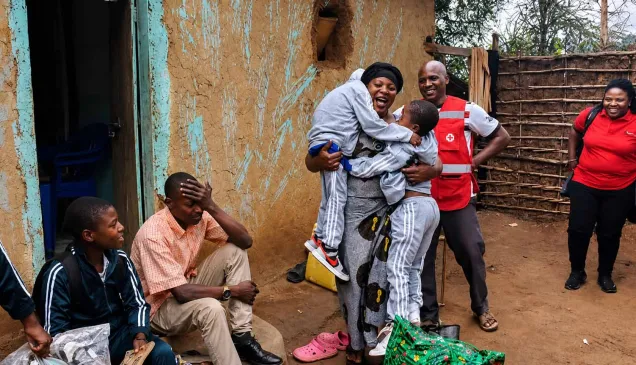
The ICRC in Uganda, together with the URCS team, delivered the Red Cross Message and facilitated a phone call between mother and son.
Although simple in form, it was profound in meaning. For the first time in thirty-one years, mother and son heard each other's voices. Both had feared the other dead.
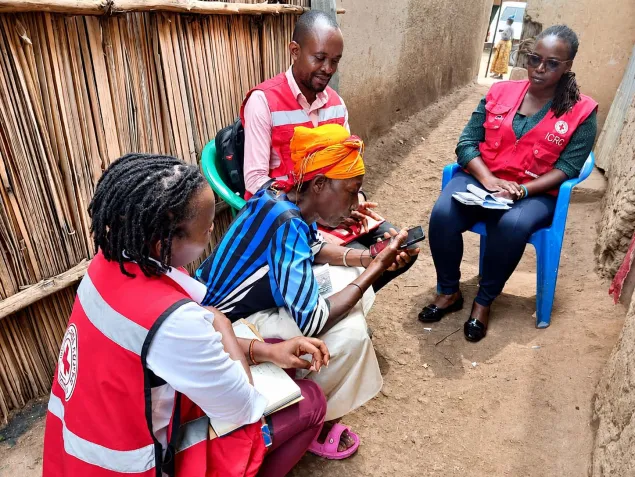
Nkundwanabake Anesia, 58 years making a call to his son.
"I now live with hope," Anesia said.
In a sense, that single sentence sums up the purpose of the Protection of Family Links programme: not just to bridge communication gaps, but to preserve the dignity of separated family members.
After thirty-one years, a mother no longer has to wonder where her son is.
Protection of Family Links is one of the ICRC's core protection activities. For people separated by armed conflict, and other situations of violence, the loss of contact with family members compounds vulnerability and strips individuals of the sense of identity and belonging that underpins human dignity.
In 2025, 1,366 Red Cross messages were exchanged between family members both in Uganda and abroad.
Through this programme, the ICRC and national societies in countries such as Uganda and Burundi work together to re-establish and maintain contact between separated family members across borders through various activities such as phone calls, searching for missing family members, and by facilitating physical family reunification where possible.