Where is my family? The search for missing loved ones in Africa’s oldest and newest refugee camps

Last year, more than 1.2 million people from the Democratic Republic of the Congo (DRC) fled their homes across borders. In Uganda and Burundi, where we visited refugee camps in November 2025 and again in March 2026, we met Furaha, Maryam, Anastasia and Michael. They share a common history marked by war and flight, and one question: Where are my loved ones?
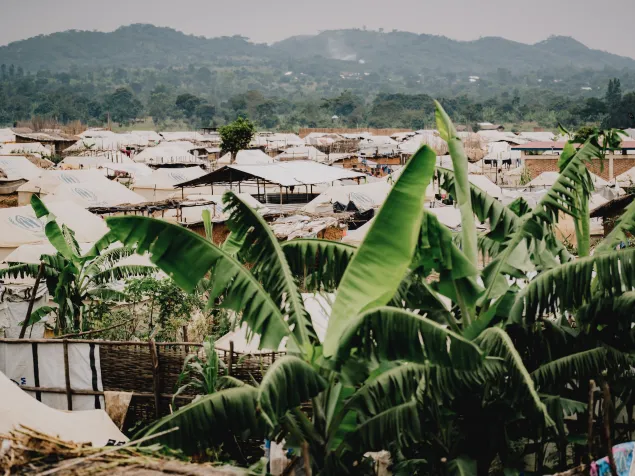
With 145,000 refugees, Burundi is the second-largest host country for Congolese people fleeing the conflict, many of whom now live in camps such as Musenyi.
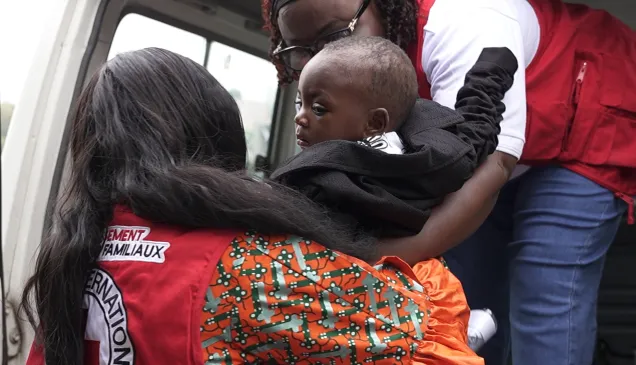
Furaha Salima was at home in her village when she heard the gunfire coming closer. She did what any mother would do without hesitation – she grabbed her children and they ran. When they reached the Rusizi River, the water that separates the DRC from Burundi, she saw a little girl standing alone. No one was claiming her. With little time to think about anything but their safety, Furaha took her by the hand and, together, they waded into the river and crossed to the other side.
She reached the Musenyi camp in Burundi in February 2025, several months pregnant, and gave birth at the camp clinic. Today she is raising six children in the camp, while the Red Cross Movement searches for the parents of the little girl she rescued at the river.
"We haven't found anyone yet," she says. "We're not sure if we have the right address."
One can only imagine what her parents themselves might be feeling.
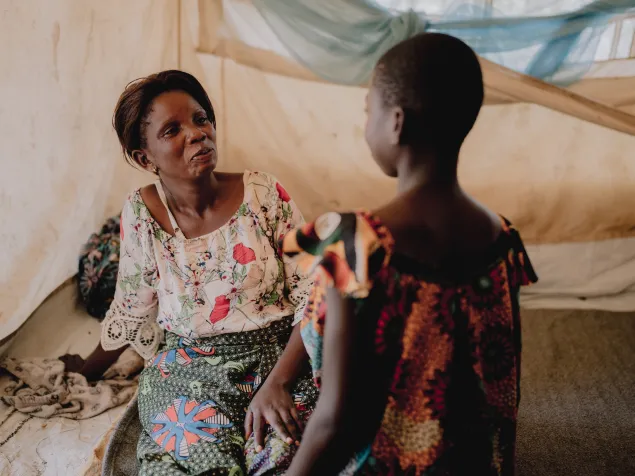
Furaha Salima fled Congo with her six children and an unaccompanied girl she found alone at the river.
One question, carried across borders
Across Africa, more than 1.2 million refugees and asylum seekers from the DRC have fled their country. More than half of them are in Uganda and Burundi. Since early 2025, intensified fighting in the eastern part of the country has displaced hundreds of thousands of people across the region.
These numbers are staggering, but the stories that lie behind them are even more so. The chaos doesn’t only displace people: it tears families apart. A mother runs one way, a son another. A border is crossed at night. A phone is lost, or stolen, or simply runs out of charge, and nothing is the same again.
In Africa's oldest refugee settlement and in some of the world's newest camps, the same question hangs in the air: Where is my family? And, very often, the same small object stands between a person and the answer – a phone.
Burundi: the newest camps
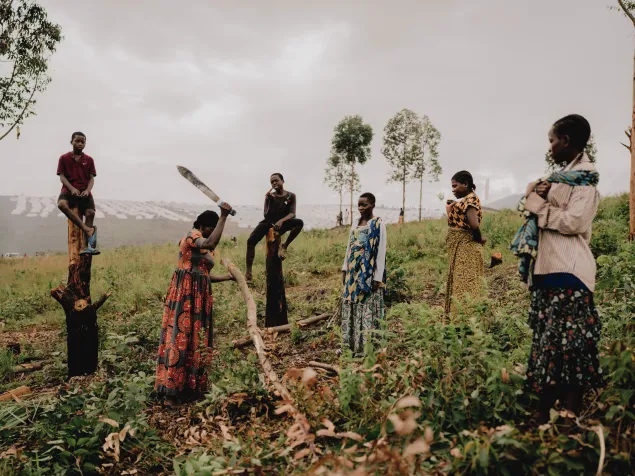
Congolese refugees collect firewood on the outskirts of Busuma camp in Burundi.
Musenyi and Busuma camps, dots on a map in Burundi, did not exist a few years ago. They were set up with plastic sheeting on low-lying land that floods when it rains, designed for a few thousand people and now holding tens of thousands.
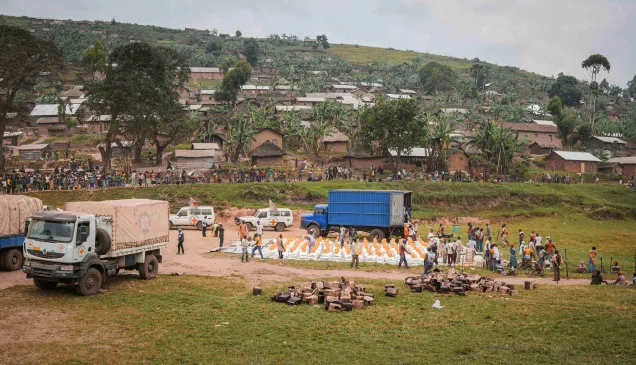
More than 80,000 Congolese refugees are seeking safety in Burundi's overcrowded camps. The ICRC works alongside the Burundi Red Cross to deliver humanitarian services here, from water trucking to disinfection, and to help families separated by conflict find one another again.
Maryam Batacoka arrived in Busuma in December 2025 with her baby, Promesse. She had crossed from Luvungi, leaving two other children behind, and she was searching for her aunt, who had fled to Uvira. At the Red Cross connectivity centre, she was finally able to reach her.
"My aunt is fine," she says. "But conditions are tough in the camp."
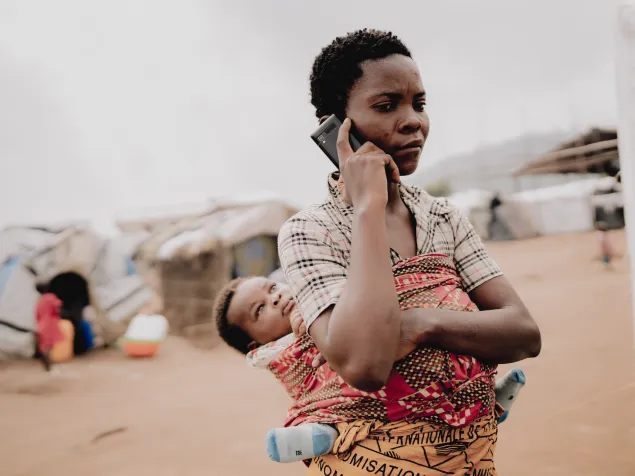
Maryam Batacoka arrived at Busuma camp in December 2025 with her child. Through the ICRC connectivity service, she reached her aunt in Uvira and learned she was alive.
A few metres away lives Annuarite Yamwaka, who was separated from three of her children while fleeing the fighting. She left Lubarika in December 2025, took refuge in Sange, then crossed the river into Burundi. Her children, she believes, are in the capital Bujumbura. Like Maryam, like thousands of others, she comes to the connectivity centre to search for them.
Last year, more than 10,000 calls were made through Red Cross connectivity centres in Burundi.
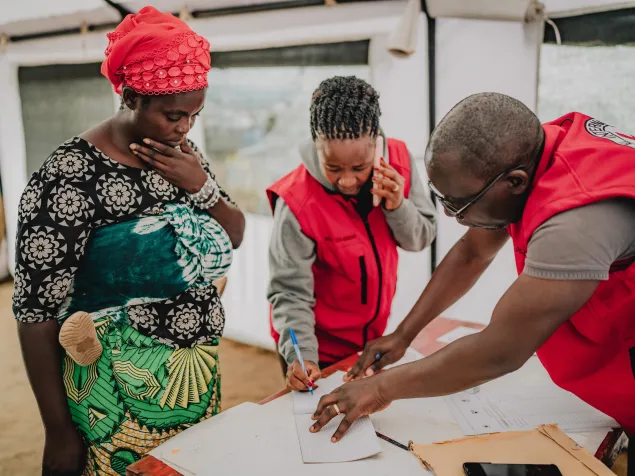
Noemie Niyongere, staff from the International Committee of the Red Cross (ICRC) assists Congolese refugee Annuarite Yamwaka at a connectivity centre. Annuarite fled fighting in Eastern Congo, and was separated from 3 of her children in the course of the displacement.
Uganda: the camp that has been listening for decades
Hundreds of kilometres to the north lies Nakivale, Africa's oldest refugee settlement. It has existed since 1958: a slice of Uganda the size of a medium-sized town, with its dirt tracks, markets and places of worship, and almost seven decades of arrivals layered into its hills. Here, the drama takes on a different tone. It is not the urgency of the new arrivals but the silent accumulation of years of waiting and loss.
It covers 72 square kilometres and stretches 34 kilometres from entrance to end. Around nine nationalities live here – Congolese, Burundians, South Sudanese, Somalis, Rwandans, Ethiopians and others – in a country that hosts nearly 1.9 million refugees.
Here, the question is the same. Only the waiting is longer.
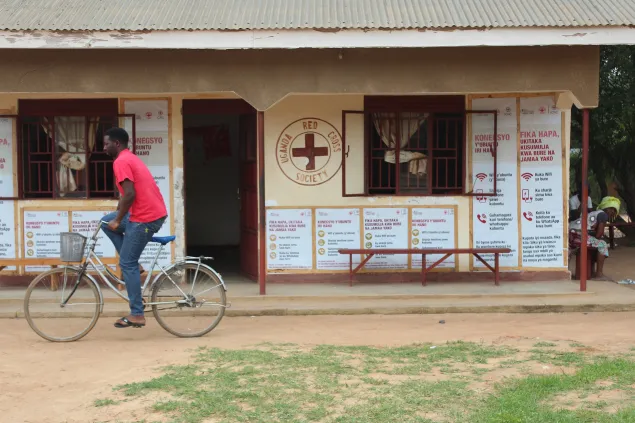
Uganda remained the largest host country, with more than 640,000 Congolese refugees and asylum-seekers. At the Red Cross connectivity centre in Nakivale, people charge their phones and access free Wi-Fi to search for family members lost during flight.
Michael Mugishu arrived from the DRC in 2025. He fled with his family and lost them along the way; a stranger guided him until he reached the settlement, alone. There are ten children in his family but he has no news of any of them – not his parents, not his younger siblings, not his older ones.
He comes to the Red Cross connectivity centre to charge his phone. When the phone is charged, there is free Wi-Fi, and the search continues.
"I have tried here and there," he says. " But I haven’t found my family."
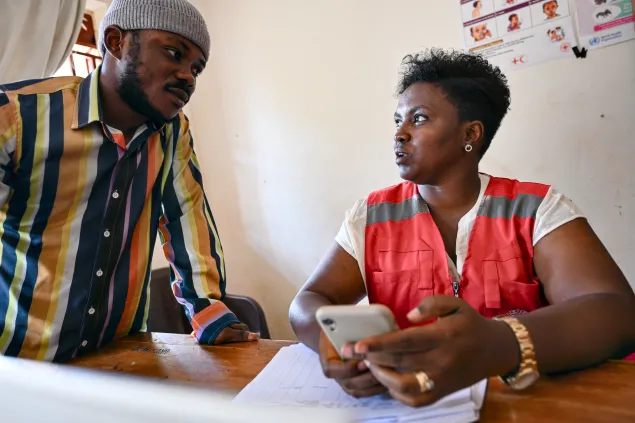
Michael Mugishu, refugee from DR Congo, arrived at Nakivale, Uganda alone after fleeing war, separated from his parents and nine siblings.
Anastasia Heri fled from Goma, the daughter of a family of ten children. She lost track of her family during the flight, and people in the settlement have told her that that a younger brother of hers may be in a nearby camp; of her parents, there has been nothing.
"I haven't seen my parents yet," she says.
At the connectivity centre, she calls and she searches. “It is a great help,” she says. “You really encourage me by being able to find information about my relatives who I have not seen yet. I feel like maybe my parents are not dead."
This is what searching looks like here: not a single dramatic phone call, but a rhythm – charge, call, message, return.
In 2025, over 17,000 calls were facilitated by the Red Cross in Uganda.
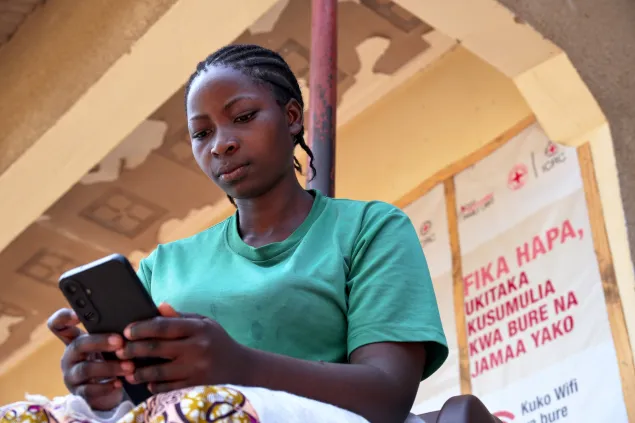
Anastasia Heri fled Goma in the DRC, separated from her parents and siblings in the chaos. She comes to the connectivity centre to call and search — "I feel like maybe my parents are not dead," she says.
Those who answer
Jessica knows this rhythm from the inside. She arrived in Uganda from the DRC in 2018, and she now volunteers at one of the connectivity centres in Nakivale, helping others do what she once had to figure out on her own: rebuild contact with the people they love.
She sees it every day. Children arrive without their parents. Most people cannot afford airtime on their own phones, so they come to the centre, every weekday, to make the call that matters most.
"The children came alone," she says. "They want to talk to their parents to know if they are still alive or if they have died."
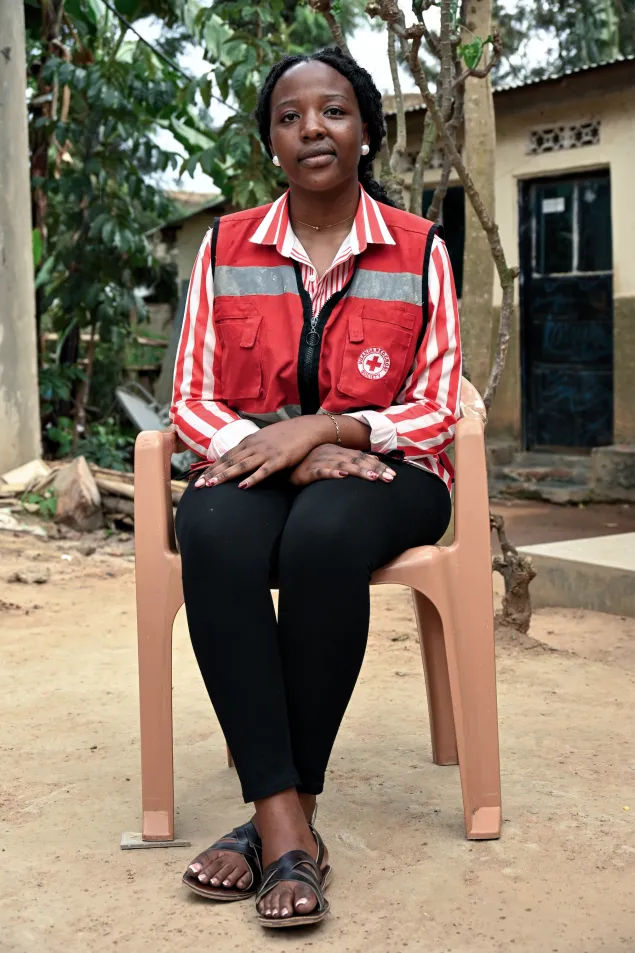
Jessica Caberuca arrived from the DRC in 2018 and now volunteers at Nakivale's reception center, helping newly arrived refugees reach their families by phone. "When they say thank you, I'm happy," she says.
Stewart Kukundapu was born in Uganda and coordinates the programme’s activities across Nakivale, where his team of volunteers goes door to door. Most of the volunteers are refugees themselves. That is deliberate: they speak the same languages as the people they serve, and they know what separation feels like, because they have lived it.
"These volunteers have gone through this," he says. "They know what it means to be a refugee, to be separated from a family member."
The services they offer are simple. A free three-minute phone call to share family news. A handwritten Red Cross message, carried across borders by the Movement's network, when there is an address but no phone number.
A tracing request when there is only a place name and the smallest glimmer of hope. A charging point, and thirty minutes of Wi-Fi. Simple perhaps – until your whole family is lost.
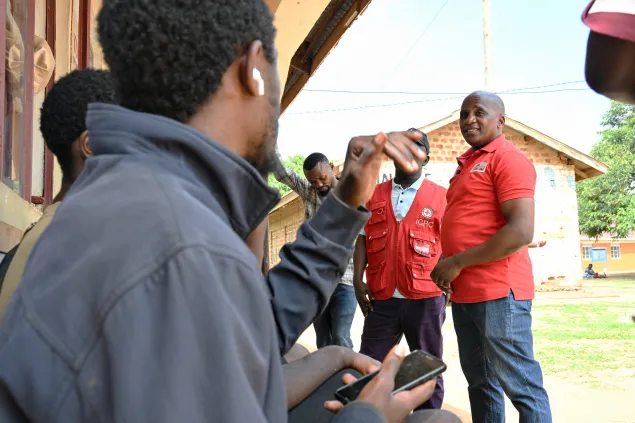
Stewart Kukundapu at Nakivale settlement. He leads family tracing and restoring contact services for refugees from nine countries at the Uganda Red Cross.
The search continues
The search for the family of the little girl from the river goes on. Furaha is raising her alongside her own children while the Red Cross keeps tracing, address by uncertain address.
In Musenyi, in Busuma, in Nakivale – camps decades apart in age but identical in their unanswered questions – the searching also continues.
One call, one message, one charged phone at a time.
UNCHR figures, 2025 report
Last year, around the world, 5.4 million people fled violence and persecution by seeking refuge in other countries. While Africa remains severely affected by forced displacement, it also provides refuge to those affected by it.
In the Democratic Republic of the Congo (DRC), for instance, peace has been absent for decades and armed conflict, climate crises and recurring epidemics have combined to create a seemingly endless humanitarian emergency.
According to UNHCR[1], more than 3.9 million people were internally displaced in 2025 due to deteriorating security and the ongoing conflict in the country’s eastern provinces of DRC. By the end of the year, 5.7 million people were still displaced within the country, while over 1.2 million more had crossed into neighboring countries such as Uganda and Burundi.
Uganda hosted 1.9 million refugees by the end of 2025, making it one of the world’s leading refugee-hosting countries. Of these, more than 640,000 came from the DRC, an increase of 16 per cent compared with the previous year as violence intensified in the east of the country.
Burundi, which in recent years has itself been a country of origin for hundreds of thousands of refugees, now also hosts those fleeing the same conflict. These refugees are living in camps that have been hastily built on low-lying agricultural land which was never designed to accommodate such large numbers of people.