Afghanistan: A year of providing healthcare and institutional support

On World Health Day 2026, attention turns to the urgent health challenges facing people in Afghanistan, where years of past conflict and current hostilities, economic and development difficulties, and natural disasters have strained an already fragile healthcare system. Millions continue to face limited access to healthcare services, particularly women, children, and those in remote areas.
Despite these challenges, the support provided by the International Committee of the Red Cross (ICRC) to 46 Basic Health Clinics (BHCs) and one District Hospital of the Afghan Red Crescent Society (ARCS) has proven to significantly contribute to improving the lives of the population.
In 2025, around 1.2 million patients, mostly women and children continued to access preventive care and early treatment at BHCs supported by the ICRC. By providing care at the earliest stages of illness, these facilities help reduce pressure on an already overstretched secondary healthcare system.
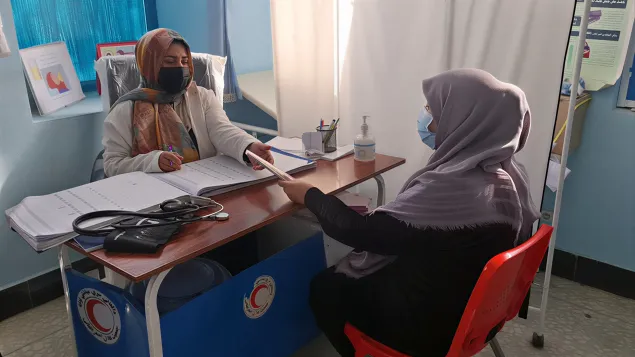
Parveen during her visit to Hazrat Abu Bakr Sediq, an ICRC-support Basic Healthcare Clinic in Herat.
It is projected by United Nations Office for the Coordination of Humanitarian Affairs (OCHA) that over 14.4 million people in the country require humanitarian health assistance during 2026. Decades of conflict have left the health system in Afghanistan heavily dependent on international assistance. The prolonged crisis and severe economic hardship mean that many families can no longer afford private health services.
In this context, healthcare services provided through ARCS clinics, supported by the ICRC, play a critical role in saving lives and ensuring that vulnerable communities can continue to receive quality care when they need it most.

A doctor examining little Bushra at a Basic Healthcare Clinic in Kandahar.
Akhtar Mohammad, a resident of Kandahar, recently brought his young daughter Bushra to an ARCS clinic supported by the ICRC after she developed flu. Having relied on the clinic for years, he describes it as an essential source of healthcare for his family.
The nutrition component of the BHCs has also been strengthened through effective coordination and the mobilization of partners, including UNICEF and World Food Programme. In addition, the ICRC continues to supply Ready-to-Use Therapeutic Food (RUTF) to ARCS BHCs that are not supported by other organization within the United Nations’ nutrition cluster.
Primary Health Care remains a priority for the ICRC and its Movement partners as a vital support system for people in need across Afghanistan. The programme is essential not only for the well-being of local communities but also for maintaining the ICRC’s understanding of the heath sector environment and ensuring the sustainability of its humanitarian operations in the country.
To further support the provision of healthcare services, the Emergency Department Support (EDS) Programme of the ICRC continued to strengthen emergency medical response and care across Afghanistan in 2024–2025, addressing gaps in clinical capacity, infrastructure, and emergency preparedness. Efforts focused on improving Emergency Departments’ functionality, upgrading equipment and infrastructure, reinforcing staff competencies, and enhancing readiness for Mass-Casualty Incidents (MCIs).
In 2024, the ICRC’s support was provided to the Emergency Departments of the Ghazni Provincial Hospital (GPH), Ghazni Regional Hospital (GRH), Rukha District Hospital (RDH), Khost Provincial Hospital (KPH), and Tirinkot Provincial Hospital (TPH). In 2025, as support concluded for GPH, GRH, and RDH, the programme onboarded Paktya Regional Hospital (PRH), Baghlan Provincial Hospital (BPH), and the Office of Prisons Administration 50-Bed Hospital (OPA-50BH), demonstrating continued adaptation to evolving humanitarian and operational needs.
Through its Basic Emergency Care (BEC) training programme, the ICRC has delivered 16 (12 BEC and four BEC Training of Trainer) comprehensive sessions, equipping 256 health professionals including 115 women and 141 men with vital life-saving skills.
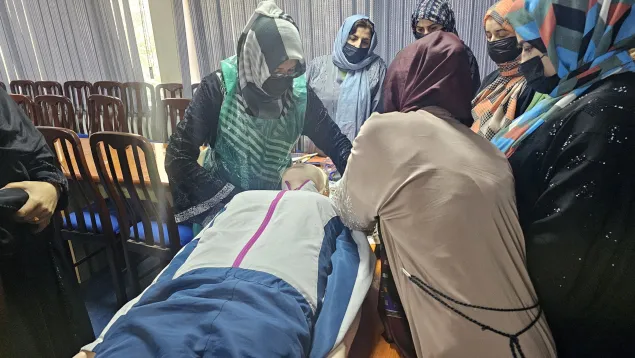
Female health personnel participating in a BEC training in Kabul.

The ICRC staff during Advanced First-Aid Training (AFAT) for Kabul Airport’s fire extinguishing staff. The training aimed to strengthen their practical skills in providing immediate lifesaving assistance during operational duties and emergencies.
In 2025, 53 First Aid training sessions were conducted across 16 provinces, reaching 779 responders. These training courses aimed to strengthen pre-hospital care capacity, enabling first responders to provide timely and life-saving assistance at the scene and during patient transport.
The ICRC prioritizes supporting Afghanistan’s healthcare system by partnering with health authorities including the Ministry of Public Health to improve access and sustainability through programmes like physical rehabilitation, first aid training, emergency medical supplies, trauma training, and primary care in collaboration with the ARCS.
Learn more about our work in Afghanistan
- Afghanistan: Four years of providing support to cerebral palsy patients
- Afghanistan: Unexploded ordnances continue devastating communities, mainly children
- Afghanistan: Searching for water is a daily battle for many Afghan families
- Afghanistan: Operational facts and figures, January to December 2025
- Frequently asked questions: Our work in Afghanistan