Afghanistan: Unexploded ordnances continue devastating communities, mainly children

As the world marks the International Day for Mine Awareness and Assistance in Mine Action on 4 April, the scale of weapon contamination in Afghanistan has made children particularly vulnerable. Children face fatal or life-changing injuries as they unknowingly step on landmines or pick up dangerous unexploded ordnance (UXO) that are littered around the places where they live, play or tend to be grazing animals.
In a quiet neighborhood of Herat, an ordinary morning in 2025 began like any other for 12-year-old Mohammad Asif. The sun had not risen as he walked to the mosque for prayers with his cousins, unaware that the day would alter his life forever.
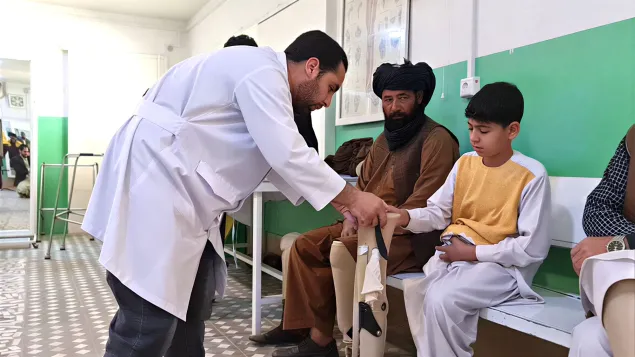
Mohmmad Asif is prepared to receive an artificial leg by a physiotherapist at the ICRC’s Physical Rehabilitation Center (PRC) in Herat.
On their way back home, they noticed something unusual lying on the ground. A small, unfamiliar object. It didn’t look dangerous. It didn’t look like something that could take lives. Out of curiosity, his cousin picked it up and carried it home. Inside the house Asif took it in his hands, trying to closely examine what it was.
“In that moment,” he recalled, “I was just curious, I didn’t think it could hurt us.” The object slipped from his hands and a sudden loud explosion shattered the morning calm.
“When I opened my eyes, everything had changed,” Asif said. “I was in the hospital. At first, I didn’t understand what had happened. Then I saw my parents’ faces and I knew something was terribly wrong.” The blast had taken more than he could comprehend. Three of his cousins were gone. His baby sister, just one and a half years old had been killed and he had lost his right leg.
The days that followed were filled with grief, confusion, and long hours of recovery. But slowly, amid the darkness, a path forward began to emerge for Asif.
At the ICRC’s PRC in Herat, Asif began learning how to live again. Step by step, he was fitted with an artificial limb and supported through the long process of walking again, each movement a small victory against what he had lost.
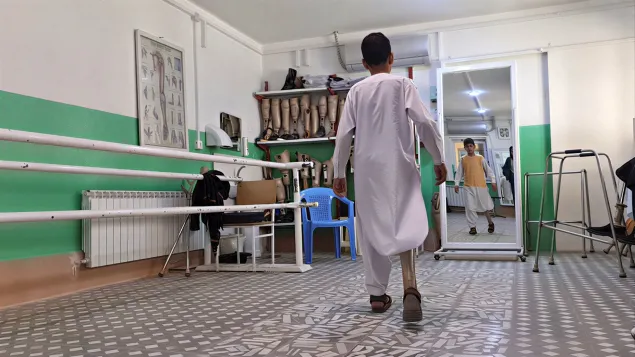
Mohammad Asif takes steps with his newly fitted artificial limb at the ICRC’s PRC in Herat.
“It was not easy,” he said. “But they stood by me. They helped me believe that my life was not over.” With time, his strength returned, he went back to school. He began studying English courses with the ICRC’s financial support so he could continue his education and keep up with his classmates.
He carries a message shaped by loss, but driven by hope,
Please, to all children, if you see something you don’t recognize, don’t touch it. Don’t bring it home. What looks harmless can take everything from you. I don’t want anyone else to go through what I did.

The diagram shows the weapon contamination incidents in Afghanistan.
In 2025, data from Directorate of Mine Action Coordination (DMAC) on weapon contamination in Afghanistan reveals a continuing and deeply uneven humanitarian crisis. A total of 217 incidents were recorded across the country, resulting in 92 deaths and 375 injuries. Behind these numbers lies a stark reality, that explosive remnants of war and landmines remain a daily threat to communities, shaping how people live, move, and survive.
The eastern region stands out as the most affected, with 67 recorded incidents which is nearly one-third of the national total. The western region follows with 48 incidents, while the south accounts for 34. Central and south-eastern regions report moderate levels, with 23 and 22 incidents respectively.
In contrast, the north and north-east show lower figures, at 14 and 9 incidents, though the danger there is far from absent. This geographical pattern reflects the legacy of past conflicts and ongoing vulnerabilities.
The human toll is especially alarming. For every person killed, roughly four others are injured, many of them left with life-changing injuries causing disabilities that require long-term care and support.
Children make up the overwhelming majority, with 309 casualties accounting for 66 per cent out of total. Their vulnerability is often linked to everyday activities such playing outdoors, helping their families by collecting scraps, or unknowingly handling dangerous objects.
Overall, the figures point to a crisis that is both immediate and long-term. The high number of child casualties underscores an urgent need for stronger risk education and community awareness. At the same time, the scale of injuries highlights the growing burden on limited healthcare and rehabilitation services.
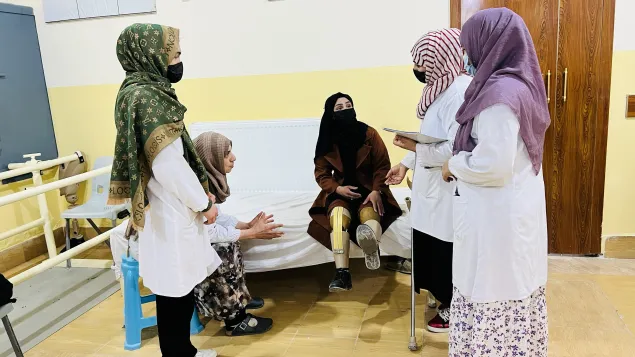
Marzia Hussaini with physiotherapists at the ICRC’s PRC in Mazar-e-Sharif.
In Mazar-e-Sharif, 25-year-old Marzia Hussaini’s life changed in an instant. “We were travelling when our car hit a landmine,” she recalled. “When I woke up, both of my legs were gone. It felt like my life had ended.”
The days that followed were filled with despair. “I lost hope,” she said. “Everything felt dark, and I could not imagine a future.” But at the ICRC’s PRC, something shifted. “I saw others like me who were still moving forward. That gave me strength.”
With time, she was fitted with artificial limbs and slowly with the help of the physiotherapists she began walking again. Through the ICRC’s social inclusion program, she also received an interest-free loan to rebuild her life.
“Now I run a small cattle business and sell dairy products to support my family,” she said.
In 2025, ICRC’s PRCs assisted over 6,750 people affected by mines and explosive ordinance. Kabul recorded the highest number of beneficiaries (2,221), followed by Jalalabad (1,328), Mazar (924), and Herat (871), while centers like Faizabad (457) and Gulbahar (265) reported lower but still significant caseloads.
The demographic breakdown shows that men and boys accounted for 6,225 users, compared to 359 women and girls.
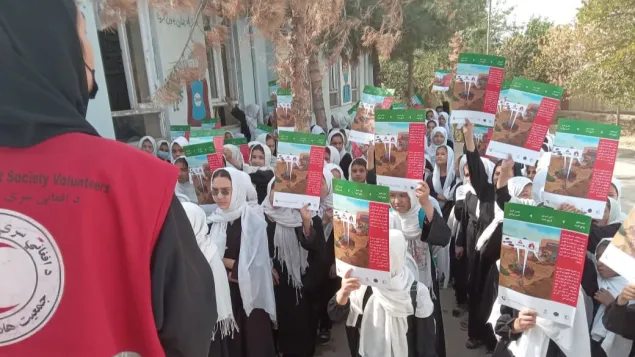
An ARCS volunteer providing RASB session for 50 school students in Saripal province Sayedabad area.
Additionally, between 2023 and 2025, the ICRC, in partnership with the Afghan Red Crescent Society (ARCS), trained 120 volunteers to conduct Risk Awareness and Safer Behaviour (RASB) sessions across five regions of Afghanistan particularly contaminated by mines and UXOs.
In 2025, over 210,500 people (130,742 children, 41,851 men and 37,990 women) in six regions contaminated by weapons were trained in RASB by the ARCS volunteers.
Clearing these weapons is essential to restore safety and security. Carrying this out and making sure that communities are aware of the risks is a long-term task that requires combined involvement and coordination with the national authorities, the ARCS, and International Organizations.
Learn more about our work in Afghanistan
- Afghanistan: Searching for water is a daily battle for many Afghan families
- Afghanistan: A visual journey through Afghanistan’s humanitarian challenges and ICRC’s humanitarian response
- Earthquake in Afghanistan: ICRC response
- Afghanistan: Operational facts and figures, January to December 2025
- Frequently asked questions: Our work in Afghanistan