Ethiopia: Helping those caught in the middle of the conflict in Oromia

Communities in several parts of Ethiopia’s Oromia region have been heavily affected by recent conflict and violence. Every day, people fear the impact of armed violence on their safety and livelihoods. The ICRC is responding to many humanitarian needs in the region, mostly in cooperation with the Ethiopian Red Cross Society (ERCS).
"We work in some of the most affected areas of the region, in East and West Wollega, Horo Guduru Wollega, Guji and Borena zones,” says Igor Moroz, deputy head of the ICRC in Oromia, based in Nekemte. “Our teams do their utmost to help restore access to essential services and reach those caught in the middle of the conflict.”
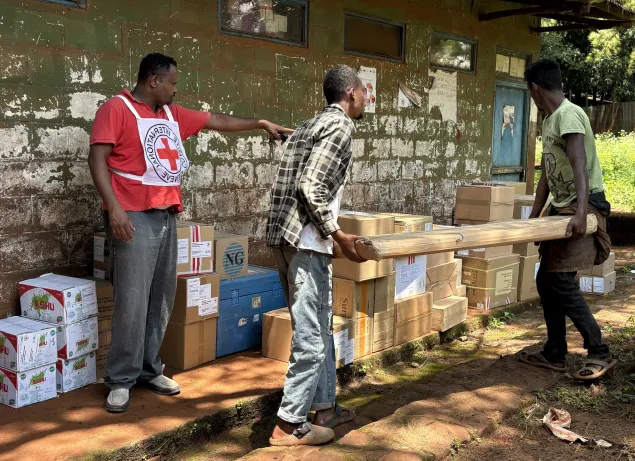
Offloading the medical donation at the Primary Health Center in Balo kebele, Sasiga woreda, East Wellega.
In partnership with ERCS we have supported tens of thousands of families in Oromia in recent weeks:
- We donated medical supplies to support health facilities, benefiting over 125,000 patients and often enabling staff to conduct significantly more consultations. We renovated two health centres, while similar projects are under way at two other health facilities.
- To ensure access to safe water, we restored over 300 hand pumps and installed solar power to upgrade pumps, boreholes and water systems. These works have benefited 90,000 people so far, and many more will be reached upon completion of ongoing projects.
- To strengthen the resilience of communities, we provided agricultural tools to 7,000 farming families in East and West Wollega, and cash to help almost 2,900 families replace lost assets in East Wollega, West Wollega and East Borena.
- In our efforts to help separated families restore or maintain contact with their loved ones, we contacted over 70 families in the region over the past two months.
Earlier this year, over 2,300 displaced people received assistance to address urgent needs in Angar village, Sasiga district, in the East Wollega zone. “When we met them first, these people had no possessions,” says Igor Moroz. “Working with ERCS, we also improved their access to clean water and sanitation.”
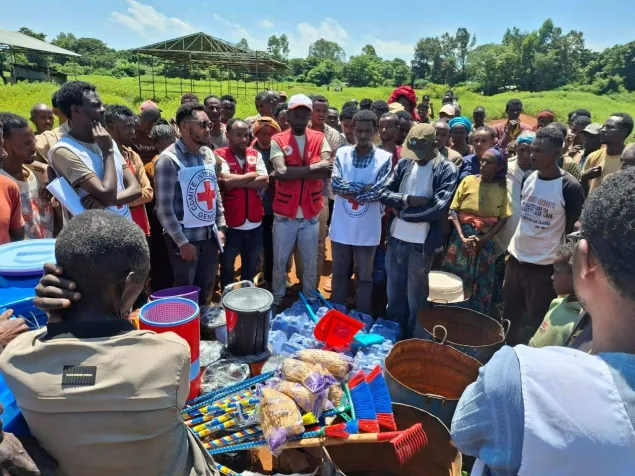
Sanitary materials are distributed as part of the emergency assistance to displaced people in Angar kebele, Sasiga woreda.
Despite the difficult security environment, the ICRC met several times with arms carriers, authorities, religious and community leaders to strengthen respect for international humanitarian law and other relevant rules. It also facilitated workshops in East and West Wollega to train first responders on the proper management of the dead.
In Ethiopia, the ICRC is attentive to emerging humanitarian needs related to conflict and violence, both in the areas where it operates and beyond. This includes Moyale and its surroundings in the Oromia and Somali regions, on the border with Kenya, where continuous clashes have resulted in a wide range of humanitarian needs. While the assessments and response are being led by other humanitarian organizations, the ICRC stands ready to help through its main partner, ERCS, in coordination with all those concerned, to ensure the most acute needs are covered.

Upgrading hand pumps to solar-powered water systems in rural communities, here in Wal-Jallachisa Sirba kebele in Guduru woreda.