Ethiopia: A powerful guide for those who carry weapons

What is the ICRC’s role in assisting arms carriers to promote international humanitarian rules and undertake to ensure their respect? This article aims to provide some answers, focusing on what this means in Ethiopia today.
“A refresher on the law can be a powerful guide in difficult situations,” said an Ethiopian military Colonel during one of the ICRC’s sessions on international humanitarian law (IHL), also known as the law of armed conflict or law of war. When states adopt these international rules, notably the universally endorsed Geneva Conventions of 1949, they commit themselves to disseminating them.
This engagement to disseminate IHL is valid both in peacetime and in periods of armed conflict. In Ethiopia, in 2026, both situations coexist in parts of the country. Numerous, mostly rural areas of the Amhara, Oromia and Tigray regions are affected by conflict, or by the consequences thereof. The ICRC engages with all those involved in fighting to help prevent violations of IHL. Our prevention efforts complement our bilateral dialogue – notably to address issues affecting the civilian population – and are carried out in complementarity with the Ethiopian Red Cross Society (ERCS). These combined efforts come in addition to helping communities in those areas, often alongside the ERCS.
Training for armed and security forces
In Ethiopia, in the first semester of 2026, the ICRC engaged with more than 1,600 arms carriers through workshops and meetings on the law of armed conflict and other applicable rules. Twice as many were reached in 2025, a year in which we organized almost 70 training sessions for armed and security forces, mostly in operational areas. Subjects addressed in these sessions include respect due to the civilians, the wounded, protection of health staff and facilities, humane treatment of detainees.
“We will apply this training to ensure our junior soldiers clearly understand their obligations,” said an Ethiopian National Defense Force (ENDF) officer. Through practical discussions and lessons drawn from past conflicts, participants explore concrete ways to uphold legal and humanitarian standards in combat. The Federal Police, Regional Police, and Militias are similarly engaged about the respect for IHL and the use of force in the field, particularly in the Amhara and Oromia regions. In addition, all these forces need to know about the humanitarian roles and fundamental principles of the ICRC and the ERCS, to allow them safe access to people in need.
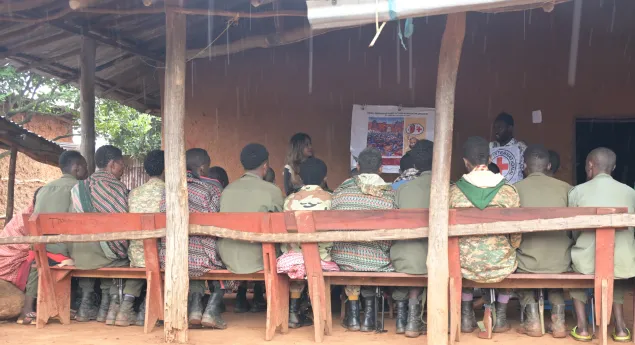
Session on international humanitarian law and the use of force with Ethiopian militia members.
“It is those who carry weapons who can kill – and be killed. It is also they who can facilitate or hinder humanitarian action. We therefore maintain a dialogue with all weapon bearers, State and non-State, as part of our mandate to protect and assist people affected by war and other violence”. (ICRC, on its dialogue with weapon bearers globally)
Armed groups must also know the rules – notably in Amhara and Oromia
In Ethiopia and elsewhere, non-State armed groups involved in conflict also need to know and respect IHL. We reach out to them with the same messages calling for the safeguard of civilians, wounded and sick, those no longer fighting, health- and humanitarian workers. These engagements are adapted to the specificities of these groups, involving informal sessions rather than structured “training”, and keeping bilateral dialogue as the main type of interaction on the humanitarian issues at stake.
We are sometimes asked why we engage with armed groups such as those operating in the Amhara and Oromia regions. The answer is found in the ICRC’s neutrality, which means that, in any situation of armed conflict or armed violence, we cannot, and do not, take sides. In Ethiopia, to carry out our humanitarian work, we maintain a strictly humanitarian and confidential dialogue with all those involved in conflicts, including members of such non-State armed groups.
These contacts aim to strengthen both the respect for basic humanitarian principles and our safe access to conflict-affected communities, often in remote areas. This dialogue doesn’t imply any political recognition or endorsement of these armed groups.
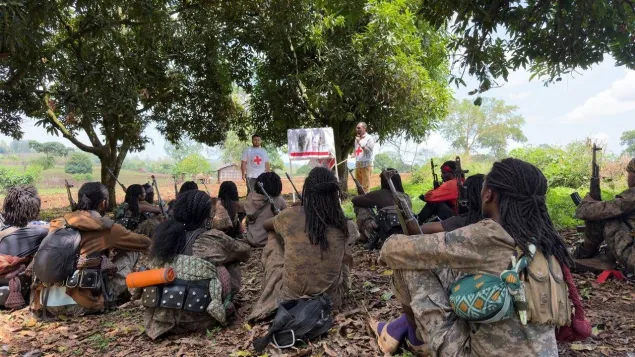
Engagement on basic humanitarian rules with a non-State armed group in Ethiopia.
In and around the Tigray region
In recent months, the ICRC conducted sessions with ENDF operational commands in Bahir Dar, Woldiya, Kombolcha, and various other locations of northern Ethiopia, to discuss IHL and its unique humanitarian role. The sessions highlighted the importance of protecting civilians and respecting the rules of armed conflict. The ICRC also conducted sessions on IHL with Tigray security forces in Shire, Wukro, Maichew, and elsewhere in the region.
“As is public knowledge, lately the situation on the ground has been tense, so the ICRC has been engaging with the ENDF and the Tigray forces to help them meet their IHL obligations should hostilities further escalate,” said an ICRC expert in the law of war.
He added: “We do the same job in peacetime and in wartime, whether things are quiet or tensions arise. Of course, peace is always the better solution for the civilian population.” As a matter of fact, respect for IHL during conflicts can contribute to the return to lasting peace.
Conduct of armed hostilities
As part of its IHL-related role, the ICRC also monitors the parties’ conduct of armed hostilities. Military necessity must always balance with the humanitarian objective of reducing human suffering, particularly among civilians. Key principles of IHL must be respected in this regard, such as distinction (ensuring that military action is not directed against civilian persons or objects) and proportionality (avoiding excessive civilian harm in relation to the concrete and direct anticipated military advantage).
Resolutions adopted in the International Conferences of 2019 and 2024 further emphasize the responsibility of the Red Cross and Red Crescent Movement to take concrete steps to disseminate IHL effectively. In doing so, we need to pay particular attention to those called upon to implement or apply IHL, namely the authorities and those who carry weapons.