Preserving humanity and dignity in the Philippines’ armed conflicts

I first met Sandra* inside a detention center in Cavite several years ago. While other detainees actively participated in our discussions, Sandra was one of the quiet ones. On the last day of our visit, however, she approached me and asked for help. She wanted to reach out to her father, whom she hadn’t seen in 10 years.
I visit some of the country’s jails and prisons as a protection field officer for the International Committee of the Red Cross (ICRC), a humanitarian organization that works to preserve the dignity of people and relieve their suffering whenever war strikes. Our visits are meant to help uphold the humane treatment of detainees, specifically those arrested in relation to conflict; to advocate for their access to food, clean water, sanitary and healthcare facilities; and support them in contacting their families.
Sandra told us that she wanted to send her father a Red Cross message, a letter containing family news that detainees can send to and receive from their loved ones. In many cases, like Sandra’s, those behind bars have not had contact with their families for years—even decades.
“I want him to know that I am here in jail,” she said.
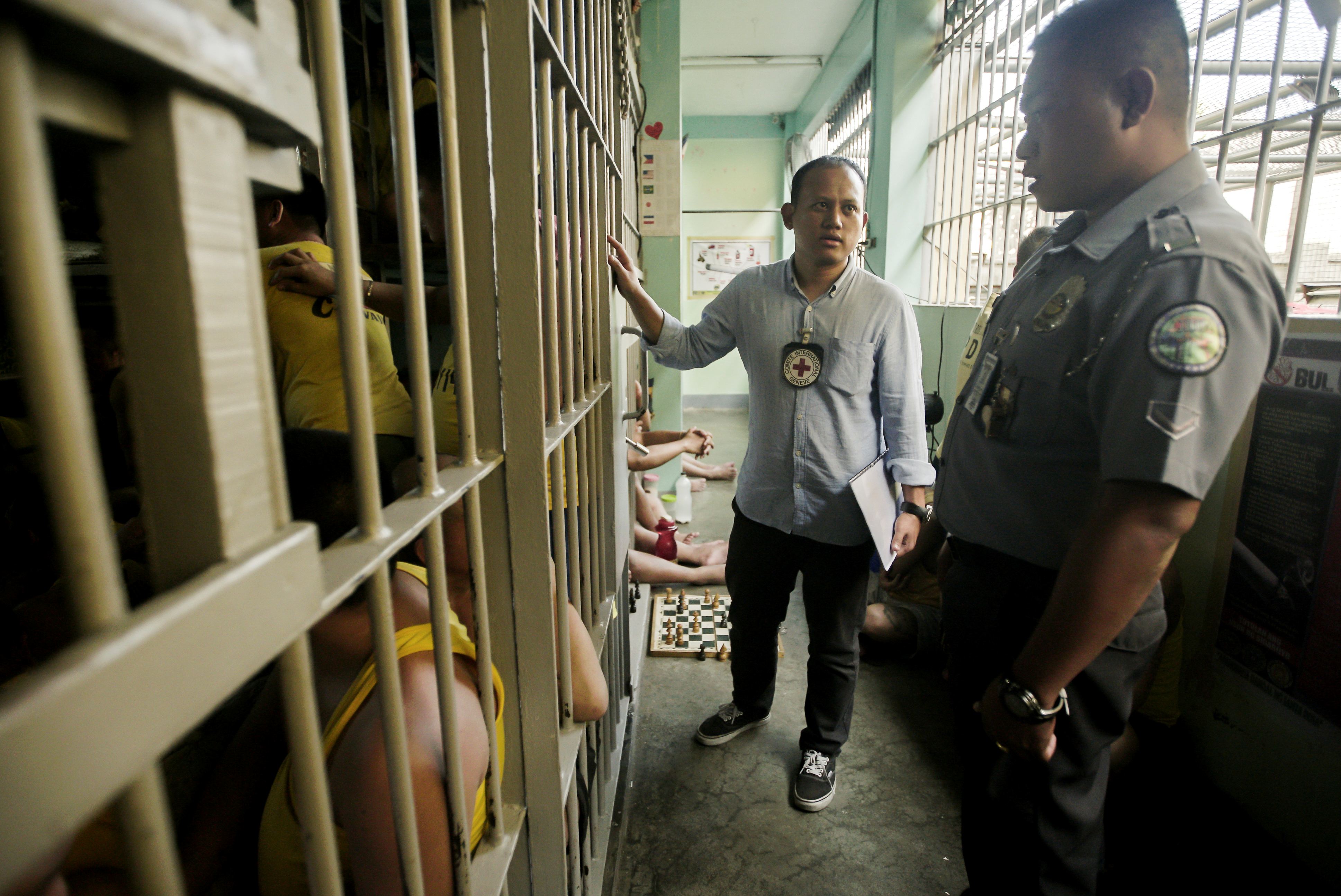
Von Gustilo visits a jail in Laguna as part of the ICRC’s work to monitor conditions of detention and the treatment afforded to detainees. Photo: Vee Salazar/ICRC
To reconnect detainees and their families, the ICRC often works with the Philippine Red Cross (PRC) and its network of 102 chapters in the country. Sandra gave us the last known address of her father, which was handed to the PRC along with the Red Cross message.
The father’s address was vague, so the PRC had a hard time trying to find the father. But after several attempts, the PRC was able to find him.
When the PRC found Sandra’s father in the Visayas region, he was emotional. He thought Sandra was dead, so he was really surprised to receive that letter.
The father wrote a Red Cross message to Sandra, and we brought his letter to her in jail. Sandra was very touched when she received this, and we arranged a phone call with her father almost immediately. This was a momentous occasion for her, and she was overjoyed.
This is just one of the many (often unique) ways in which the ICRC has helped detainees and their families, displaced communities, the wounded and sick, and those whose loved ones went missing due to the conflict, in over 90 countries.
Building trust in the community
For the past 14 years that I have worked for the ICRC, I have become familiar with how armed conflict affects people. They face harm, death or destruction, while some people have had to deal with invisible scars. Some people have lost their livelihoods after they had to move to another place to escape the fighting.
It is for this reason that the ICRC urges arms carriers—both state and nonstate—to respect international humanitarian law (IHL), or the rules of war. IHL makes it clear that civilians must not be attacked. We strive to have bilateral and confidential dialogues with the warring sides to raise the affected communities’ concerns so they could be addressed and prevented from happening again. We build relationships with affected people based on trust, respect and our commitment to a purely humanitarian mission.
One memory that stands out to me is when we went to a remote village in Northern Samar many years ago. The ICRC is one of the few humanitarian organizations that go to the province, parts of which have been called “geographically isolated and disadvantaged areas.” Public transportation is almost non-existent, and many roads are unpaved. My colleagues and I often must walk for several hours through muddy fields to reach the homes of affected people.
The residents in the village met us with suspicion at the time, as they didn’t know the ICRC. So, we introduced the organization and discussed our activities in areas like Mindanao, where we have a wider, more consistent presence due to decades of internal armed conflicts there. After months of relationship-building, they began to trust us. When we visited them again, they would freely share their concerns, such as how they were being affected by the conflict.
Later, one of the leaders shared a concern that could result in the residents being caught in the crossfire in case fighting happened. Residents felt pressure from one party to the conflict, and they were hesitant to give in to a certain request.
We informed the community that they had a right to be protected and not to be put at risk. We didn’t even have to intervene: the residents addressed the issue directly with the group concerned, which thankfully listened to them.
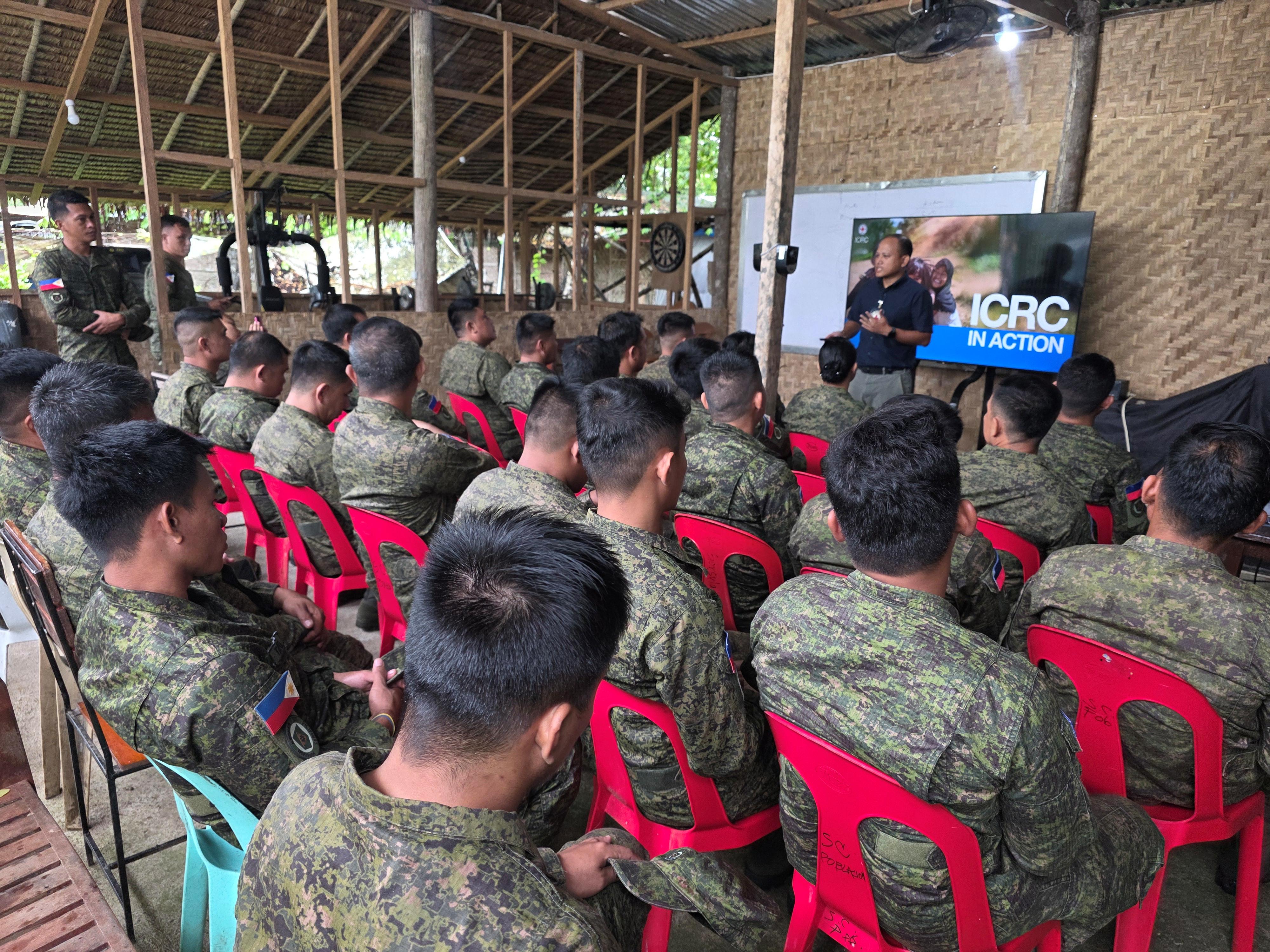
Von gives an orientation to soldiers in Negros, where he emphasizes the obligations that all parties to the conflict have under IHL to protect affected people. Photo: Allelu de Jesus/ICRC
Effecting meaningful change
In my work in the ICRC, I have met farmers who have lost access to their farmlands. When an armed conflict strikes, the movement of the people who work there could be restricted by parties to the conflict. In some places, farmers are not allowed to bring certain objects to their farms.
There was this case in Northern Samar where we had to intervene on behalf of the residents by discussing the matter with the concerned party to the conflict. As part of our bilateral and confidential dialogue, we emphasized that it was important for the farmers to be allowed to work longer in their fields, or they would suffer financially.
This dialogue took several months. Eventually, they were convinced, and the farmers have told us that they are able to work longer in their fields.
Such is our “protection” action—it’s not as visible as giving food or water because it’s about protecting the life and dignity of civilians by persuading arms bearers to abide by IHL and recognizing the value of doing so.
When parties to the conflict follow the rules of war—to spare civilians and those who are not or no longer participating in the fighting—there are fewer grievances and more possible pathways to peace.
The ways in which we help conflict-affected people goes far beyond the examples I have shared. We regularly orient community members and leaders, arms bearers, authorities, journalists, religious groups, and other stakeholders, so that they develop a better understanding of what IHL is and how they can all contribute to an environment that respects the rules of war. This is necessary because the ICRC cannot do this alone— protecting individuals affected by armed conflict requires a collective effort, particularly through all parties to the conflict respecting their obligations under IHL.
The good news is that armed clashes have been on a downward trend in many parts of the Philippines. Despite that, we are still witnessing pockets of fighting where communities are still at the receiving end. We in the ICRC will remain on the frontline of humanity: standing with the affected people, to their safety and dignity, for over 160 years.
* Name has been changed to protect the person’s identity.
Article written by Von Gustilo, ICRC field team leader