Somalia’s families face impossible choices as fuel and food costs soar

Somalia is in the grip of a hunger crisis. At Kismayo General Hospital in southern Somalia, the ICRC-supported stabilization centre saw a 41% increase in child admissions during the first half of 2026 compared to the same period last year – all of whom were malnourished.
One of them is Hassan. He is not yet three and a half years old. Hassan arrived at the centre in July, showing signs of severe malnutrition, stomatitis, marasmus, and pneumonia.
His mother, Sabirin, is a widow. When she saw Hassan’s condition deteriorate, she knew it was a matter of life or death. But with no clinic nearby, transport prohibitively expensive, and the roads clogged with mud, reaching help would not be easy.
“[Hassan] was swollen, and his skin was cracking all over. I didn’t have money for transport, so contributions were made. I got in the car, and we spent days on the road. It had rained, making the road impassable. We got here on the third night, around evening,” she said.
“Now, thank God, he is doing better.”
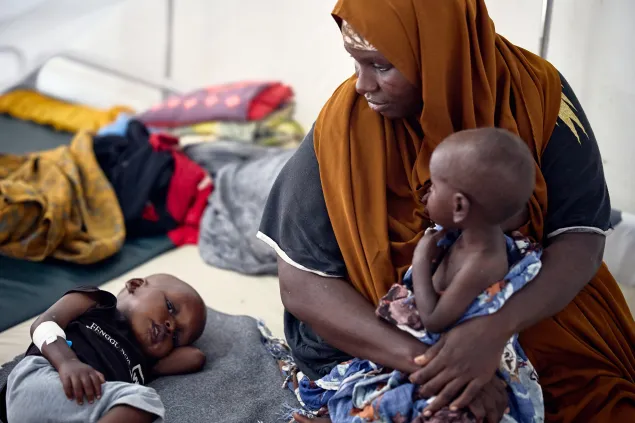
Sabirin Abdi Idris with her two sons, Hassan and Mohamed, at the Kismayo Stabilization Centre.
The ICRC has recently expanded the number of Somali Red Crescent nutrition clinics it supports from 10 to 22. But access remains a challenge: many rural areas still lack health facilities, and some have been forced to close due to aid cuts.
As a result, families often travel for days to get help, paying large sums of money to cover the cost of fuel, which has more than doubled in recent months due to disruptions along regional shipping routes.
Like Sabirin, Hawa had an arduous 60-kilometre journey to Kismayo General Hospital - the only facility in the region equipped to provide the life-saving care that her daughter, Nasro, so desperately needed.
Hawa saved for weeks to afford the $30 taxi fare, as Nasro’s health deteriorated by the hour. By the time they arrived at the hospital, Nasro’s condition was critical. She was rushed to the intensive care unit and has since shown signs of improvement.
“I came yesterday and spent the night here. When I arrived, they examined [Nasro] and fixed an IV on her after giving her an injection. They gave her milk,” Hawa said.
“She’s better than she was yesterday. She was in critical condition. Now her eyes are open."
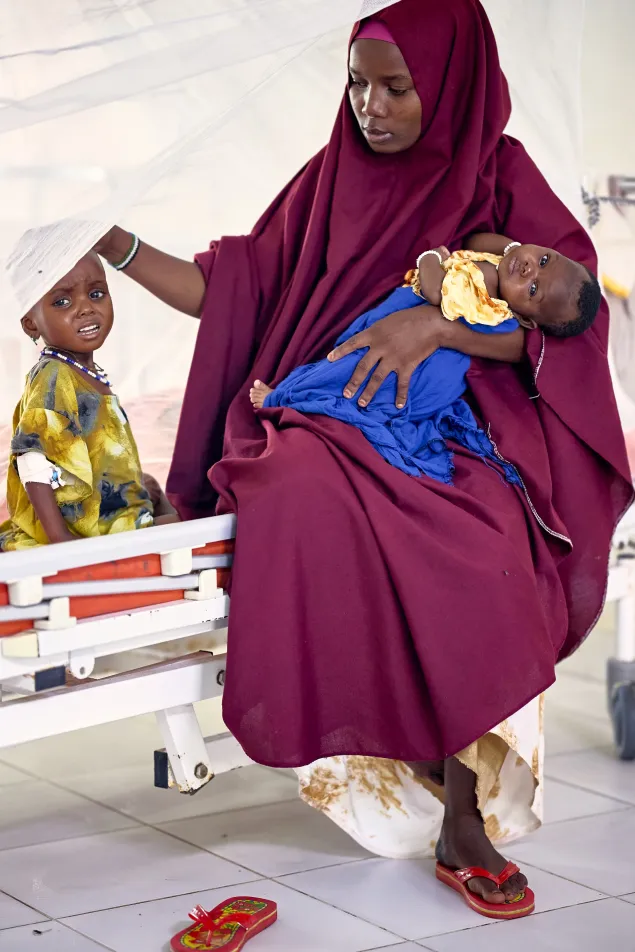
Hawa Osman Mahamud sits in the ICU wing of the Kismayo Stabilization Centre with her two children.
Shrinking aid funding, the lingering effects of drought, and increasing costs of basic goods like food and fuel are driving acute food insecurity across Somalia. This impact is noticeable in Kismayo’s markets, where the soaring cost of transporting and purchasing food is a major burden for families already living on the edge.
Everything in the world depends on fuel. Before the conflict [in Iran], five litres of fuel sold for $3.80. This morning, five litres were going for $8.50. You can see the difference. This change affects everything we use,”
said Ali Isse, a trader in Jamaame market in Kismayo.
“Almost 95 per cent of everything has been affected. A sack of potatoes used to cost $45, but today it’s $80. That’s a $35 increase, all because of the ongoing conflict. It’s disrupted the shipping routes for fuel, and this is impacting our daily lives.”
As needs rise, funding is shrinking. Aid cuts have resulted in devastating disruptions to healthcare, nutritional programmes, and food assistance, with women and children especially hard hit.
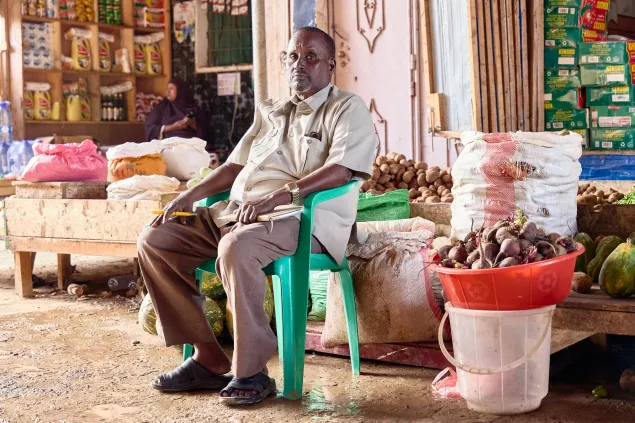
Ali Isse, a trader in Jamaame market.
“We’re seeing the combined impact of rising fuel and food costs, the lingering consequences of drought which have disrupted livelihoods, and reductions in aid funding just as families in Somalia need that help the most. We are working with our partners, the Somali Red Crescent, to provide healthcare services across the country, but more work is needed,” said Antoine Grand, head of the ICRC in Somalia.
Despite budget reductions, Somalia remains the ICRC’s third-largest operation in Africa, with a budget of $80 million. Without urgent and sustained funding relative to the scale of needs, however, more lives will be lost and the gains made in building resilience among communities will be reversed.