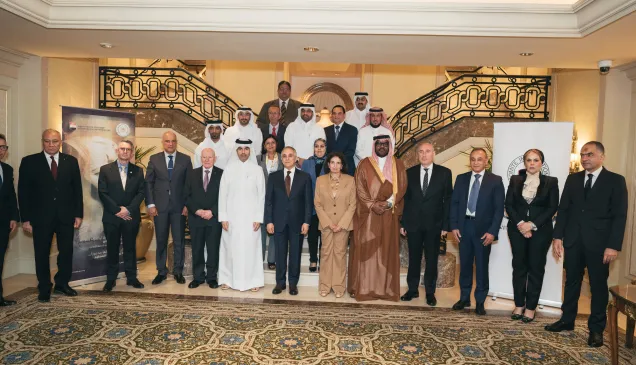
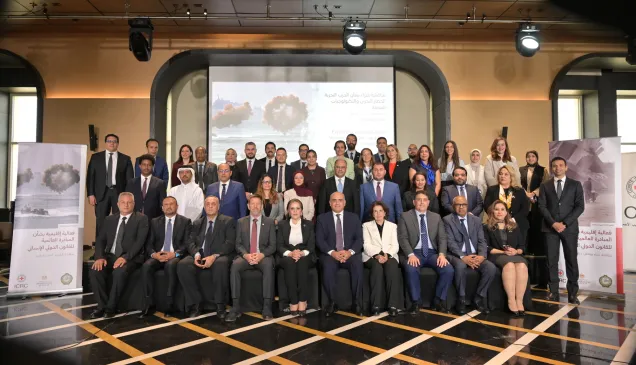
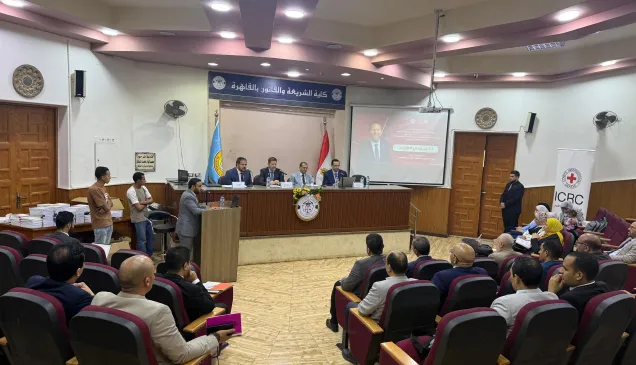
Bringing together expertise in IHL and Islamic jurisprudence, the seminar aimed to deepen understanding of the humanitarian principles shared by the two legal traditions and discuss their relevance to the protection of people affected by armed conflict.
“Our seminar opens avenues for dialogue on the shared values and noble principles of Islamic law and IHL, foremost among them safeguarding human dignity, promoting compassion and solidarity, and alleviating human suffering, particularly during crises and conflicts. These shared principles foster a common understanding of our moral and humanitarian responsibility towards humanity,” said Professor Abeer Badawy, Dean of the Faculty of Islamic and Arabic Studies, during the opening ceremony.
Ahmed El-Sintrissy, Professor of Public Law at the Faculty of Sharia and Law in Cairo, echoed this view, stressing that the similarities between IHL and Islamic Sharia are no coincidence. “Modern international humanitarian law, with its conventions and principles designed to protect the vulnerable, safeguard civilians and limit the cruelty of war, did not emerge from a vacuum. Rather, it reflects and formalises deeply rooted ethical and humanitarian values,” he said in his opening remarks.
The first day of the seminar was dedicated to teachers and faculty members, while the second one brought together 70 students from the Faculty of Sharia and Law representing several governorates across Egypt.
The seminar featured sessions introducing the ICRC and the International Red Cross and Red Crescent Movement, the ICRC’s work in Egypt, and Al-Azhar’s efforts in the humanitarian field. Participants also explored the role of national committees in promoting and implementing IHL at the national level.
A panel discussion examined the protection of missing persons and their families from the perspectives of IHL and Islamic Sharia law. The issue of missing persons has profound humanitarian consequences, affecting not only those whose fate and whereabouts remain unknown but also the families left waiting for answers.
Over the past five years, the number of missing-person cases reported to the ICRC has almost tripled. “When addressing the issue of missing persons, we must put their families at the centre, as they bear the humanitarian consequences of this uncertainty. Families have a right to know, and living with the pain of not knowing, without closure, is extremely difficult. States should therefore take families’ needs into account when developing legal and policy frameworks,” said Basant Abdel Meguid, Regional Legal Advisor at the ICRC, during the panel discussion.
Badeea Al-Tamlawy, Professor of Comparative Islamic Jurisprudence at the Faculty of Islamic and Arabic Studies said that human dignity remains a priority even after death. “Families’ right to know the fate of their loved ones is not merely an emotional need, but an ethical and legal right. Islam recognises these needs and upholds these rights,” she said.
The seminar is part of the ICRC Egypt delegation’s ongoing collaboration with Al-Azhar and the ICRC’s broader dialogue with Islamic scholars and academics worldwide. As with other religious and cultural traditions, this dialogue aims to highlight the shared principles and values that transcend differences and are common to all humanity.
About the ICRC
The International Committee of the Red Cross (ICRC) is an impartial, neutral, and independent organization ensuring humanitarian protection and assistance for victims of war and armed violence. It is present in more than 90 countries around the world, including Egypt, where it has been working for over 100 years.
For further information, please contact:
Nesma Nowar, ICRC Cairo, tel: 0100 0708515, email: nnowar@icrc.org