Mr President,
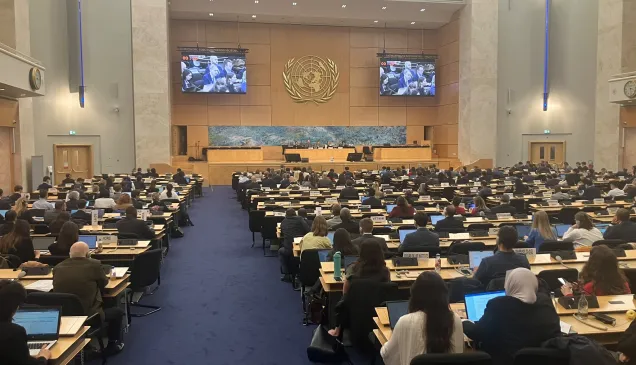
Thank you to Latvia for convening this important meeting and giving me the opportunity to brief this Council.
For as long as there has been war, people have found new ways to kill each other. But today, for the first time in history, we are rapidly approaching a moment where human lives may be entirely surrendered to machines.
AI will not set its own limits in warfare. States must.
In August, the UN Secretary General and I renewed our warning about the dangers autonomous weapons systems pose and the moral and legal red lines they represent.
Last week, after years of discussions, States gathered in Geneva to decide if they would negotiate legally binding rules on autonomous weapons systems.
The Seventh Review Conference of the Convention on Certain Conventional Weapons concluded without a clear and immediate negotiation mandate. But States must not resign themselves to complacency.
Technology is advancing at high speed without a shared understanding of how it can be applied in war. It is extremely dangerous to wait until these capabilities are so widespread, entrenched or powerful that meaningful control is no longer possible.
States must take urgent action to ensure that humans, and not machines, remain accountable for decisions in war. Autonomous weapons that are designed to target humans, or whose effects are unpredictable, must be prohibited.
By adopting and implementing legally binding instruments that prohibit or regulate indiscriminate types of weapons, States have been able to and can still limit the brutality of war and enhance the safety and security of their own people.
Mr President,
AI-powered warfare does not automatically equal better outcomes for civilians.
Despite assurances from militaries and technology companies that AI will make warfare more precise and less lethal for civilians, we are witnessing opposite trends.
We are seeing AI already accelerating and amplifying military operations, with disastrous costs to civilians.
In real-world terms, this can mean hundreds of attacks carried out in rapid-fire succession, often without consideration for their cumulative effects.
The high volume and sequencing of attacks can trigger a humanitarian disaster by outstripping the capacity for first responders, aid organisations, and communities to absorb the consequences.
Civilians need time to shelter and evacuate. Hospitals need time to replenish supplies. Repair services need time to restore essential services.
Evidence also shows that AI decision-support systems do not capture the complexity and unpredictability of the battlefield. They cannot anticipate all the ways in which civilians behave and move when they are seeking safety.
That is why, no matter how faithfully a system applies IHL, human judgement remains essential in assessing each attack.
AI decision-support systems can also mass produce targeting decisions that violate international humanitarian law. When AI models are programmed based on lax interpretations of the rules of war, they become systems of killing and destruction.
AI cannot remedy increasingly elastic interpretations of the rules of war, nor can it be held accountable for the decisions it facilitates.
Good-faith interpretation and application of IHL are – and must remain – a human responsibility. International humanitarian law cannot simply be “coded into AI” as a substitute for human involvement.
But this does not mean that AI systems have no role to play or should be prohibited in military use altogether. What we are asking for is that these systems strengthen IHL compliance – not undermine it.
AI support systems can be trained to promote a rigorous application of the rules and principles of IHL. For instance, we suggest that AI in the military domain could be used to map essential infrastructure and patterns of civilian life to minimise harm. It could identify evacuation routes for families to escape safely.
However, today, resourcing and investment are not being directed towards these applications at the scale they should be.
Technology companies developing and designing AI also bear significant responsibility. They are not simply creating new military capabilities; they are shaping the future of warfare.
That is why we engage with them on how their tools can be used in compliance with IHL and to enhance civilian protection.
Technology companies, like States, have the power to make the battlefield safer or more dangerous for civilians.
Mr President,
Consider what happens when the technologies shaping the next frontier of warfare converge.
We already see the significant consequences that AI-enabled cyber operations can have in non-conflict settings or in criminal activities.
Now imagine the devastation if AI agents are instructed to conduct cyber operations against essential services in armed conflict. Or if they “go rogue” and attack essential infrastructure because insufficient precautions have been taken to limit their operations and protect civilian networks.
We already see how drones are used to target essential infrastructure. Now imagine the consequences if AI-enabled drones select and engage targets without human control.
No weapon, technology or method of war should put the conduct of hostilities beyond the limits of human control.
On 7 December, leaders will gather in Jordan at the High-Level Humanity in War Conference to stand behind the rules of war. As warfare evolves, political commitment is critical to ensuring that IHL protects people living through war not only today, but tomorrow.
Mr President,
Let me be clear: the International Committee of the Red Cross is not calling for all military applications of AI to stop. We are calling on States to establish clear international frameworks and rules that regulate their development and use.
Because without regulations, this technology will continue to be tested on the battlefield, and civilians will be subjected to the consequences of trial and error.
Technology must serve humanity and not destroy it.
Thank you.